Mast Problem another candidate for the Darwin award

Praxinoscope

Well-Known Member
Joined
12 Mar 2018
Messages
5,788
Location
Aberaeron
Visit site
Kicking myself! I’m blaming Covid (I don’ make mistakes). The winter season before we got locked down, we dropped the mast on my Sadler 25 so it was 18 months to 2 years before we eventually got the mast back up, since then I have had problems adjusting the rake and getting rid of a slight curve to stern at spreader level.
Cap shrouds are perfect, tightened to about 15% port and stbd, backstay about 12%, lower shrouds are both about 12% and have provided the lateral adjustment needed to straighten mast laterally, but still can’t get rake correct and lose the slight curve at spreader height.
This is where I apply for the Darwin award, boat has a Plastimo 608-1 furling system which is totally new to me (my last boat was hank on sails) unfortunately I find the Plastimo installation instructions a bit vague at some points and the relationship between the forestay and the Palstimo chainplates a bit lacking.
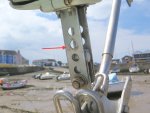
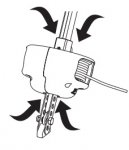
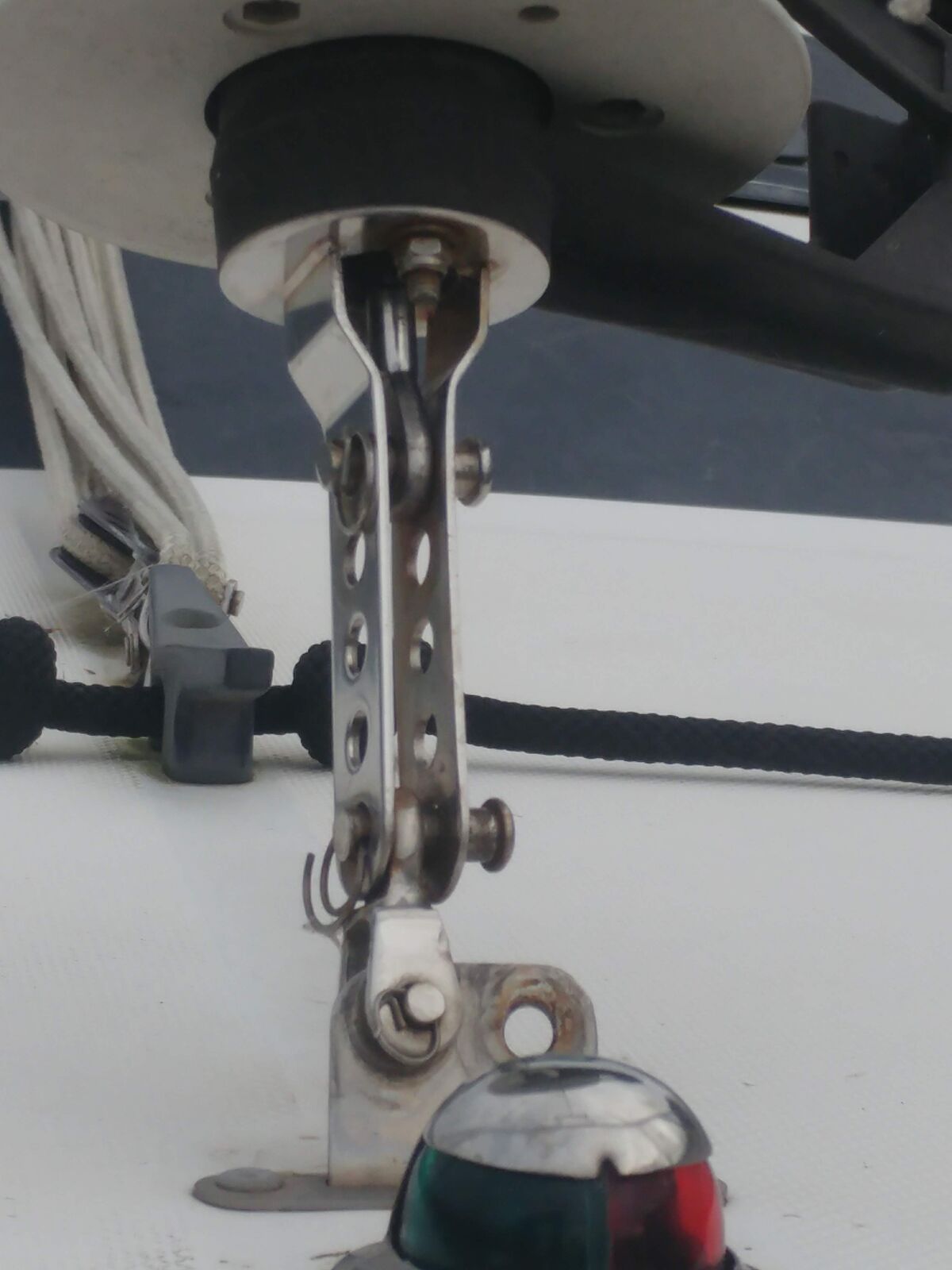
Hving looked very closely at the chainplate unit (photo’s attached) I think maybe we missed a second bolt when putting the mast up and assumed that the forestay and the chainplate are bolted through the same hole (photo 1:2), I now think I am wrong and looking at the chainplate it looks as if before the mast was dropped and I bought the boat the forestay was bolted through the holes further up indictaed by an arrow in photo 2:2, there are signs of a bolt previously fitted at that point.
Am I right in thinking that the plastic chain plates are fastened to the stemmed roller and the forestay fixed further up thus allowing the rake and reaction in mast bend I have been trying to cure?
Any advice on this much appreciated.

Furling Chainplate 1-2.jpg 1:2 Furling Chainplate 2-2.jpg 2:2
 
Why do you want to remove mast bend. I deliberately induce 50mm prebend & 150mm when backstay cranked on to flatten the mainsail.
I believe that prebend is important to counteract any inversion of the mast which could be dangerous. But then I do not know your rig & if at lower level you have fore & aft sets of lowers or just aft ones like mine
15% for uppers is not very tight. Mine are considerably more
 
Looks that way to me. Mast rake is controlled by forestay length so moving the fastening a couple of holes up will give you more rake. Position of the drum does not matter too much.

Incidentally, bolts are not ideal here, clevis pins with washers and split pins would be better.
 
Should have said the bend is in the wrong direction, centre of the mast is bending astern, I agree there should be a degree of bend but not the centre section bending astern.
 
Changing boltholes adjusts the height of the furler, but does not alter the forestay tension. Having the furler high up is often a good idea to stop the foot of sail contacting the guard wires.

(Vyv, second picture seems to me to show that the forestay tension is not affected by how high the furler is fitted)
 
Looks that way to me. Mast rake is controlled by forestay length so moving the fastening a couple of holes up will give you more rake. Position of the drum does not matter too much.

Incidentally, bolts are not ideal here, clevis pins with washers and split pins would be better.

Thanks,
I agree Clevis pins would be better, but have 12 mm s/s bolts immediately available, in the meantime looking for 12 mm Dia 40mm long s/s clevis pins.
 
Should have said the bend is in the wrong direction, centre of the mast is bending astern, I agree there should be a degree of bend but not the centre section bending astern.
Then crank up the upper shrouds to 20% & tighten the backstay & leave the forestay where it is. Mids could go up a bit as well. It depends how much bend you are trying to remove, of course.
 
Changing boltholes adjust the height of the furler, but does not alter the forestay tension. Having the furler high up is often a good idea to stop the foot of sail contacting the guard wires.

I don’t think so, the Plastimo chain plates will stay with the fixing to the stemhead, so the Genoa tack will remain at the same height as it is now, but the forestay will move up two holes, this will give the required mast rake when the backstay is tensioned, the only ifference will be that the head of the Genoa will in effect be an inch or so further away from the masthead.
 
I don’t think so, the Plastimo chain plates will stay with the fixing to the stemhead, so the Genoa tack will remain at the same height as it is now, but the forestay will move up two holes, this will give the required mast rake when the backstay is tensioned, the only ifference will be that the head of the Genoa will in effect be an inch or so further away from the masthead.
Surely not? The steel piece the goes into the centre of the furler, between the two plates looks like the swage for the forestay wire to me. If so moving the two plates that hold the furler will have no effect on forestay length and changing matters so that the second holes from the top are used, will just move the furling gear down the forestay..
 
I don’t think so, the Plastimo chain plates will stay with the fixing to the stemhead, so the Genoa tack will remain at the same height as it is now, but the forestay will move up two holes, this will give the required mast rake when the backstay is tensioned, the only difference will be that the head of the Genoa will in effect be an inch or so further away from the masthead.

I've seen them rigged like that, and I seem to remember Plastimo say that you can, but I don't like the look of it. All the load of the forestay goes through those weedy bits of Meccano strip. The amount of metal there at the holes taking the load is less than in the forestay wire and way less than the stemhead fitting. You can see that in photo 1 by comparing how thin the Meccano bits are compared to the stemhead fitting. Those strips often look a bit battered and out of shape. They're probably not just in tension but get slightly bent and twisted from supporting the furler, and most likely aren't changed when rigging is renewed. Stainless has a finite life, especially when it gets battered and twisted like that. If used to take the forestay load I'd see if I could get some strips drilled to fit to double up the Meccano strips. There appears to be plenty of space fit them in.
 
Last edited:
Hi AngusMcdoon,
Thanks for your input, this is exactly why I was questioning the whole thing, I agree the bits of ‘meccano’ don’t look man enough for the job, but according to the user manual I have just managed to find this is what Plastimo intend, you idea of b’beefing‘ them up sounds sensible will look into this, as we are lifting out at the end September, I may just go for it without the the additional strengthening, especially as I am dropping the mast this winter.
Plastimo seem to specialise in things which look as if they are not up to the job, but surprisingly they seem to work, I had Navik self steering on my last boat, some of the components on the Navik look more suitable to a watchmakers workshop than on sea going piece of kit, but it worked superbly with no breakages.
 
Surely the threaded piece goes to a bottlescrew inside the furling drum. This is swaged to the end of the forestay. The drum just rotates around it. It should not be fixed to it. It is just located there by the foil length. You disconnect the fitting from the deck. Undo the 2 holed strips. Rotate the fitting to screw the stud into the bottle screw, to shorten the overall length. Then when you have established the length you want you fit it back onto the deck & the holed strips are attached. These prevent the base section of the drum from rotating whilst the upper part of the bearing rotates as the line is pulled. The only weight on the strips is the weight of the halyard on the sail, plus the winding rotational force of the furled sail.
Is that not how it is supposed to work?
 
Here's a diagram from the Plastimo manual showing the forestay attached to the Meccano strips...

Untitled.jpg
There is no bottle screw for adjusting the forestay length, it's done by moving the pin or bolt attaching the bottom of the forestay up or down the holey strip.
 
Last edited:
Surely the threaded piece goes to a bottlescrew inside the furling drum. This is swaged to the end of the forestay. The drum just rotates around it. It should not be fixed to it. It is just located there by the foil length. You disconnect the fitting from the deck. Undo the 2 holed strips. Rotate the fitting to screw the stud into the bottle screw, to shorten the overall length. Then when you have established the length you want you fit it back onto the deck & the holed strips are attached. These prevent the base section of the drum from rotating whilst the upper part of the bearing rotates as the line is pulled. The only weight on the strips is the weight of the halyard on the sail, plus the winding rotational force of the furled sail.
Is that not how it is supposed to work?
No
There are two variations of this size of Plastimo furler.
One with short side plates ( 5 holes) and no bottle screw ... This is what the OP has. The forestay will have been made specially to the required length.

The other with long (11 hole ) side plates which has a bottle screw between then. This type can usually be fitted to an existing forestay and bottle screw and is, I think< what you are describing
 
Last edited:
I am sorry but I don't agree with anyone who thinks that swapping holes in those two "meccano strips" will have any effect on forestay length. If you look at the picture without the red arrow it appears that the thick piece of steel at the bottom of the picture is a toggle and that it connects to the boat's bow fitting (out of shot). In turn the bolt holds the strap around the end of the forestay swage fitting. If you look carefully you can see that the holes in the strap are oversize, and that the forestay tension is taken through them. as there is clearance at the top of the bolt. It is quite clear to me that as set up those strips have no bearing at all on the forestay tension, and that they merely support the furling gear to which they are bolted. It may be the case that it could be assembled differently, but as set up forestay tension can only be adjusted either by increasing or decreasing backstay tension or by moving the forestay attachment point if the bow fitting has more than one choice. It does not look as if there is any bottlescrew adjustment.

One point. Is there a toggle at the masthead? There should be to avoid fatigue at the upper swage, and if one has been left out, adding it might allow the unwanted forward mast bend to be eliminated.
 
I am sorry but I don't agree with anyone who thinks that swapping holes in those two "meccano strips" will have any effect on forestay length. If you look at the picture without the red arrow it appears that the thick piece of steel at the bottom of the picture is a toggle and that it connects to the boat's bow fitting (out of shot). In turn the bolt holds the strap around the end of the forestay swage fitting. If you look carefully you can see that the holes in the strap are oversize, and that the forestay tension is taken through them. as there is clearance at the top of the bolt. It is quite clear to me that as set up those strips have no bearing at all on the forestay tension, and that they merely support the furling gear to which they are bolted. It may be the case that it could be assembled differently, but as set up forestay tension can only be adjusted either by increasing or decreasing backstay tension or by moving the forestay attachment point if the bow fitting has more than one choice. It does not look as if there is any bottlescrew adjustment.

In the pictures the bottom of the forestay is not assembled as to Plastimo's manual. The diagram from the manual shown in post #14 shows how it should be done. There should be 2 pins/bolts, not 1 (although the Plastimo manual diagram above does not show the lower pin/bolt). Also the toggle at the bottom of the forestay is not required according to Plastimo, but it won't do any harm. The forestay length is not changed - it can't, it has no bottlescrew. However, its effective length is changed by moving its lower point of attachment up or down the Meccano strip thus affecting mast rake. Assembled like this the full load of the forestay goes through the Meccano strips - they don't just support the furling gear. I think you are commenting on how it is assembled in the photos, not how it should be assembled.

This is how it should be assembled...

20201013_114804.jpg


As you can see here the full load of the forestay is going through the Meccano strips, and the forestay can be effectively lengthened or shortened by choosing a different hole for the upper pin.

I had this furling gear on my first boat many years ago and remember thinking it was odd at the time, but the rigger confirmed that it was correct.
 
Last edited:
In the pictures the bottom of the forestay is not assembled as to Plastimo's manual. The diagram from the manual shown in post #14 shows how it should be done. There should be 2 pins/bolts, not 1 (although the Plastimo manual diagram above does not show the lower pin/bolt). Also the toggle at the bottom of the forestay is not required according to Plastimo, but it won't do any harm. The forestay length is not changed - it can't, it has no bottlescrew. However, its effective length is changed by moving its lower point of attachment up or down the Meccano strip thus affecting mast rake. Assembled like this the full load of the forestay goes through the Meccano strips - they don't just support the furling gear. I think you are commenting on how it is assembled in the photos, not how it should be assembled.

This is how it should be assembled...

20201013_114804.jpg


As you can see here the full load of the forestay is going through the Meccano strips, and the forestay can be effectively lengthened or shortened by choosing a different hole for the upper pin.

I had this furling gear on my first boat many years ago and remember thinking it was odd at the time, but the rigger confirmed that it was correct.
Those split rings (keyrings) are an accident waiting to happen. Use split pins.
 
Last edited:
There certainly are TWO variants of the Plastimo 609S ( and possibly other ranges ) - one which has 5 short s/s straps and one which has 11 s/s longer straps. The latter is intended to accommodate a rigging screw within, with a wider range of adjustment - the former is not.

The long straps version can have the WIDTH of the straps adjusted within the drum, due to elongated slots. The short straps version cannot, as it is not intended that a rigging screw should fit between them.

This is contrary to the diagrams in the SWEDISH text of the 'how to' book I have ( later versions are probably different ). Like many things Plastimo, the reality varies from that indicated. It's a French thing...

Every pro rigger I have encountered - no, I'll qualify that. See below* - insist that toggles are necessary top and bottom, everywhere... if only to keep them from rerigging very new masts each season.

Essentially, without toggles rigging breaks.... masts fall down.... people get hurt.... boats get sunk.

*that recalls a long dull tale about a mast falling over on a nearly-new 10m Danish trimaran, at night halfway down the Irish Sea in a gale, its recovery back on board, and a nuclear attack submarine 'standing by' as an uncomfortable Act of Seamanship. The boat had been sold to my host by its UK agent, a pro rigger, without a forestay toggle.....

"You can bend stainless - just once."

:oops:
 
Last edited:
Top