
Mast lights Question?

cowpat

Well-Known Member
Joined
28 Jul 2003
Messages
224
Location
Helston,Cornwall GB
Visit site
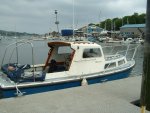
On my 22 ft motorboat there is fitted a forward facing steaming light and a aft facing stern light. These are both in the same vertical position/plain or height.
That is to say with the short mast sandwiched between them.
Surely these two lights will appear as one when viewed from a boat as it passes.
That is as one closes and the other opens it's arc of visibility.
My question is why didn't the builder just install a single all round white light light ?
I have looked up the regulations and an all round white is all that a boat of that size requires.
(So, perhaps another topic -:)) If I fitted a l..e.d. which has been shown to be visible at a greater distance for the same light output as a filament.)
My lights are leaky and need replacement anyway. So why not a single all round white which would double as anchor.?
Any thoughts on this would be appreciated. Chris.
 

Attachments

  • 2016_0612finepix0009.JPG
    2016_0612finepix0009.JPG
    337.4 KB · Views: 0
I've never understood this either. The rules (except for v small boats) require a steaming light and a stern light that together make up 360 deg, and a 360deg anchor light. Just one single 360 light would work perfectly well, as you say.

My thinking is that the rules allow a builder to separate the lights if they so wish, but they have been interpreted for years as requiring separate lights. 1st world problem I suppose!
 
As far as I can see the rules do not allow combined steaming and stern light for vessels over 12m. The stern light has to be as near the stern as practicable, visible at 2 miles, and doesn't have to be on the centreline. The Steaming light must be on the centreline, at least 2.5m above the gunwale, visible at 5 miles and a proportional height above the sidelights, too,

For vessels 12m and under the steaming light and stern light may be combined. 2 miles visibility for both (separate or combined). At least 1 m above sidelights.

Most important (as well as required by the rules) is that the light is actually visible over the required arc. No point having a combined light if it can't be seen because of other kit, ensigns, other lights, etc. For a combined steaming/stern light that is more likely to be the case, I would guess, for the aft sector of the light.
 
Thank you for those useful replies. It is good to know others have been thinking along the same lines. I can conclude that an all round white 2.5M above the gunwale with 2M viability and a set of red and green lights set at 1M min' below will be possible on this boat. Or as they seem to say these days...... "Sorted"
 
The lights are specified so that type of boat can be recognized at night. Mobo's recognised by having the stern light higher than the forward light when under power. This differentiates from the anchor light when stationary which is the single 360 deg light. There are complications regarding boat length, and it is worth spending a bit of time on the RYA website for full clarification. Sailing boats have a different lighting configuration so one can in principle recognize the difference at night.
 
Last edited:
There must be various interpretations, or vague ish rules so,s everybody can make them stick so to speak

Take my boat .@ MapishM ,the Passerelle is in the mid line answering you Q above ?
So they fitted the light off centre .

What I have not got in my view is a proper anchor light ,ie a single 360 white .
Not convinced these two on quite cover the sides close in ?
We do have a LED bat 360 light which I hang under the Bimini .

As a side issue of form over function we have a radar reflector it’s in a box with its mounting bracket in a locker .
But I bet it ticked a box - never put up , bit where do you fit it ? You can,t really .

https://imgur.com/gallery/a0zG8
 
Last edited:
Mobo's recognised by having the stern light higher than the forward light when under power. This differentiates from the anchor light when stationary which is the single 360 deg light.
Raf, that makes no sense to me:

1. You're not supposed to see the steaming light and stern light at same time so how would you know if one is higher than the other? And anyway there is no rule telling you to mount them at different heights.
2. And how would you differentiate a stern light from an anchor light? They're both white. In fact, you're not meant to differentiate them, because you give way to both
 
As a side issue of form over function we have a radar reflector it’s in a box with its mounting bracket in a locker .
I always put my r/r in a box or some container, because they're ugly. Has no impact on function provided the container is transparent to radar
 
Raf, that makes no sense to me:

1. You're not supposed to see the steaming light and stern light at same time so how would you know if one is higher than the other? And anyway there is no rule telling you to mount them at different heights.
2. And how would you differentiate a stern light from an anchor light? They're both white. In fact, you're not meant to differentiate them, because you give way to both
Regretting getting into this :rolleyes:
Quoting the RYA:
All vessels underway must show running lights during the hours of darkness. Running lights comprise 3 lights of different colours showing in 3 sectors, with white as the stern sector. Small boats under 7m and not capable of exceeding 7kn need only show a single all round white light. In addition to port and starboard lights, power vessels less than 50m must show a white masthead light, and stern light. Vessels less than 12m can combine these two in a single all round white light. Motor vessels over 50m must show white steaming light above and behind the first. I expect Match has this configuration, Rafiki does.

So it looks like the OP is ok with the single white light.
 
Regretting getting into this :rolleyes:
Quoting the RYA:
All vessels underway must show running lights during the hours of darkness. Running lights comprise 3 lights of different colours showing in 3 sectors, with white as the stern sector. Small boats under 7m and not capable of exceeding 7kn need only show a single all round white light. In addition to port and starboard lights, power vessels less than 50m must show a white masthead light, and stern light. Vessels less than 12m can combine these two in a single all round white light. Motor vessels over 50m must show white steaming light above and behind the first. I expect Match has this configuration, Rafiki does.

So it looks like the OP is ok with the single white light.
None of that answers my Q!
No worries, but two things: first, don't go by RYA because they write plenty of junk. E.g. The 4th sentence borders on non sequitur ness relative to the first two sentences. It's also unclear what is "the first". The source of truth here is colregs not RYA. Second, it doesn't shed any light on why the stern light and the steaming light must be separate items when their total coverage is mandated to be 360 deg.
As said 100 times, imho col regs are shoddy and need a re-write. :cool:
 
None of that answers my Q!
No worries, but two things: first, don't go by RYA because they write plenty of junk. E.g. The 4th sentence borders on non sequitur ness relative to the first two sentences. It's also unclear what is "the first". The source of truth here is colregs not RYA. Second, it doesn't shed any light on why the stern light and the steaming light must be separate items when their total coverage is mandated to be 360 deg.
As said 100 times, imho col regs are shoddy and need a re-write. :cool:
I make no claim to expertise, but I think the lighting patterns are meant to differentiate sail from power in order to enable the right colregs decision at night.
This was covered in detail during my recent sail ICC.
 
I make no claim to expertise, but I think the lighting patterns are meant to differentiate sail from power in order to enable the right colregs decision at night.
This was covered in detail during my recent sail ICC.
Thats of course true, but no way does it answer the exam Q.

From ahead or abeam, the steaming light tells you it's power. And it would do so perfectly well if combined with the stern light as a 360 deg light.

From astern, both power and sail show just white, the logic being that you are not meant to be able to distinguish. There is no need: whatever sort of boat you're in, you give way to a single white, whatever sort of boat it is.
 
1. You're not supposed to see the steaming light and stern light at same time so how would you know if one is higher than the other? And anyway there is no rule telling you to mount them at different heights.

I assumed he's thinking of the two masthead lights required on vessels over 50m. In that case the after one is indeed required to be higher than the forward, and this is what tells you which way a distant ship is going. At long range you can't usually make out the sidelights, but on a typical bulker, tanker, or box-boat the two masthead lights are very clear.

Not very relevant to the installation of lights on our own boats, though :)

Pete
 
The lights are specified so that type of boat can be recognized at night. Mobo's recognised by having the stern light higher than the forward light when under power. This differentiates from the anchor light when stationary which is the single 360 deg light. There are complications regarding boat length, and it is worth spending a bit of time on the RYA website for full clarification. Sailing boats have a different lighting configuration so one can in principle recognize the difference at night.

Rafiki,,For boats over 12m (not me)That difference in height between the stern and the steaming light is the other way round ( stern light lower) I do not know why because viewed from the stern you can only see one W light, the height is immaterial.
I have double checked and my conclusion that you initially commented on, I feel is correct. Chris
 
Rafiki,,For boats over 12m (not me)That difference in height between the stern and the steaming light is the other way round ( stern light lower) I do not know why because viewed from the stern you can only see one W light, the height is immaterial.
I have double checked and my conclusion that you initially commented on, I feel is correct. Chris

Sorry, stern higher on a mobo, lower on a sailer.
 
Leaving aside >50m vessels which is a red herring, it seems to me that you guys are at cross purposes, with this lower/higher debate.
This is how I understand what you are saying:
- cowpat: in a mobo, the stern light is lower than the masthead of the same boat.
- rafiki: in a mobo, the stern light is higher compared to its position in a sailboat.

If so, both points are as correct as they are, I believe, irrelevant.
The first because the stern and steaming lights are not supposed to be seen together, and the latter because you could never tell, while seeing a white light, whether it's a sailboat or a mobo stern light (or an allround, for that matter) based on its height. And even if you could, it wouldn't make any difference.
 
I'm not sure that this is spelled out anywhere in IRPCS but it seems quite a good idea to have separate stern and masthead lights on larger (but still <50m) vessels so that you can tell where the rear end is. On much smaller vessels I suppose the ankle bone is, as it were, sufficiently proximate to the neck bone to make no material difference.

In saying this, I do appreciate that anyone intending to buzz a 25m vessel from an approach angle <22.5 degrees abaft the beam is still only going to see the stern light at the point of impact but, there you go. :D
 
Top