Mast fixing for a 20ft Vivacity - does this look right?

MarcJ

Well-Known Member
Joined
17 Apr 2013
Messages
455
Location
Nantwich, Cheshire
Visit site
Hi there,
Spent yesterday trying to find a leak we've got, and think I've got it, it's the windows, result! Found a great link on here to using butyl which will solve that..:)
Meanwhile whilst pondering the layout and where the cables for the electrics are going to run, I noticed the bracing for the mast support. The mast support above deck looks like this:
View attachment 31237
Below deck the bolts are braced with wood, I presume hardwood - but even so I would have expected a large metal spreader plate. Erring on the side of caution I thought I'd ask here. The guy who sold the boat to us only had one trip out on it in the last year, helped by a friend of his - so the history of the boat is unknown.
This is what it looks like below deck:
View attachment 31238
 
There is no problem that I can see with the mast fixing itself however a mast does need support under neath to take the huge down loads imposed. Now being a smaller boat it may be that the designer thought he could take the downloads out to the gunwhales and bow with that reinforcing under the deck but somehow I doubt it. Has the boat ever had any sort of post under the deck from keel to under the mast. That is the most common form of support. Yes it does get in the way of access to the forecabin so may have been removable and has gone missing. The other form of support on smaller boats is 2 supports coming from just along side the under mast down to the hull allowing a tunnel access to the forecabin or similar in a circle or arch shape.

If you loosen the stays then take a measurement of head room under the mast then apply some tension I think you might be surprised how much the deck sags without support. Usually sailing down loads are much more on the mast than static stay tension. As shown by the fact that lee stays always go slack.
I would suggest that if my understanding is correct you get made up a post with flanges that can be bolted under the deck. Think 2 bolts on one side of that rib would suffice. The post it can be wood ali or ss tube should have a flange to suit the floor or top of keel to spread load. If you want it removable then 2 tubes telescoping that fit into sockets top and bottom with a through bolt to lock it at correct length once it is in place. good luck with the new boat olewill
 
Below deck the bolts are braced with wood, I presume hardwood - but even so I would have expected a large metal spreader plate. Erring on the side of caution I thought I'd ask here. The guy who sold the boat to us only had one trip out on it in the last year, helped by a friend of his - so the history of the boat is unknown.
This is what it looks like below deck:

It looks fine to me. The deck is reinforced by the transverse beam glassed in. That is what takes all the load. The four bolts and their backing pads do little more than hold the tabernacle in place. The loads on them are only those imposed when raising or lowering the mast.

I expect that the beam is wood so it is important that any screws etc through the deck into it are properly sealed to prevent water ingress causing rot.

My boat has similar beam but is a raised external beam so does not encroach on the head room inside:


DSCF0815.jpg
 
Last edited:
Not only will the beam below take the mast loads, but also the end of the coachroof if the deck structure is stiff enough. The end of the coachroof makes a substantial beam. If there is flexibility in the beam supporting the mast foot, you can expect to see cracks in the deck behind the mast foot.
 
That moulding on the deckhead will cover a square steel tube. I had similar on my Mk1 Foxcub. A bit of eye-surveying will show if it's sagging.
Mine was, and as the Mk11 Foxcub had gone down th route of installing a mast compression post I did the same.

I made one with a large-threaded insert and an adjusting nut which I gradually over a period of weeks managed to extend and regain most of the "lost" profile of the coachroof. If there appears to be no distortion, leave it alone.

The U-shaped bracket bolted through to the mast foot cup on coachroof The little saddle inside the "U" bracket connects to the 1" square steel tube. The creates a solid connection between the compression post, the mast foot and the deck head. The little saddle is also on a threaded bolt to allow final adjustment.

foxcubUbracket02.jpg


foxcubUbracket03.jpg


I had to cut out the deckhead lining to expose the beam and drilled a core out to make sure there was something solid in there.


foxcubplug01.jpg


foxcubplug02.jpg


I recast the area using glass fibre paste to make a good fit for the U-bracket.


foxcubbeam03.jpg


Base plate with a big fat threaded bolt welded on.


foxcubmastpost3.jpg


The adjuster (I did finish the tube end off better)


foxcubpostadjuster01.jpg


The (almost) finished post. Yes it's not pretty, but it was a £900 boat for day sailing so cosmetics weren't top of the list.


foxcubmastpost1.jpg


Thanks for all your replies! I'm a fan of "if it aint broke don't fix it" so I'll keep an eye on it - I'll have a look for any sign of sagging, but I don't think there is.
Thanks again - a lot of useful info! :)
 
Perhaps some investigation of the beam with a magnet? Then you will know whether it is steel or not.
If it is then it is unlikely (IMHO) that there will be much deflection if it is, even if it is wood there may still not be much.

The flip side of "If it ain't broke...." probably ought to be " A stitch in time....".
 
Last edited:
Perhaps some investigation of the beam with a magnet? Then you will know whether it is steel or not.
If it is then it is unlikely (IMHO) that there will be much deflection if it is, even if it is wood there may still not be much.

The flip side of "If it ain't broke...." probably ought to be " A stitch in time....".
Yes thanks for that, I'll check with a magnet, but I think it's probably wood. "A stitch in time" is def the flip side - but I'm stuck with a variable feast of "what if's" and "what knots"...and a limited budget! :D
I'm looking at fitting a 12v system, for nav lights and gps/sounder for when we take the boat to the sea. The good news is that I can get hold of some free top spec gel battery's from my brother, maybe a solar panel or two from work, I've fitted out a camper van with 12V/mains and I've got a HND in electronics. The bad news is I'm going to be asking a lot of questions on here! ;)
What's occupying my thoughts at the moment is getting a waterproof switch panel with the right combination of fused switches, battery monitor and a cig lighter point (at the right price), and how to get through the deck with 3 cables, mast head light, tricolour and transducer for the sounder.....
I really appreciate the help I've already had from the forum, many thanks!
 
Last edited:
If there is no evidence of sagging forget it. It'll not come crashing through the foredeck. The right angle moulding up to the higher section of the coach roof just aft of the tabernacle will also give support.
Forget it and carry on with the other items on your list.
 
Yes thanks for that, I'll check with a magnet, but I think it's probably wood. "A stitch in time" is def the flip side - but I'm stuck with a variable feast of "what if's" and "what knots"...and a limited budget! :D
I'm looking at fitting a 12v system, for nav lights and gps/sounder for when we take the boat to the sea. The good news is that I can get hold of some free top spec gel battery's from my brother, maybe a solar panel or two from work, I've fitted out a camper van with 12V/mains and I've got a HND in electronics. The bad news is I'm going to be asking a lot of questions on here! ;)
What's occupying my thoughts at the moment is getting a waterproof switch panel with the right combination of fused switches, battery monitor and a cig lighter point (at the right price), and how to get through the deck with 3 cables, mast head light, tricolour and transducer for the sounder.....
I really appreciate the help I've already had from the forum, many thanks!

A magnet won't detect stainless steel which I suppose is possibility.

I don't know if you'll find a waterproof switch panel. Are any of them really waterproof?

If yo make up your own panel you can do so with the combination of switches you require otherwise you have to make do with the best you can find. Unless you pay to get front panel made home made ones tend to look homemade.
Bought panels tend to be expensive

Sounder transducer can be fitted internally so does not require wiring through the deck.

Your choice whether to take the other cables through the deck through glands or to use deck plugs. Personally I prefer deck plugs and I'd recommend 'Dri plugs'. I'd also suggest two separate ones for the two lights. Using just one leads to wiring complications. Don't ask.

Fully fledged battery monitor is a 'stand alone' instrument, and for a little boat a bit of an overkill imho. A simple voltmeter incorporated into the panel may be useful though.

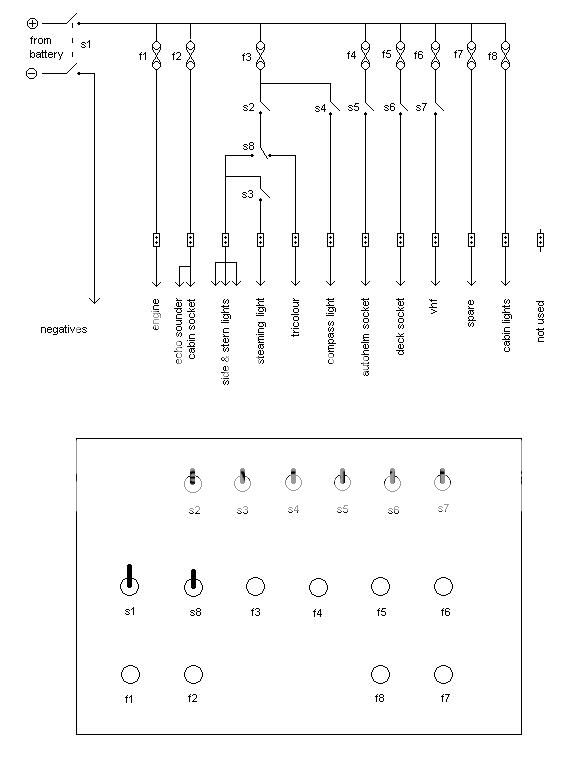
My homemade panel below. Too compact... made wiring difficult.

DSCF0846.jpg
 
Last edited:
Thanks Vic,

That's a neat setup, looks good!

Looking at the panels on the internet, some look more "waterproof" than others. By the time you've bought the individual bits you're going to have spent a fair chunk, also they come prewired so that saves a job. Suppose I'll bite the bullet once I decide what combination will work. I was only thinking of a voltmeter, same as I have on the van and some panels come with them on.

Interested in your comment about firing the transducer through the hull - currently that's what I do on my plastic kayak. I assumed it wouldn't work going through 1" of GRP...Its a Hummingbird 383c combi unit http://store.humminbird.com/media/document/M_531450-1_F.pdf
Can't find any info at the moment about the transducer installation and how thick a hull it'll go through.
I've already thought up a cunning mount on one of the stanctions to take the transducer over the side, but it would be better through the hull.

I'll look up "dri plugs", they sound like just the job!

Cheers,
Marc
 
Thanks Vic,

That's a neat setup, looks good!

Looking at the panels on the internet, some look more "waterproof" than others. By the time you've bought the individual bits you're going to have spent a fair chunk, also they come prewired so that saves a job. Suppose I'll bite the bullet once I decide what combination will work. I was only thinking of a voltmeter, same as I have on the van and some panels come with them on.

Interested in your comment about firing the transducer through the hull - currently that's what I do on my plastic kayak. I assumed it wouldn't work going through 1" of GRP...Its a Hummingbird 383c combi unit http://store.humminbird.com/media/document/M_531450-1_F.pdf
Can't find any info at the moment about the transducer installation and how thick a hull it'll go through.
I've already thought up a cunning mount on one of the stanctions to take the transducer over the side, but it would be better through the hull.

I'll look up "dri plugs", they sound like just the job!

Cheers,
Marc

You are right about spending a good part of the price of a ready made panel just buying parts but you end up with a "custom" made panel.
If you make your own leave a couple of spare circuits you'll probably want to add more stuff.

You can try your sounder transducer to see if it works through the hull, and find a good place by sticking in down temporarily with a big dollop of Blutak or chewing gum.
Seafarer suggest up to 3/4 " thickness is Ok ... your Vivacity is not more than that surely ? My Seawych is no where near that thick.


Circuit of my switch panel if of interest below. Probably not do exactly the same if I did it again.

97a15036.jpg
 
Thanks Vic,

I'll see if I can find somewhere that the transducer works - as you say it's probably not thicker than 3/4".
Your diagram is very clear, and reminds me why I'll probably buy a ready made one! :) I'll only need 6 fused switches I think, though my experience with the van suggests I probably should allow for 12! :D
 
That's the standard arrangement for the mast step/support on a Vivacity 20. The rig is little more than that of a large dinghy anyway, and its more than strong enough for the job. Its not an issue with these boats which were very well engineered. what IS an issue is the rust on the bolt in your pic - it means there is water ingress there which will rot the timber. Easily enough dealt with, just draw the bolt and reinstall it with a good smear of sealant.
 
That's the standard arrangement for the mast step/support on a Vivacity 20. The rig is little more than that of a large dinghy anyway, and its more than strong enough for the job. Its not an issue with these boats which were very well engineered. what IS an issue is the rust on the bolt in your pic - it means there is water ingress there which will rot the timber. Easily enough dealt with, just draw the bolt and reinstall it with a good smear of sealant.
Well spotted! I'll do as you suggest, thanks!
 
Top