Mast Base

I have just fixed a boat with the same issue. The T bar for the mast to fit on was bent due to mast compression and the substrate getting crushed.
The cause of the problem virtually every time is those crap substandard deck glands to plug cables in.. Ive yet to see one that does not leak. the worst part having a cored deck is the first you know about the leak is the mast plinth and deck starts to bend, by then it needs repairing.
Its a fairly easy job though as under the deck will be around 2 layers of 18mm ply, to which your mast base screws will screw into. The electrical fittings leak, the ply softens over time and the T bar mast base bends.
I would cut the deck out from the top around the mast base, dig out the old ply, epoxy in new ply, Epoxy the cut out grp back or layer new grp or epoxy.
Give the T bar to an engineering company to bend straight and weld up the small crack then maybe get it re anodised?
Bin the electrical sockets and fit a stainless swan neck to feed the cables through and connect inside the boat .
Thanks for that. That’s probably the cause of my issues, I seem to have an array of poorly fitted deck fittings causing various issues.

I have a sheet of half inch Tufnell, I’m thinking of bedding this into the deck with resin, to creat a raised and flat plinth. Mast heel can sit on that!
 
Note that even if the deck is balsa cored, there will be (or certainly ought to be!*) solid timber (or GRP) under the mast, around hatches, and in the way of fittings such as foredeck cleats that are going to take a lot of load. Balsa is effective as a filler in a GRP sandwich (unless it gets wet!), but can't take big point loads.

(*I have seen an example of where the timber had been laid out of position when the deck was being assembled, and so had 'missed' the deck fitting position, and this had only come to light later when things failed.)
 
Note that even if the deck is balsa cored, there will be (or certainly ought to be!*) solid timber (or GRP) under the mast, around hatches, and in the way of fittings such as foredeck cleats that are going to take a lot of load. Balsa is effective as a filler in a GRP sandwich (unless it gets wet!), but can't take big point loads.

(*I have seen an example of where the timber had been laid out of position when the deck was being assembled, and so had 'missed' the deck fitting position, and this had only come to light later when things failed.)
Yes, that makes sense to me. There must be something substantial below....

The deck has not completely depressed under the foot, but there is evidence of some compression.
The screws which hold the base in must also be in something substantial... as they’re well and truly home and don’t want to come out!
 
Its a nice idea but why not just use ply? The boats where it has softened are usually well over 25 yrs old so if you were to use ply again it would last maybe longer than you have the boat?
If the designers decided screws were adequate when the boat was built why complicate things as no one (yet) has reported a mast base ripping out of the deck due to being screwed and not bolted?
I suspect the bolted mast bases are for larger boats whereas lighter rigs can get away with screws?
 
Its a nice idea but why not just use ply? The boats where it has softened are usually well over 25 yrs old so if you were to use ply again it would last maybe longer than you have the boat?
If the designers decided screws were adequate when the boat was built why complicate things as no one (yet) has reported a mast base ripping out of the deck due to being screwed and not bolted?
I suspect the bolted mast bases are for larger boats whereas lighter rigs can get away with screws?
The current pad is bolted in, albeit with CSK slotted heads.
Tufnell is far superior to ply... and I happen to have a sheet collecting dust ?
 
If it were me I would use epoxy in preference to polyester, cut back the core to a little beyond the hole in the upper GRP layer, and make sure that the epoxy filler was well attached to the underside of that top GRP for a short distance (not just at the joint as shown) so any movement didn't let water in.

I think ideally the rigid base (whether timber, Tufnol or GRP laminate) would extend under the upper GRP layer well beyond the mast base it was supporting, in order to spread the loads and to stop the deck moving differentially to the area supporting the mast.

It isn't clear from your drawing what is under the deck to support the mast - is there a mast support post, bulkhead or ring beam inside doing so?
 
If it were me I would use epoxy in preference to polyester, cut back the core to a little beyond the hole in the upper GRP layer, and make sure that the epoxy filler was well attached to the underside of that top GRP for a short distance (not just at the joint as shown) so any movement didn't let water in.

I think ideally the rigid base (whether timber, Tufnol or GRP laminate) would extend under the upper GRP layer well beyond the mast base it was supporting, in order to spread the loads and to stop the deck moving differentially to the area supporting the mast.

It isn't clear from your drawing what is under the deck to support the mast - is there a mast support post, bulkhead or ring beam inside doing so?
There’s a post under the mast base.
 
The one i did last week was a 28ft boat. The two layers of 18mm ply were around 4.5x the size of the mast base (balsa core boat)
 
The compression load from the mast needs to go directly to a post or bulkhead, spreading it around the deck is mostly irrelevant. the deck does need to be stiff, to stop it from buckling due to the shrouds squeezing it inwards, and to support other loads like people walking on it.
The bottom of the post or bulkhead needs to get the forces back to the shrouds.
If the base of the mast is moving, check everything else that takes the rig loads too.
I've seen more than one boat where the real problem is at the bottom of the post.

As for the mast base, you could either get something welded up, or buy a lump of T section and carve it to shape.
If you can't get it anodised, coating with epoxy and paint will maybe suffice?
3 in x 3 in x 3/8 in - Aluminium Tee Section : Ali Warehouse
Other retailers may sell short bits?
And that's just a random size?
 
The compression load from the mast needs to go directly to a post or bulkhead, spreading it around the deck is mostly irrelevant. the deck does need to be stiff, to stop it from buckling due to the shrouds squeezing it inwards, and to support other loads like people walking on it.
The bottom of the post or bulkhead needs to get the forces back to the shrouds.
If the base of the mast is moving, check everything else that takes the rig loads too.
I've seen more than one boat where the real problem is at the bottom of the post.

As for the mast base, you could either get something welded up, or buy a lump of T section and carve it to shape.
If you can't get it anodised, coating with epoxy and paint will maybe suffice?
3 in x 3 in x 3/8 in - Aluminium Tee Section : Ali Warehouse
Other retailers may sell short bits?
And that's just a random size?
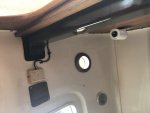
I hadn’t considered the compression could be due to the base of the post... that’s an interesting possibility. The post is actually directly behind a bulkhead, see picture.

Aluminium t section is a good idea... again, I’d not considered that.
 

Attachments

  • 62AC63FA-B952-4F68-810B-B9FA53D4C702.jpeg
    62AC63FA-B952-4F68-810B-B9FA53D4C702.jpeg
    54.2 KB · Views: 14
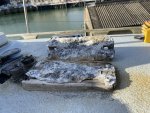
This is what was left of the mast base. Quite literally dissolved.
 

Attachments

  • D951B75C-EB30-4870-8D5A-D45321380119.jpeg
    D951B75C-EB30-4870-8D5A-D45321380119.jpeg
    419.2 KB · Views: 19
Note that even if the deck is balsa cored, there will be (or certainly ought to be!*) solid timber (or GRP) under the mast, around hatches, and in the way of fittings such as foredeck cleats that are going to take a lot of load. Balsa is effective as a filler in a GRP sandwich (unless it gets wet!), but can't take big point loads.

(*I have seen an example of where the timber had been laid out of position when the deck was being assembled, and so had 'missed' the deck fitting position, and this had only come to light later when things failed.)
Unlike traditional boatbuilding where you could see the structure and in general it was fashioned by a time served boatbuilder the glass fiber boatbuilding employed many unskilled Labour and the results of their labors disappeared under the flowcoat
 
That mast base is quite shocking, but i think the cause of that problem is the wooden plinth as the wood can hold moisture which in turn has led to the oxidisation of the mast base.
 
That mast base is quite shocking, but i think the cause of that problem is the wooden plinth as the wood can hold moisture which in turn has led to the oxidisation of the mast base.
I'd say it's probably quite old.
Wrong to expect anything to last forever.
I'd suspect it's been destroyed by electrolysis, in contact with stainless parts.

I've seen similar effects on dinghy parts only a handful of years old, due to carbon fibre in contact with aluminium.
 
Aluminium just does not like being in contact with anything where water can get between.
You could make another wooden plinth but epoxy seal it, then seal around the aluminium mast base to prevent water getting under it, or maybe cover the mating face of the base with duralac?
 
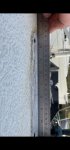
The deck seems solid under the mast base... no obvious signs of rot and the stainless bolts were untarnished and dry. However , as in image below, the deck is depressed about 4-5mm in the centre.

So, plan currently is not to cut the deck open....

This said, still need to figure out how best to sit a flat plate on the curved deck, due to the compression.

The timber plate was also tapered, 28mm fwd and 10mm. Assume to level the plate.
 

Attachments

  • 5CCD7D10-F9BE-47DE-B4C3-34246C19960C.jpeg
    5CCD7D10-F9BE-47DE-B4C3-34246C19960C.jpeg
    948.4 KB · Views: 12
Top