Marine Elecitircal Question - How should I connect my starter battery negative so as not to avoid the shunt

CapPugwash

Well-Known Member
Joined
16 Mar 2016
Messages
232
Location
The Firth of Clyde
Visit site
Hello boys and girls (and everything in between)

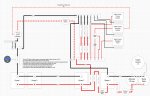
I am about to overhaul my wiring and have created the diagram below. It shows how I am intending to connect everything. As part of the process I am adding a Victron BMV-712 battery monitor and shunt. There is a Victron Cyrix-CT Battery combiner that connects the positive to the domestic battery bank when the alternator is charging. This disconnects when the voltage drops to 12.8 volts on either side. I am considering adding a relay that is triggered by the ignition switch to resolve this.

However, I am unsure how to connect the Stater Battery negative so that it doesn't bypass the shunt. I have thought of running it a longer a distance so that it becomes the longest route. I feel that it will still bypass the shunt though. Maybe I could add ignition controlled relay to the negative too?

I'm also not sure how the engine is grounded, I'll work that out at the weekend. I am guessing it is via the starter motor.
PatienceWiring.jpg
 
Why would you want the large starter current through the shunt?
The engine will earth through preferably a 50mm sq cable to the battery but fortuitous earths may be exhaust, control cables, fuel pipes etc.
 
I don't. And i don't think it will, the Cyrix CT battery combiner doesn't combine the batteries until a certain duration has passed.

My concern is that once the engine has stopped and the alternator is no longer charging, the negative post of the starter battery is still part of the circuit so will attract some electrons. I believe that will skew the figures from the monitor. Maybe it is too little to matter or maybe I don't need that connection at all? The domestic bank and starter battery negatives are connected at the moment which is why I am asking the question. :)
 
I don't. And i don't think it will, the Cyrix CT battery combiner doesn't combine the batteries until a certain duration has passed.

My concern is that once the engine has stopped and the alternator is no longer charging, the negative post of the starter battery is still part of the circuit so will attract some electrons. I believe that will skew the figures from the monitor. Maybe it is too little to matter or maybe I don't need that connection at all? The domestic bank and starter battery negatives are connected at the moment which is why I am asking the question. :)

It won't.

The dotted line between the starter battery and the shunt is correct and essential for correct operation of the monitor.

Connecting it will not "skew the figures". Not connecting it will skew the figures, because alternator charging will not be measured correctly.
 
Thanks for you comments chaps/esses. The more I read the more I feel I am making a problem out of nothing. So the internet says just wire the negative up to the common negative bus as it is currently.

PatienceWiring.jpg
 
I don't. And i don't think it will, the Cyrix CT battery combiner doesn't combine the batteries until a certain duration has passed.

My concern is that once the engine has stopped and the alternator is no longer charging, the negative post of the starter battery is still part of the circuit so will attract some electrons. I believe that will skew the figures from the monitor. Maybe it is too little to matter or maybe I don't need that connection at all? The domestic bank and starter battery negatives are connected at the moment which is why I am asking the question. :)
No, that's flawed thought, just leave all the negs connected with the shunt in the cabin neg main feed.
Many shunts won't stand starter current for long!
 
It seems unusual and unnecessary to let the starter motor cables connect via terminals on the alternator.
The other way around is more common, for the positive cable. The negative cable from the starter battery is often taken to a bolt/terminal on the engine block. A negative cable from the alternator can also be attached to this.
 
It seems unusual and unnecessary to let the starter motor cables connect via terminals on the alternator.
The other way around is more common, for the positive cable. The negative cable from the starter battery is often taken to a bolt/terminal on the engine block. A negative cable from the alternator can also be attached to this.

If the diagram is taken literally, you are correct. I took the question marks and dotted lines to mean that the OP hadn't finalised that part of the diagram, but it's point worth raising.

I'd expect the positive to go to the starter, with a link wire to the alternator.

If it's an isolated return system i'd expect the same for the negative. If it's not isolated return, then it should only have the negative going to the engine block.
 
If the diagram is taken literally, you are correct. I took the question marks and dotted lines to mean that the OP hadn't finalised that part of the diagram, but it's point worth raising.

I'd expect the positive to go to the starter, with a link wire to the alternator.

If it's an isolated return system i'd expect the same for the negative. If it's not isolated return, then it should only have the negative going to the engine block.

Yes, the dotted lines and question marks mean I’m not sure. I’ll be mapping that bit out at the weekend.

It is an insulated return alternator.

thank you for your advice, much appreciated.
 
Hello again Fantastic Fomrumites Friends. :)

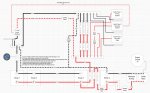
Here is my revised drawing. There are two options for connecting the negative bus to the shunt in dotted lines. The physics is beyond me but I worry those little electrons will take the easy option and head to the start battery missing the shunt. If that is not the case, as you advise, can I wire the negative bus via the starter battery? That is the blue dotted line in the drawing. This would save me some cable but all electrons would flow over the starter battery negative terminal.

The other option is the black dotted line.

Edit : I suppose the third option would be both the dotted lines minus the solid one!

Also, how are my fuses?

Edit 2: oh, and will 35mm2 tinned be ok, including the starter/engine connection?

PatienceWiring.jpg
 
Last edited:
You really are over thinking it.

Use the two dotted lines and omit the solid black line. (your option 3)

If the starter, alternator and engine sensors are isolated return, omit the negative cable to the engine block.

Most fuses are in the wrong place. They are there to protect the wiring and possibly some loads, they should all be close to the power source, the three switch panels should be fused close to the busbar.

Cable size depends on current and length of cable, what engine do you have ?

Your windlass wiring is also wrong. Connect the positive straight to the battery, with a thermal circuit breaker. This cable will likely need to be bigger then the engine battery cables, in which case you will need thicker cables from the battery to the shunt and from the shunt to the busbar.
 
You really are over thinking it.

Use the two dotted lines and omit the solid black line. (your option 3)

Thank you.

If the starter, alternator and engine sensors are isolated return, omit the negative cable to the engine block.

The alternator is an insulated return (is that the same as isolated?) and is wired to the stater motor as shown. I don't know if the starter motor is or isn't isolated but the thick battery cable (I believe it is 35mm2) is currently wired to the engine and starter motor at the same place. This is as it was when the boat was built I suspect. I was just planning on replacing the cable.

Most fuses are in the wrong place. They are there to protect the wiring and possibly some loads, they should all be close to the power source, the three switch panels should be fused close to the busbar.

Understood, thank you.

Cable size depends on current and length of cable, what engine do you have ?

It is a Yanmar 3HMF 27-HP, and i think the existing cable is a corroded 35mm2.

Your windlass wiring is also wrong. Connect the positive straight to the battery, with a thermal circuit breaker. This cable will likely need to be bigger then the engine battery cables, in which case you will need thicker cables from the battery to the shunt and from the shunt to the busbar.

It is currently wired as you describe, I thought I was being modern by moving the positive connection but I think I'll leave it as is. Although the current cables are definitely nowhere near the battery cable size so maybe that's a concern!
 
It is a Yanmar 3HMF 27-HP, and i think the existing cable is a corroded 35mm2.

35mm will be fine. Use it for all battery cables, link cables, etc, including to the two main busbars.

It is currently wired as you describe, I thought I was being modern by moving the positive connection but I think I'll leave it as is. Although the current cables are definitely nowhere near the battery cable size so maybe that's a concern!

Make and model of windlass ?
 
I think that the level of expertise offered by Paul for free is exceptional. Where else will you find this? It's way beyond my knowledge to comment but I learn a lot
 
Top