Marina 'berthmaster' pontoon electricity supply keeps tripping out.

It is interesting to see your diagnosis as probably the shore supply cable. When I hold the 12 Volt DC training course I created one of the practical tasks is to identify issues upon a severely faulty shore power cable.

I create ~ 8 faults on a sample cable and ask the participants to identify as many as they can, generally they find ~ 6 of them. I then suggest they carry out the same exercise to inspect their own shore cables.
 
"It is interesting to see your diagnosis as probably the shore supply cable."
My backgrpund is in theatre and film, and the installations I've worked with have always been bone dry, and generally provided by a rental company that keeps it all in decent condition. So it's never the cable, other than the connections. But when folks who have considerably more marine experience tell me otherwise...

And... it was the cable! I've put in a fressh one. I reckon that UV and repeated bending have introduced tiny cracks.
I thought I'd swapped it out years ago and kept the old as a spare. In fact I had done precisely that, but some visiting twit trod on the boat power inlet, cracked the housing, and the next time it rained bang! I replaced the in socket (that was an awkward job!) and temporarily put the old cable back, meaning to put a fresh out plug on the new cable, but then I had a major life distraction and completely forgot.

Many thanks for the input. It saved me completely, and needlessly, taking the whole boat apart! ;)
.

But I do wonder if this stray amount of boat current (not enough to trip the RCD, but enough to trip it when another small leakage is added with a faulty cable) is something I should worry about? :confused:
 
So, would humidity be enough to trigger a sensitive breaker? :unsure:
I know it's sorted but I'm answering this anyway! Yes, it is when it's cold. My old boat tripped the marina RCD because a 4 gang socket accumulated enough water from condensation in cold weather to almost completely fill itself up. This then burned quite a bit of juice before tripping the marina systems. They then spent a happy few days isolating to my boat before contacting me :) I also had a power cable which cut itself in half due to a poor skipper taking shortcuts when leaving the boat. This didn't trip any RCD until it has burned £5 of electricity apparently boiling water in the marina!
 
"Are you using "Arctic" cable?"
I got this from a chandlery. It was the cable mentioned above that was the replacement I purchased some years ago but had the socket blown out because of water ingress into the boat's socket. Socket on cable now replaced. Cable hardly used. 'Arctic'? Who knows? :unsure:
 
"accumulated enough water from condensation"
I don't think you need to have actual water accumulate to trip an RCD. Just a thin layer of moisture could (should?) do it.
 
No, that's not how RCDs work. You need to have current leakage for them to trip. If the current goes between live and neutral then they will happily supply power all day, even if the power is going through a human. The moment there's a difference between live and neutral they'll trip, but don't expect that to be immediately upon any issues. The premise is that in most cases where there's danger current would leak. Bear in mind you're standing in a dry, plastic boat though...
 
The pontoon will just have a really, really good version of it I imagine, but I'll let others comment as I only know what I've learned from here and through experience, and that's quite limited!
 
The pontoon will just have a really, really good version of it I imagine, but I'll let others comment as I only know what I've learned from here and through experience, and that's quite limited!

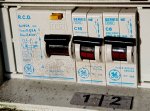
What's on the pontoon will vary, but it's unlikely to be any better than what's fitted to the boat. It might be an RCD and MCB or it might be an RCBO.
 
Paul what's the reason they tend to trip faster than the boat one? Or is that just coincidence?
 
Paul what's the reason they tend to trip faster than the boat one? Or is that just coincidence?

There can be a few factors, but there's no set in stone case of which trips first. When i test onboard sockets with my RCD tester it almost alwys trips the onboard RCD.
 
Bollard New 4way.jpgBollard Original fit.jpg Hope this works! Examples of bollard power supplies. One with RCD and MCBs (two way) and one with RCBOs (four way). As Paul has said no rhyme nor reason for which will trip first , boat or bollard, depends solely on sensitivity. assuming both are the same type.
 
Those are just the ones for the sockets on the pontoon, there are also some per pontoon which are the ones mine tripped. I guess you're right though it's just pot luck which one trips first
 
And... it was the cable! I've put in a fressh one. I reckon that UV and repeated bending have introduced tiny cracks.
I would be interested to know if it's the cable or the connectors.

If you cut the last inch off each end and replace the connectors, does it work again?

As per my previous comments, IMO the CeeNorm plugs are far superior to the more common Walther ones - the CeeNorm has much better weather sealing.
 
It is worth while seeing what grade rating the breakers are fitted on your boat and on the pontoon.

On my pontoon they are B rated, but on the boat they are C rated. This refers to the speed at which they operate on detecting an overload. Most household are C rated where there are inductive loads (motors) as these draw a brief overload when starting which a B rated MCB may not tolerate. A is fastest D is slowest.

This morning I tripped the 16a B rated shore supply when I started the hoover (~3a), but with the main heater on full tilt at 2.3 kW (9.5 a) and the calorifier 1.1 kW (~ 5a) also on. The main incomer breaker C Rated is also 16a, but that did not go first, which would have been preferable in my moment of electrical greed !
 
Top