Making oak laminated plywood floor panels - what glue?

Lomax

Well-Known Member
Joined
22 Sep 2016
Messages
375
Visit site
Making oak laminated plywood floor panels

I'm about to start making a new floor for my boat, and want to try something a little bit different: I plan to glue 2mm thick oak "boards" to 15mm WBP plywood sheets, from which the panels will be cut. The plywood will be painted on the back and sides (for moisture proofing), and the oak will be treated with oil or wax after the panels have been installed. Because it will be difficult to apply pressure across full size plywood sheets, and because some flexibility of the glue is desirable, I'm thinking of using an epoxy glue, but thought I'd check here first if anyone have any thoughts. Should I be using a different type of glue?
 
Last edited:
Last edited:
I've applied cherry veneer to full height locker doors, not quite the same level as wear as you'll get on a floor board, but the same damp environment. I used waterproof PVA adhesive and have had no problems with delamination in 4 years.

The key to getting a good result is being able to spread the adhesive very evenly, get all the air out by using a rubber roller, working out from the centre, and then apply even pressure to the the veneer. If you don't you'll get bubbles of adhesive and air forming, and it won't look so good, and the bubbles may lead to delamination.

When I used PVA I used a small foam roller to make sure the glue was spread evenly, and I had access to a local cabinet makers very large veneer press. The doors where left overnight in the press to ensure that the bond was solid.

I think you'll have difficulty working with relatively viscous and sticky glues like epoxy and Sikaflex.
 
I'm about to start making a new floor for my boat, and want to try something a little bit different: I plan to glue 2mm thick oak "boards" to 15mm WBP plywood sheets, from which the panels will be cut. The plywood will be painted on the back and sides (for moisture proofing), and the oak will be treated with oil or wax after the panels have been installed. Because it will be difficult to apply pressure across full size plywood sheets, and because some flexibility of the glue is desirable, I'm thinking of using an epoxy glue, but thought I'd check here first if anyone have any thoughts. Should I be using a different type of glue?

cascamite would be my choice of adhesive.
we used to hot & cold press / bond formica to ply. laminating an 8 x 4 at home will be the biggest problem, can you cut the backing ply into smaller sizes to make it more manageable
 
Sorry dont know where your based, you could save yourself a lot of work, walk into your nearest Magnet trade and look at their wood flooring. both have several grades of engineered oak flooring and they are designed to be put in conservatories which are a real pain due to thermal movement. I am not covinced a 2mm thick veneer will last under foot.
 
Couple of thoughts: Apart from using some of the more flexible epoxys, if your sole flexes enough to concern you about the glue, it is probably in need of more support.
Ply uses recorcinol glue in big presses. A vacuum bag will do the same with a venturi attachement on a compressor.

Or, cut out the ply to your patterns and glue the oak after, so you are working with smaller pièces and can use concrete blocks to press the bits.
I would use époxy everytime, applied with a serrated edge tile cement float to get an even coverage. Special attention to the edges, to avoid water ingress between the laminâtes.

Edit: I was replying to #3, but made the tea before sending. Bit of repetition ;o)
 
Last edited:
I've done some veneering using Cascamite. Good as it is waterbased (but waterproof) and non-staining.

2mm veneer should be fine.

Have a look at vacuum bagging. You will get an even pressure, and it gets the air bubbles out. A vacuum cleaner is fine for the vacuum - gets about 4-5psi.

I'm not sure about using an oil as a finish. I've had good success on floorboards (several year's use now) with Blackfriars one pack floor varnish (matt).
 
2mm veneer should be fine.

Have a look at vacuum bagging. You will get an even pressure, and it gets the air bubbles out. A vacuum cleaner is fine for the vacuum - gets about 4-5psi.

.

I would be a bit careful about using a normal vacuum cleaner, they rely on the airflow to cool the motor. Leaving it for several hours with no cooling..........
My shopvac has seperate motor cooling, so would be OK, but I happen to have two big vaccum pumps :o
 
I would be a bit careful about using a normal vacuum cleaner, they rely on the airflow to cool the motor. Leaving it for several hours with no cooling..........
My shopvac has seperate motor cooling, so would be OK, but I happen to have two big vaccum pumps :o

Agreed, it must not be left running, but the bags I use are airtight, so just need pumping out for a less than a minute.
 
Have done the same thing but using 3mm teak veneers. Long time ago and I used epoxy, but now would probably use a moisture curing polyurethane such as PUR.

Agree with the suggestion to make the boards to size in the ply backing first and then apply the veneer, making sure the stripes line up in adjacent boards. By doing smaller boards you can get good adhesion just using weights such as concrete blocks or bricks. Finish with floor varnish - I use ordinary Ronseal. Easy to apply, good finish and very durable.

However if I wanted an Oak finish I would use a good quality engineered floor board recommended for use in damp environments such as kitchens and bathrooms. I have just done my kitchen with one of these products. 15mm thick, 3 ply and 3mm oak veneer already coated with a durable finish that so far has withstood anything my lively labrador can do to it. Would probably stick it on a 4mm ply backing. Paint the underside of any ply with Danboline, including the end grain. No need for epoxy as Danboline is formulated for just this use. I did my boards 20 years ago in a wooden boat that always has some water in the bilge. No sign of any delamination or distortion.
 
Last edited:
As the man above says....polyurethane glue but onto wbp quality Birch ply. It will not splinter as much when cut especially if using DIY / low quality cutting equipment.
Apply the glue with a roller such as https://www.amazon.co.uk/Draper-42594-WALLPAPER-SOFT-ROLLER/dp/B000VMA7C8 . You will need to work quickly before the glue starts to 'activate'! Have a few trial runs first to get the feel for using PU glue as its excellent stuff once your used to it!
 
Just don't do what I did a couple of months ago. Glued 3mm oak down oversized onto ply, routered the edges and then refitted the frame making the 1930's table top. Waxed it and took it indoors. I was secretly impressed with the perfect fit and finish. Lasted a couple of days before the cracks started to appear.

Make sure the veneer is nice and dry.....
 
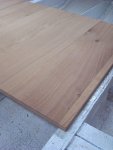
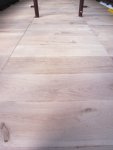
Thanks everyone for helpful tips and advice! In the end I used a polyurethane glue designed for gluing floors (Setcrete Flexible Wood Flooring Adhesive). We taped the oak sheets together with masking tape (taking care to also cover all knot holes!), flipped them over and quickly sanded the back with 60 grit, before laying them onto 18mm WBP ply which we had rollered with the glue. I upped the plywood thickness from 15mm to 18mm since pretty much anyone I asked said they thought 15mm would be too thin. The eight glued plywood sheets were then stacked in a pile with plastic sheeting in between, on a flat surface with a 5cm styrofoam sheet and a tarpaulin underneath, and another seven unused sheets of ply were stacked on top, before wrapping the tarp around it all. We had raided the battery recycling station for lead-acid batteries and piled as many as we could carry on top of it all and left it overnight. Out of the eight boards we glued only one showed signs of delamination, which considering the cold & damp weather must be considered a success! Possibly this was caused by us taking a little too long to apply the oak on that one sheet, so that the glue had already begun to set. A few days later and the installed boards show no sign of delaminating or warping, and the floor looks amazing!

sheet.jpg floor.jpg

The big question now, is what to use for finishing the surface? Wax, oil or varnish? I had previously tried a piece with beeswax, which looks very beautiful, but I worry that this would need to be re-applied quite frequently to preserve the oak. I don't want to use anything that darkens the wood too much, and I want a smooth streak free finish... Any suggestions?
 
Last edited:
Floor varnish. I use Ronseal but there are other brands. Formulated for heavy duty domestic use. Water based so easy to apply. You could do the whole lot (3-4 coats) in a day because of the short overcoating time. Self leveling and gives an off gloss finish that does not mark and is relatively non slip. Last forever in a boat.

Well done with the gluing.
 
Floor varnish. I use Ronseal but there are other brands. Formulated for heavy duty domestic use. Water based so easy to apply. You could do the whole lot (3-4 coats) in a day because of the short overcoating time. Self leveling and gives an off gloss finish that does not mark and is relatively non slip. Last forever in a boat.

Well done with the gluing.

I used Blackfriars from ebay or Amazon, similar product & much cheaper
 
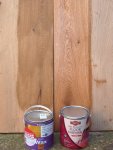
Thanks. A quick test, water based wax/oil vs solvent based varnish:

wax_vs_varnish.jpg

And the varnish wins by a country mile. Not only does it look 1000 times better, it is also far easier to apply evenly!

Edit: Now, what order should I go about this; paint back & edges first (undercoat + Danboline) or varnish the front first? Thinking about bending of the ply, in case one side swells more than the other...
 
Last edited:
Thanks. A quick test, water based wax/oil vs solvent based varnish:

View attachment 70420

And the varnish wins by a country mile. Not only does it look 1000 times better, it is also far easier to apply evenly!

Edit: Now, what order should I go about this; paint back & edges first (undercoat + Danboline) or varnish the front first? Thinking about bending of the ply, in case one side swells more than the other...

Why 2 different finishes? I would use the water based floor varnish all over. Easiest way to paint panels is to make some stand-offs - pieces of ply or wood with long screw all the way through. Paint underside first then stand board on the screws and paint the face. Next coat will fill the tiny spots where screws were on first coat. Don't use the stand-offs on the face side.
 
Why 2 different finishes? I would use the water based floor varnish all over.

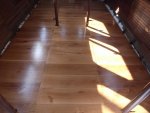
Not sure how you got the idea I planned to mix oil/wax with varnish? It was always one or the other; the photo I posted was just a side by side comparison - which showed quite clearly that not only would varnish look much better, it would also be easier to apply evenly. I am not inexperienced with a paintbrush, but it proved very difficult to get an even coat of the wax/oil thing (which by the way I'd picked up on sale). In the end, after a week of filling, sanding, varnishing and panting, not always under ideal conditions, here's the result:

floorshow.jpg

I also took the opportunity to line the stringers with 2mm thick EPDM rubber; flat 50mm strips on the wide stringers, and "u-channel" rubbers on the narrow ones:

rubbers.jpg

Makes a huge difference to feel & noise - the hull is old and nothing is straight; even minor unevenness meant fairly heavy impact against the tops of the stringers when walking up & down. This is greatly dampened by the rubber strips.

Edit: Before anyone asks about the posts, and the floor panels seemingly being off-centre; they're not - it's actually the posts themselves which are not quite centered!
 
Last edited:
Top