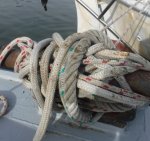
Making fast in a marina

I can think of very few places we have stayed where significant boat movement occurred even in bad weather, the exceptions generally being moorings. The point about Frank's original remark is that leaving a 'bird's nest' on the cleat adds nothing to the boat's security and that both the jumble and the frequent mess on the pontoon represents both a level of incompetence and lack of respect for other sailors that may to some extent be more common in recent years. I'm not sure that there is much one can do other than spread the word and encourage sailing schools and others to teach traditional sailing manners.
In general, I think sailing schools do teach the seamanlike manner of tying up a boat, but there is a large cohort of self-taught or taught-by-a-friend sailors out there who are a bit wooly on the finer points. I have noticed a lot of this kind of ropework on the inland waterways in Ireland and have come to believe that there is an element of inverted snobbery involved.
 
If you do the former and someone else wants to also use the cleat they will have to tie on over your line, meaning you will have to disturb their line if you want to leave before they do. If you do the latter then it is possible for someone else to use the cleat without disturbing your line and for you to cast off without disturbing theirs.
I take your point but I have never had any difficulty removing the round-turn-and-two-half-hitches; even when the most over-enthusiastic figure-of-eighter has been at work.
 
I take your point but I have never had any difficulty removing the round-turn-and-two-half-hitches; even when the most over-enthusiastic figure-of-eighter has been at work.
The rule is very simple. You must leave any cleat that may be shared in a manner that enables it to be occupied by a second boat (or more when rafting is involved). That’s it really, but styles can differ according to the type of cleat. How you tie to a solo cleat is purely a matter of whether you have any pride or not and whether you are leaving a trip hazard.
 
The rule is very simple. You must leave any cleat that may be shared in a manner that enables it to be occupied by a second boat (or more when rafting is involved). That’s it really, but styles can differ according to the type of cleat. How you tie to a solo cleat is purely a matter of whether you have any pride or not and whether you are leaving a trip hazard.
Exactly.

Look at this beauty. I bet whoever did that thought he was doing a really good job!
"That should hold her!"

]View attachment 117026
 

Attachments

  • 1623263205087.png
    1623263205087.png
    205.8 KB · Views: 33
Last edited:
... The trouble with the passing under and over cleat is that unlike ships bollards - this does not always mean either line can be released without releasing the other. ...

At least here, the over-under cleat practice is ONLY for home lines that are left on the dock while away. There is never a reason to remove them under load. (It is a mistake for overnight use.)

Also, floating docks are rare in my home area. Line length must be accurately set to adjust for tide while still allowing for boarding, and having a home set of of lines makes this much easier when day sailing.
 
If you do the former and someone else wants to also use the cleat they will have to tie on over your line, meaning you will have to disturb their line if you want to leave before they do. If you do the latter then it is possible for someone else to use the cleat without disturbing your line and for you to cast off without disturbing theirs.
I think that you have that the wrong way round perhaps ?????
 
Yes. I did some each way, just to see, and the eyes that were just looped over the cleats chafed many times (>10) faster. Obviously, this depends on how smooth the cleats are and how much motion there is in your slip. Many never observe this and thus think it is a silly practice.

I can see it making sense at the home berth where they're left in position for long periods.

What I was describing was for visiting other marinas for a night or two. At home we have fixed lines, which have splices on the end and are cow-hitched around one leg of the cleat so that there's no movement to cause chafe. The home lines are also about twice the diameter of the normal warps, so even if they did chafe a bit it would take a long time to become a problem.

In the past with a different boat I put hard eyes in the shore ends of the fixed lines and attached them to the cleats with large galvanised bow shackles. It looked very solid and professional but I can't see that it actually added anything useful, and in fact probably meant more potential ways to fail. Hence switching to the simple splices and hitches.

Pete
 
Chafe ... this is the main item after making sure line cannot come of the cleat. Chafe is reduced significantly by using the traditional turn + fig 8's on the shore side. Spliced loops ... doubled back lines etc. - all allow the line to move and chafe on the cleat.
Long term home mooring lines are generally to cleats only for your boat unlike short stay locations where usually cleats serve more than one boat.
 
If you can't tie knots, tie lots. This is how the British Army (infantry) tied up my boat one time; it certainly wasn't going anywhere. View attachment 117054

I'm no great defender of the British Army having served my time in the RN and Royal Marines, but it's a tad unfair to judge "The British Army' on the efforts of what might have been a not very bright 18 year old infantry soldier who'd been taken sailing as a bit of adventurous training by his or her 23 year old 'just day skipper' qualified boss. (The minimum qualification in the services for sailing a small yacht round the solent is Day Skipper. (and Yachtmaster Coastal Skippers aren't allowed to cross the channel.)
 
We have just spent 9 nights in a West Country marina. We are appalled at the poor seamanship and lack of consideration shown in the way many sailors tie up. The majority made fast to a cleat and did not return lines to their boats. They just dumped the lines on the pontoon inviting people to be tripped up. Some took so many turns that the next boat could not use the cleat. When we arrived, I could not get my bow line through the cleat to return to our boat. The boat ahead, a 40 footer, had put three thin lines from one cleat his boat that it was totally unusable by anyone else. He (surely nota she) had just dumped the three line in a tangled mess on the pontoon.

Surely, it is good manners and good seamanship to put lines through cleats as is usually possible and make fast on board. Departing is then straightforward. If considered necessary, take a turn on the pontoon cleat and then return to your own boat. If returning a line to the boat is not possible, then why not make a Flemish mat? That ensures your line is not tangled up and minimises the chance of tripping up the unwary.

Electric cables are another hazard to which some are blind. Just plugging in takin the cable direct to your boat usually creates another hazard. Why not take the cable round the electricity box. That way it will lie flat on the pontoon. Also, if you forget to unplug, easily done, you are more likely to recognise that gentle tug rather than trying to pull the plug out directly as you move slowly out.

We saw all sizes of boats offending in these matters from a large yacht flying white ensign down to small motor boats. Maybe I am getting to be a cantankerous old man but I do despair at such examples of poor practice and thoughtlessness.
I'd say your socks drawer is a sight to behold
 
Top