Making a new exhaust riser for MD2B.

I envy your welded SS elbows! I can't find a way to align them without being loose... Guess will have to abandon the project with the taper threaded fittings because of this problem... Will probably buy SS elbows and tubes needed and go to a pro welder do the job...
 
I envy your welded SS elbows! I can't find a way to align them without being loose... Guess will have to abandon the project with the taper threaded fittings because of this problem... Will probably buy SS elbows and tubes needed and go to a pro welder do the job...


To align tubes for welding I take a short piece of tube cut a slot along the length of the short tube and congress it until is slides into the two tubes to be joined.

No reason you cannot take the screwed tubes to be welded os sealing and locking then at the required position.

You could also silver solder / braze the stainless and brass fittings to seal and lock position.
 
To align tubes for welding I take a short piece of tube cut a slot along the length of the short tube and congress it until is slides into the two tubes to be joined.

No reason you cannot take the screwed tubes to be welded os sealing and locking then at the required position.

You could also silver solder / braze the stainless and brass fittings to seal and lock position.
Thanks that's good news:).I ll watch some brazing videos as i have a torch already.
 
Last edited:
I have a Perkins 4 108 and made up my own water injection set-up.

The first photo shows the exhaust/water injection and on the RHS the water muffler.
 
I miserably failed to learn to braze overnight, it looked very easy on the videos but bought rods and flux, started trying on some steel with embarrassing results. :whistle:. Finally managed to lock in place the fittings with no welding just tightening! Having a look in the gas pipeline coming from the street and into the buildings, observed that they had used galvanized pipes and fittings oriented such as making their way in. By the way, all through hulls and seacocks on the boat are parallel thread and had to mark the though hull position before installing it, so the seacock handle will be on the wanted side. Unlike parallel threads where you reach the end and you can't tight more than a few degrees, the taper pipe threads can be tightened way more than one full round after they are hand tight, making it easy to seal exactly at the desired angle. Not sure if they are NPT or BSPT but doesn't matter since they are the same thread type. From left to right:
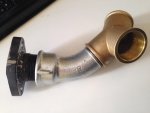
- male taper flange to female taper part of the elbow, (the flange is custom made on a machine shop)
-male taper elbow to possibly parallel female bronze Y mixer, which is not an ideal connection but acceptable from what reading around.
The galvanizing of the elbow will be removed with citric acid to avoid getting poisoned by fumes when the engine runs...
Thank you all for your feedback! you really contributed to making this final version of the elbow which is robust, not heavy as the initial riser design, with easily replaceable parts.
I will update the thread soon after i make the fiberglass muffler.

elbow.jpg
 
Good job.

When I am using parallel pipe threads I use a spacer or socket to adjust the valve position by filing the end of the spacer/socket to get the valve position as required.
 
I miserably failed to learn to braze overnight, it looked very easy on the videos but bought rods and flux, started trying on some steel with embarrassing results. :whistle:. Finally managed to lock in place the fittings with no welding just tightening! Having a look in the gas pipeline coming from the street and into the buildings, observed that they had used galvanized pipes and fittings oriented such as making their way in. By the way, all through hulls and seacocks on the boat are parallel thread and had to mark the though hull position before installing it, so the seacock handle will be on the wanted side. Unlike parallel threads where you reach the end and you can't tight more than a few degrees, the taper pipe threads can be tightened way more than one full round after they are hand tight, making it easy to seal exactly at the desired angle. Not sure if they are NPT or BSPT but doesn't matter since they are the same thread type. From left to right:
- male taper flange to female taper part of the elbow, (the flange is custom made on a machine shop)
-male taper elbow to possibly parallel female bronze Y mixer, which is not an ideal connection but acceptable from what reading around.
The galvanizing of the elbow will be removed with citric acid to avoid getting poisoned by fumes when the engine runs...
Thank you all for your feedback! you really contributed to making this final version of the elbow which is robust, not heavy as the initial riser design, with easily replaceable parts.
I will update the thread soon after i make the fiberglass muffler.

View attachment 103498
No need to remove the galvanising, it wont get hot enough to burn it off. You can wrap some fi glass tape over it to prevent it warming up your engine space. Thats what I did when I made my SS one
 
The galvanizing of the elbow will be removed with citric acid to avoid getting poisoned by fumes when the engine runs...


As Beneteau381 said.
The gal will stay put except for salt water and heat,
Looks like a neat solution.
Let us know in 5 years.
gary


Not understanding completely your installation by the pic, but would like to ask how high above the water line is the higher dry part from the sea level and from your exit fitting
As the weight is supported on the cockpit fiberglass, how do you prevent the heat transmission through the bolts? Good job!
The mixer is around 400mm above the waterline. It is as cool as the seawater as the seawater mixes with exhaust inside the mixer.
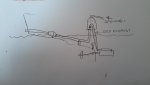
My pic is far from scale but I could not get anything lower than the engine .
All the original threaded steel pipes were in good condition at 38 yrs old but the welded bits corroded at the welds .
The thick cast iron snorkel or swan neck inside the mixer was the part that cracked and corroded through.
 

Attachments

  • 1606132356830-221184059.jpg
    1606132356830-221184059.jpg
    431.3 KB · Views: 10
The mixer is around 400mm above the waterline. It is as cool as the seawater as the seawater mixes with exhaust inside the mixer.
My pic is far from scale but I could not get anything lower than the engine .
All the original threaded steel pipes were in good condition at 38 yrs old but the welded bits corroded at the welds .
The thick cast iron snorkel or swan neck inside the mixer was the part that cracked and corroded through.
Understood! That's a nice design, and now with SS looks very safe.
 
The galvanizing of the elbow will be removed with citric acid to avoid getting poisoned by fumes when the engine runs...


As Beneteau381 said.
The gal will stay put except for salt water and heat,
Looks like a neat solution.
Let us know in 5 years.
gary
If it works well, guess i 'll replace both elbow and Y fittings with 316 SS in the near future. Unfortunately the Y fitting is CW617N yellow brass and not bronze (good for making a trumpet?) - not very optimistic about it holding for more than one summer! Problem is that few chandlers have bronze, most have normal brass and sell it as bronze. Recently polished water pump's cover, which is a Johnson made from real bronze in the early '70s and is still like new. If both alloys are polished, visually I can't see any difference between a yellow brass fitting and a bronze, very hard to tell.
 
I have an original one of those Volvo mixer bends at home. I can weigh it up if you or anyone is interested, just for a comparison. I'd be surprised if it was much less then 4kg. Like you, I considered using gas pipe pretty much as you ended up.

Remind me please, they are 1-1/4" BSP fittings, aren't they?

No idea of quality but you can buy plenty of 316 rated fittings off Ebay. I think they use them in the food industry.

There are specialist very high temperature threadlockers (liquid solutions) made by Loctite or Hot-Lock for joining exhausts. I guess your problem with brazing was trying to join non-matching metals, but I can't see why a few tack weld would be good, if they were all the same metal.

I was going to use a female-to-female 45° (I'm partial to female-on-female action), then a short length of straight pipe to move the Y-connector further way, and lower down, from the exhaust port.
 
Asap supplies have a good line of 316 fittings but twice the price of a plumbing/pipework supplier.
I used 2" bsp but then learnt that 2" is not the internal size of the elbows.
 
Yeah, given the price difference, you'd be better to go with cheap ones and just accept some eventual disposability.

But what is it that blows the original Volvo ones out, is it rust or ice?

Any evidence that any of those fancy ceramic coatings work inside marine/salt water exhausts?

Any reasonable automotive exhaust system welder should be able to knock you up an equivalent to a £400 S/S replacement for beer money during their lunch break. Many exhuast makers use stainless to do so, although I have no idea of the wall thickness they use. Like the guy above, just get a couple made up at the same time.
 
I have an original one of those Volvo mixer bends at home. I can weigh it up if you or anyone is interested, just for a comparison. I'd be surprised if it was much less then 4kg. Like you, I considered using gas pipe pretty much as you ended up.

Remind me please, they are 1-1/4" BSP fittings, aren't they?

No idea of quality but you can buy plenty of 316 rated fittings off Ebay. I think they use them in the food industry.

There are specialist very high temperature threadlockers (liquid solutions) made by Loctite or Hot-Lock for joining exhausts. I guess your problem with brazing was trying to join non-matching metals, but I can't see why a few tack weld would be good, if they were all the same metal.

I was going to use a female-to-female 45° (I'm partial to female-on-female action), then a short length of straight pipe to move the Y-connector further way, and lower down, from the exhaust port.
The weight of the original elbow would be good to know, the 2 fittings including the fabricated flange, is maximum around 1,5 kgs.
These are 1 1/4 not sure if they are NPT or BSP, but they are definitely tapered of the same type, except the brass Y female which is parallel but can accept a tapered male.
Brazing is supposed to be ideal for dissimilar metals, so i was doing something wrong hehe..
Starting with a female to female elbow is even better because it's easily accessible. It was hard to find a male to female elbow, and only found it in galvanized steel, here in Greece.
I used red silicone rated for 500 celsius, for sealing only, as fittings are nicely tight in position and can be undone only with a plumber's pliers.
 
Any reasonable automotive exhaust system welder should be able to knock you up an equivalent to a £400 S/S replacement for beer money during their lunch break. Many exhuast makers use stainless to do so, although I have no idea of the wall thickness they use. Like the guy above, just get a couple made up at the same time.
Only if you give him the parts to be welded ready it shouldn't be expensive indeed. Problem is that at some point the welds will fail. Plumbing fittings will also fail, but thinking that can be easily and quickly replaced made it a more attractive approach. The custom flange cost 30 euros to fabricate, a fair price.
 
Only if you give him the parts to be welded ready it shouldn't be expensive indeed. Problem is that at some point the welds will fail. Plumbing fittings will also fail, but thinking that can be easily and quickly replaced made it a more attractive approach. The custom flange cost 30 euros to fabricate, a fair price.
My SS one is still going strong after 8 years! Mind you it is made of schedule 40 pipe fittings
 
is it 316 or 304? Send some pics of your installation if you would like , i found very cheap 304 fittings on aliexpress , better than any iron ,steel or brass
316, I made an 8mm flange, welded a 2" short thread on to it, threaded a 45deg elbow on, then used an ASAP supplies threaded water injection tube and that was it.
 
Top