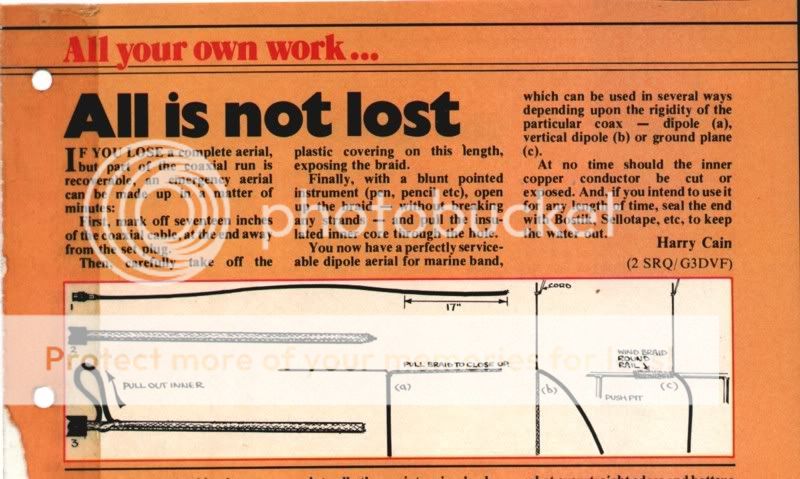
Make your own VHF aerial

j712

Active Member
Joined
3 Mar 2008
Messages
68
Visit site
Good evening all.

May I introduce myself (sort of - as best as one can on a forum).

May I ask a question too.

Years ago when I used to buy PBO magazine there was an article for making one's own VHF aerial.

I made one and tested it on an old unit - all ok. I have loads of cable and connectors left over.

Do you think such an aerial would be ok to use on a modern unit (i.e. not blow up the radio)

I know I could buy one for £35, but_ _ _ I am an old PBO type.

Regards
 
Hello and welcome,

The tolerances are such that if you get a tiny bit wrong you will suffer terribly in performance, even shop bought antennae should be replaced now and then as the materials degrade slightly.

After all the marine vhf is a fairly important bit to get right. /forums/images/graemlins/wink.gif
 
What happens is that the aerial must be matched to the output stage of the radio and the transmitted carrier (?)frequency. If the impedance is wrong there will be a lot of reflected power which causes 2 problems,
one; less power is transmitted,
two; power reflected back in the output stage may blow the output of the transmitter.

At least that is as well as I can remember from the VHF theory I did in the late 1970's. Physics doesn't change much, but my memory is decaying these days.
 
Granted, but, in practical terms, how far off does one need to be in the measurements of the aerial itself before actual damage is done? (Original poster's intention). I would think that the state of the cable itself is more important than the aerial's being a couple of millimetres too long or too short.

How wrong am I? (Please, don't just say 'Very' and leave it at that!) /forums/images/graemlins/wink.gif
 
On the contrary to the 2 responses so far the VHF band is quite wide so that any antenna is going to be right at the middle or chosen channel and wrong at the extreme ends. ergo they are not as critical as you might imagine.
I run a home made antenna on the pushpit of my sail boat and have had no problems in practice with range. The VSWR is quite good at centre of the band. ie ch16 for me.

I use a coaxial antenna design where the centre conductor of the cable is exposed for 17.3 inches. This makes a 1/4 wavelength driven element. The ground plane is in the form of 17.3 inches again of copper screen from the larger RG8U coax cable. This additional ground plane/screen is connected only at the end of the original coax screen and slides over the outer insulation of the feed coax down. (for 17.3 inches) The additional screen can be insulated with heat shrink if it is not put into an insulated tube.

The whole thing is fed up into a plastic conduit pipe or an old fishing rod that is clamped to the ast or in my case stern rail.
You need to remember that the end of the additional screen is relatively high voltage so should be kept away from the rail. ie the bottom of the additional screen needs to be more than 12 inches above the rail making the whole antenna about 4 ft from rail to top.

Obviously the higher the antenna the better.

I actually have about 6 innches of the inner insulated wire sticking out the top of the supporting tube. (going through sealant) 6 inches is reasonably self supporting and permits maximum height or min plastic tubing length.

The antenna is very reliable because there is no join of coax cable to antenna. Just a continuation of the inner wire. The screens can be soldered together in a fairly robust manner.

As an emergency antenna the whole thing could be covered in heatshrink and coiled up. Have asection of fishing line attached to the top so it can be hoisted up a mast or even held up by hand if mast has gone. PM me if you have any questions. olewill

Incidentally here in Oz we also use 27megahertz for marine. A carry over from the old American CB band.
I use a coiled whip about 2 metres long made for vehicles. with the same arrangement of additional screen in this case about 10 ft of it to form a ground plane (on F/G boat) It also works very well from deck level. Yes home made is good. olewill
 
Wow, thanks for the link - alot more detail than the old copper pipe bit from PBO days

i think i will give it a go - I'll let you know if i fry a set.
 
I can confirm that I have made one to Olewill's design (Thanks again, Olewill!) some time ago. I keep it coiled on board as an emergency antenna. The idea is that I would hold the tip aloft by tying it to the tip of a telescopic fishing pole that is always on board. I just hope that I never have to use it in anger! /forums/images/graemlins/wink.gif
 
[ QUOTE ]
i think i will give it a go - I'll let you know if i fry a set.

[/ QUOTE ]
A big word of warning, even though the design, for the Slim-Jim is sound and will work perfectly well as it stands, it is NOT, repeat NOT for the marine band frequency as it states it is for Band II VHF broadcast radio frequency 88MHz-107MHz.

You will have to alter (shorten) the sizes to allow the aerial to resonate at the correct frequency.
 
PBO.......Blue Peter of the sea /forums/images/graemlins/grin.gif

The marine band is approx 155-162mhz, you would need to pick a tunning frequency in the middle.

This is a great idea for tha HAMS around us but would you want to trust this fragile bit of kit for use with your safety of life radio service?

Now I am not saying don't do it but IMHO don't have it as your only anntenna on board.
Always better to have something that is built for the marine world and not your shed or shack.

Good luck.
 
This is a great idea for tha HAMS around us but would you want to trust this fragile bit of kit for use with your safety of life radio service?
**************************************************

These are extremely sturdy if done properly however the better design is the one utilising 300 ohm feeder which will fit inside 20mm pipe .

The tuning is quite tolerant on this design and I have used one for about 15 years which is cut to about 150 mhz which gives acceptable results on both ham and marine bands .

The design I have has about 8 inches of aluminium pipe slipped over the lower end of the plastic pipe which assists clamping. Otherwise is is as the hamuniverse.com one mentioned by another poster.

This serves as emergency VHF and or ham radio and clamped to the pushpit.
 
I made a few of these slim jims tuned to Ch16 and packaged into a length of oval conduit - a good snug fit. Ends sealed up with acrylic mastic and fitted with string loops to hang from the spreaders. The users tell me they got better performance than with their masthead arials up to medium range. Probably because the feeder was new...
 
The J-match antenna gains performance by virtue of a very flat radiation pattern. So if it is tilted it will send signal into the sky and the sea. This makes it less than ideal for a monohull (unless it is free to swing from a spreader!)
 
[ QUOTE ]
If the impedance is wrong there will be a lot of reflected power which causes 2 problems,
one; less power is transmitted,
two; power reflected back in the output stage may blow the output of the transmitter

[/ QUOTE ] I wish people would stop perpetuating this incorrect theory.

An impedence mismatch will certainly be capable of blowing up the power output stage of your VHF, but its NOT due to 'reflected power'. There's no such thing. What happens is that the impedence mismatch means the power is NOT TRANSFERRED and the end result is the same.

Even bloody Wiki perpetuates the myth of reflected power...

The actual maths of tranmission lines and mismatch is quite complicated (pardon the pun as it involves 'complex maths') but the simple VSWR meter (which measures Standing Waves by the way) also helps perpetuate the common and wrongly held assumption
 
[ QUOTE ]
Years ago when I used to buy PBO

[/ QUOTE ] Much improved these days /forums/images/graemlins/laugh.gif . <span style="color:white"> ............ </span> However from an old PBO:
975885de.jpg
 
Most grateful for the info gents.

Will take me a while to get round to making one, will let u know the outcome
 
So if you do intend to brew you own, get a VSWR meter to get the dimensions exactly right. This measures the power sent out and reflected back from the antenna. The idea is that none get reflected back. You never get to this and the null will only be a spot frequency anyway. Don't try a cheap CB type as they will often not work at marine VHF frequencies. Get a HAM type that's rated for the 2m band - that's 144-146MHz so will be finefor the marine VHF band.

Use the radio on low power when you rae tuning the antenna too. Radios die because operating them into a mis-matched load creates high voltages on the output transistors. If you operate low power then the voltages will be lower and the radio will be OK.
 
Top