Major shear pin design fail

Adios

...
Joined
20 Sep 2020
Messages
2,390
Visit site
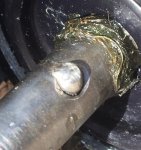
I hit the prop on my Tohatsu 3.5 two stroke last night and sheared the pin. No problem I thought, a few seconds to pop a new one in. No chance!! Some idiot decided to bevel the hole on the shaft so the pin can bend into it both sides before shearing making it impossible to remove the pin with the usual tools I expect most of us have in a dinghy. I've sheared pins on every outboard I've owned and never had any trouble before.

I'm now wondering what to do about this. Carry a hammer and punch? Use smaller pins so even when its bent i can still push it through? Ideally find more brittle metal pins that do nothing but shear... where from? Maybe I need to heat and quench some pins? But then will that make them too hard?? And do I have to hit something deliberately to test that I can get it out before using it again? I guess I should. How do I create that scenario in my wheelie bin?? ? I was incredibly lucky with where it happened, if it had earlier in the day would have been a major inconvenience. Adding this to the long list of "nothing bloody works right anymore these days"
IMG_0064.jpg
 
That pin looks as if it is too ductile and possibly a fraction undersized. Is it OEM supplied ?

I have a similar motor, and the pins shear along the circumference of the shaft rather than bend.

Vyv Cox on the forum is the man to ask about metallurgy.
 
I have had the same problem with a Torqeedo - shear pin bends at both ends and doesn't shear. And damages the plastic propellor where the shear pin sits. And it was a proper Torqeedo one. I don't carry the socket needed to remove the propellor with me in the dinghy so I just go very carefully in shallows. And carry oars.
 
This is what I carry for my 3.3 Mariner 2T:
P1010808.JPG
Note the red handled punch.
Rather than spend £5 on a new shear pin I got a 1m length of 3mm brass from B&Q for less. The one time the brass sheared it was quite easy tap out the remains of the old pin.
I think if you have a metal prop you need a stainless pin but brass is correct for the plastic prop.
 
I have sheared the pin on my Tohatsu 3.5 several times and never encountered this problem. Is it possible this countersink is not original?
I have also used brass rod as a substitute shear pin but it would be 70/30 brass, relatively ductile.
 
I have sheared the pin on my Tohatsu 3.5 several times and never encountered this problem. Is it possible this countersink is not original?
I have also used brass rod as a substitute shear pin but it would be 70/30 brass, relatively ductile.

I think the champher is stock and it was a mistake. I don't have the motor any more, but it looks familiar and I remember the problem. The brass is not perfect, but at least it is easier to knock out.
 
This is what I carry for my 3.3 Mariner 2T:
View attachment 137971
Note the red handled punch.
Rather than spend £5 on a new shear pin I got a 1m length of 3mm brass from B&Q for less. The one time the brass sheared it was quite easy tap out the remains of the old pin.
I think if you have a metal prop you need a stainless pin but brass is correct for the plastic prop.
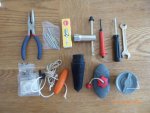
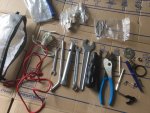
This is what I carry in the dinghy. Whenever I do any work on an outboard I just use whats in the dinghy tool kit so I know I have everything I might need. Having no punch I tried taping with the spanner on a new pin but it was obviously hopeless so I gave it up. I will now carry a punch!

signal-2022-07-05-093129_001.jpeg
 
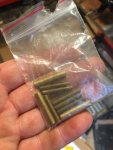
I've got some brass pins from a long forgotten source. Right size and shape for a shear pin. Its a plastic prop on a small engine so and that does make sense to have something less than stainless strength but OEM seems to be stainless.

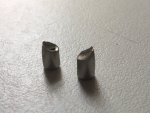
These are the ends of the pin. Looks like it tore rather than snapped. I didn't buy the motor new or replace the pin so can't be sure if its original. The motor was mint though with no marks on the prop.

signal-2022-07-05-093129_002.jpeg
 
I like the idea of using the dinghy toolkit instead of my usual bag of tools I would normally take if doing work. I suspect it would immediately show deficiencies in my onboard kit. Only last week i went to remove the spark plug and found that the "onboard" plug spanner had a manufacturing burr on the inside which stopped it even going onto the plug.
 
I have sheared the pin on my Tohatsu 3.5 several times and never encountered this problem. Is it possible this countersink is not original?
I have also used brass rod as a substitute shear pin but it would be 70/30 brass, relatively ductile.
What year is yours? Mine's 2006. Pretty certain its original but maybe just on newer models? Bizarre thing for an engineer to add to the production process if they knew what the part's application was.
 
I like the idea of using the dinghy toolkit instead of my usual bag of tools I would normally take if doing work. I suspect it would immediately show deficiencies in my onboard kit. Only last week i went to remove the spark plug and found that the "onboard" plug spanner had a manufacturing burr on the inside which stopped it even going onto the plug.
Thats just the sort of thing that taught me to use the kit for maintenance. Makes it all the more annoying though when I find the kit is deficient when I needed it
 
I have a 1996 model, which I bought unused in 2007 (was bought but never used for 11 years)
It has the beveled or countersunk hole. It also had a factory brass pin that sheared around hr 7, the first 5 hrs were running it in.
I now use stainless and it has not yet sheared.
 
I have a 1996 model, which I bought unused in 2007 (was bought but never used for 11 years)
It has the beveled or countersunk hole. It also had a factory brass pin that sheared around hr 7, the first 5 hrs were running it in.
I now use stainless and it has not yet sheared.
It just sheared or you hit something?
 
The countersink is standard; the shear pin must be made from out of spec material.
I'm coming to that conclusion. Even with the countersink it shouldn't have bent that much and torn off. Its like the metal from the pin is smeared around the shaft.

I'll try one of the brass pins I found and take spares of those and some stainless pins and a punch and a file and a hammer
 
What year is yours? Mine's 2006. Pretty certain its original but maybe just on newer models? Bizarre thing for an engineer to add to the production process if they knew what the part's application was.
I bought mine in 2004 and admit that it is quite a few years since I sheared a pin. So I cannot say whether mine is countersunk or not.
 
I'm coming to that conclusion. Even with the countersink it shouldn't have bent that much and torn off. Its like the metal from the pin is smeared around the shaft.

I'll try one of the brass pins I found and take spares of those and some stainless pins and a punch and a file and a hammer
I think that based on your photo and from some reading that a metal with low ductility would be preferred to avoid the deformation that has led to your problem. I have it in the back of my mind that the bought item is manufactured from powder metallurgy stock for this reason.

I would not use a 300 series stainless steel which would be very ductile. 400 series may be available as thin rod and would have lower ductility but not great corrosion resistance. 70/30 brass is not highly ductile and should be about the best that can be bought easily. Aluminium is always ductile but 5xxx and 6xxx alloys after heat treatment should be good, if available.
 
This is infuriating. Even a punch didn't get it out using the moderate lateral blows I'm happy inflicting on the shaft. I had to grind it with a carbide bur first. I put one of the brass pins I've got in a vice and using a large flat punch and a decent size hammer i gave it a good whack and its not shearing. I don't think the plastic prop is going to do a better sheering job than a sharp steel punch in a sharp vice so now what do i do? I'm taking it out on the sea again tomorrow and can't figure out what to put in there.

signal-2022-07-05-140704_001.jpeg

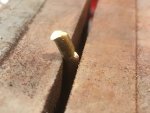
I can't remember where these came from but i can't think what they could be other than shear pins. Maybe something from old electric switches?
signal-2022-07-05-140704_002.jpeg
 
Top