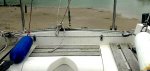
Mainsheet traveller cleats location

mogmog2

Well-Known Member
Joined
12 Feb 2011
Messages
494
Location
Sussex
Visit site
Hi,
What are the relative merits of mounting the cleats for the mainsheet traveller on the car itself or at each track end? Thanks
 
It very much depends on the boat, cockpit layout and type of sailing - balls out racing or comfy fast cruiser - but I can say from experience sitting down hard on cleats isn't all the fun it's cracked up to be, nor are main traveller stopper plungers when the plastic top comes off ! :ambivalence:

I'd go for on the car.
 
Mine are on the car on my fairly low down traveller. It's awkward to get a straight, powerful pull on them down there without back straining contortions. I've though long and hard about moving them (long night watches, nothing happening) but, as seajet suggests, they'd be bottom pinching toe stubbing monsters anywhere else. So there they will stay.
 
At the end of the track is fine if the user will be sitting above it and can pull it (and be able to release it quickly). If you're going to lead the line onward to a cleat exactly were the trimmer is sitting, that's definitely the one to have. I more or less steer my boat upwind using the traveller and have it set up like that.

On the car generally means that with an cleat set at a useful angle the rope can usually* be pulled over a wide angle, and that could work well if the user isn't going to be over or immediately adjacent to the track.

*Angling the cleat is tricky. It needs to be right in both planes so that it's easy to cleat and release, but that gets even harder when it's on the car and therefore in a different angular relationship with the user every time it moves.

I'm sure there are plenty of peculiarities with high tracks, low tracks and where they are fore and aft. I'll think of several just after I press the reply button. Seajet makes a good point though, all the extra bits on the car are painful to sit on, and do tend to get fouled up with spare line.
 
On our first cruiser season in 1978 one of the plastic tops of the Barton traveller plunger stops came off revealing a shiny metal spike ( Barton still produce good stuff, much better now ).

Anchored off Lyme Regis in the swell I suppose I wasn't yet used to the boats' motion in the swell, managed to flip backwards off the coachroof and landed with my arse skewered on the traveller plunger pointy bit.

It - and my back - hurt quite a lot.

The plunger spike was least of my worries at the time*, somersaulting backwards into the cockpit I was lucky not to knobble my spine forever - such is supple youth.

* Though of course source of much merriment offering cushions and plasters :rolleyes:
 
I think the only answer is to try the various options. Much depends on crew and boat size. On my tender little 21 ft that I race a lot with crew, the traveler is used a lot. The track extends to the sides of the cockpit at the entrance hatch. The traveller control is a 3 purchase with 2 sheaves at the end of the track. One sheave turns the line upwards to a cam cleat. The crew sits on the wide gunwhale (side deck) with legs either side of the traveler so action is a pull up to pull the traveler to windward. The choreography is that on tacking one crew leaps across to take up the new position on the gunwhale (side deck) to control the traveller and other crew pulls in the jib sheet. The crew who had been doing traveler climbs down to pull in the jib sheet. Swapping roles on each tack.
This arrangement suits really well but is not suited to single handed sailing where I resort to locate traveler central and ease or tighten the main sheet. (cam cleat on the bottom sheaves) Yes racing is in full swing now at East Fremantle YC. ol'will
 
Thanks for this. Some useful insight offered here. I was tight for time when I posted and didn't put helpful details: the traveller is old-school, across the transom for a boom-end mainsheet and reasonably high. Definitely not somewhere you'd sit. I'm looking to improve it a bit (not replace) by maybe adding blocks and moving things so that it actually works as the current alignment is such that the line doesn't engage the cleats and there's no mechanical advantage. To date we've only had a couple of sails - enough to know that this setup isn't very good. We will be mostly cruising, two of us, plus some club racing probably fairly short-handed.
 

Attachments

  • IMG_20190112_124836_2.jpg
    IMG_20190112_124836_2.jpg
    249.3 KB · Views: 8
In your situation I would think that one would be able to apply the most pressure to the car by having the cleats at the end & set horizontally so the line ran along the seat. If it was fitted to the car the crew would have to be close to it & would run out of pulling power as it moved up wind as the angle would be all wrong.
I would also suggest something like 4:1 tackle & making sure that the car ran freely under load.
Where does the mainsheet cleat from- The same place? or somewhere further forward?
 
Thanks Daydream believer. That sounds sensible - the lazarette and tiller get in the way as well. The mainsheet is cleated off on a nice modern jammer, at the car. IIRC, the car moves quite well considering and we had trouble keeping it put as the cleats don't grip in their current locations.
 
I do not know the layout of the cockpit, but it sounds as if the helmsman will be in the way of the mainsheet trimmer meaning that the helm has to do both jobs.
In that case you might consider bringing the tail of the mainsheet back up to the boom, then forward along the boom then down to a u bolt on the cockpit floor in front of the helm. The helm can still adjust it there, but so can a crew without having to get behind the helm. The helm would still have to adjust the car, of course, but the crew can dump the main via the sheet easily instead of via the track, which is the usual way.
It would be easier to cleat, because I suspect that in its current position you have to reach up quite high to engage the sheet into the jammer. On the floor it would jam immediately & to release it you would just put your foot on it. The track would still pull the boom in and out. Even with the sheet going to a fixed point.
Even if you are only cruising it is much nicer to make things easier to adjust so it is worth thinking out of the box.
 
Last edited:
I'd go for 4:1 as well, but would bring it forwards so that the cleat is forwards of you (the short handed mainsheet trimmer) and aft of the next bum along the cockpit who'll be using it when there are more of you. The ideal would be to bring it along the outer edges of the cockpit seats, turn it upwards there and have a captive camcleat on the top inside coaming face. Not comfortable to lean on - but it is the perfect place. Could the helm reach it if it were in the corner where coaming meets coachroof?
 
The simplest change would be to replace the end turning blocks (on u bolts) with double sheave blocks with cam cleats (see link below). Rig them up with the cam cleats facing forward and have a continuous line. You should be able to release the leeward cleat with a tug, then pull forward to bring the traveller up. You will need single sheave blocks with beckets at the car, to get you 3:1 purchase.

Ideally you would replace the floating blocks with fixed turning blocks mounted on the ends of the track, but this would be more effort to fit. This arrangement will work best if you helm sitting on the coaming as that will put the turning block slightly inboard of you which will be easier to use.

Having the sheet and traveller at the extreme stern means you (the helmsperson/main trimmer) will probably end up facing backwards through the tack, but that is not the end of the world (topper sailors managed for years).

https://www.theboatwarehouse.com.au...an-fiddle-block-cam-cleat-swivel-all-purpose/ In this example you would want to reverse the cleat so it releases towards the centre of the boat. You could also use a block where the sheaves are on a common spindle.
 
Top