
Mainsheet ajustment

Any sheets across the cockpit would restrict my movement, so are a no no. Only the ones across the aft winches are acceptable as they are behind me.
I have it rigged so that the controls that I need to adjust very regularly are next to the helm station. That being said, I do adjust vang, outhaul, halyards etc several times when sailing. So I have to move foreward. Plus reefs etc are done at the cabin top. Having a mainsheet to the cabin would be useless. How would I manage a gybe, for instance?
 
Any sheets across the cockpit would restrict my movement, so are a no no. Only the ones across the aft winches are acceptable as they are behind me.
I have it rigged so that the controls that I need to adjust very regularly are next to the helm station. That being said, I do adjust vang, outhaul, halyards etc several times when sailing. So I have to move foreward. Plus reefs etc are done at the cabin top. Having a mainsheet to the cabin would be useless. How would I manage a gybe, for instance?

I think Neeves was only implying there are possibilities.

For example, the mainsheet on my PDQ is handled by a starboard winch (there are two at the mast and two on each side of the cockpit). The sheet is routed along the boom, down to the base of the mast, and back to a 2-speed winch. Works very well with very low friction, in part because the mainsheet tackles in only 4:1 (the rest of the power comes from the winch). Not sayin' that is what you want, only that there may be ideas you have not considered. But I don't think winching the main would suit your (tiller steered) boat.

I like having lots of winches. Even my F-24 has four, and there are times I wish it was set up for less winch sharing.
 
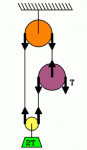
No, it's not even a 4:1. It's 2 sort of 2:1s which don't combine to a 4:1 and as drawn wouldn't work at all
I disagree. You can see that the tension in the upper string is 2x tension in the lower string (from equilibrium of the rightmost block), and that therefore the total upwards force on the load is 4x tension in the lower string (from equilibrium of the leftmost block), giving 4:1 advantage. Equally, if the load moves up 1 unit then the rightmost block moves down 1 unit. Two sections of the lower string get shorter by 1 unit, and the section between the two blocks gets shorter by 2 units, giving 4 in total.

Secondly, the system will not simply fall to the end because its position is always defined. The load and upper rope act to pull the two lower blacks apart, but this cannot happen unless the user pays out the lower rope.
 
No way would I have winches on the mast. I keep off the deck as much as possible. Deck work is the most dangerous aspects of single handed sailing - apart from sleeping (& sea sickness which i am prone to).
I only go on deck for sail drop & preparing for entering harbour, rigging lines & fenders, or hoisting mainsail & stowing lines & fenders.
The first of which I sometimes dread. Being tired, The boat rolling violently. Difficult to control the course, Pots in the way, Getting hit by a flying boom. Falling overboard.Avoiding other boats if busy. All adds to a difficult scenario.
If it is light I will often put the chute up, but I always drop it in the cockpit. A snuffer would be far too dangerous.
 
We used to have a 4:1 with a 3:1 for fine tuning on our catamaran Frankly, it was a bit of a pain. We now have a 4:1, with the 2 tails leading forward through the boom to the gooseneck, and then back to the roof-top winches. This makes it easy to sheet in with a substancial force, and also easy to let go in a hurry. However, in a squawl, I normally let go the traveller.
Sounds like you might mean a German mainsheet.

I'm not sure the ratio, but mine has enough blocks that mainsheet winches are redundant. It is like sailing a dinghy, with tiller in one hand, and mainsheet in the other - I have a good tiller pilot so I'm not sure now if I can tighten the mainsheet with one hand, but I can certainly release it.
 
Top