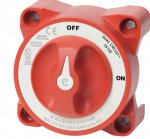
main battery switches, why is there one for neutral ?

Seems to be mostly a French thing. My last boat, a Jenneau, had one. I repurposed it as an emergency switch (paint it yellow or something). Bolted the negatives to a power post.
 
Seems to be mostly a French thing. My last boat, a Jenneau, had one. I repurposed it as an emergency switch (paint it yellow or something). Bolted the negatives to a power post.
Not just French. My Danish Nordship had the same and I followed Paul's route but without the extra paint.
 
Seems to be mostly a French thing. My last boat, a Jenneau, had one. I repurposed it as an emergency switch (paint it yellow or something). Bolted the negatives to a power post.

My Jeanneau also has the negative switch (which I only change to off when I’m leaving the boat for any length of time - I don’t know why I do, it just seems a good idea…).

I am interested in your idea of repurposing it as an emergency switch to make it ‘useful’ but I’m not sure of that function either. Please could you expand? Thanks
 
My Jeanneau also has the negative switch (which I only change to off when I’m leaving the boat for any length of time - I don’t know why I do, it just seems a good idea…).

I am interested in your idea of repurposing it as an emergency switch to make it ‘useful’ but I’m not sure of that function either. Please could you expand? Thanks
+1 on our Jen too!

Perhaps they thought it might help with galvanic action - or stray/parasitic current loss - or… something?!

I do like the separate house, engine, and windlass switch setup - vs 1-2-both. With the (4th!) negative switch, you can pretend you’re powering up an electricity substation or some such!
 
Some systems have unswitched circuits connected straight to the battery, (via inline fuse) like gas or bilge alarms or even float switched pumps. The neg switch is the only way to turn them off. I hate them, by the way. When I had to have some of that stuff I used to wire eg the bilge alarm float switch into the neg side, so no + current down the bilge. From bat + to siren to float switch, neg back to bat. Not sure if it worked, does the +tive bleed through the siren and get to the float switch, and all the wet around it?
 
It is a requirement for some commercial boats and is also common for metal vessels especially aluminium.

A true double pole switching and circuit protection system (where both the positive and the negative poles are switched and fused) does add significantly to safety and reduces the chance of stray current corrosion problems. Installing negative switching only on the main battery switch is of more limited benefit, but it is not something I would remove if already installed.
 
I have expressed my worries about negs in the boat, and been told I'm wrong, but here goes. If you leave something switched on/permanently wired, there is + current in the circuit. If the + gets across to the neg, say through damp, then is there residual current going to the neg terminal on every electrical item in the boat? Hence have the neg switched off....
 
I have expressed my worries about negs in the boat, and been told I'm wrong, but here goes. If you leave something switched on/permanently wired, there is + current in the circuit. If the + gets across to the neg, say through damp, then is there residual current going to the neg terminal on every electrical item in the boat? Hence have the neg switched off....
As you point out, without double pole switching (both positive and negative) the negative terminal of the battery is permanently connected to every device (whether the switch powering the device is off or on).

While most boats are wired this way, it does create some additional safety and stray current corrosion problems compared to double pole switching and circuit protection. However, double pole switching is more expensive and complicated to install so many boat builders do not consider the effort worthwhile which I think is a reasonable approach for a fibreglass boat.

The main concern regarding stray current corrosion problems is for devices that have some potential connection to sea water such as the anchor windlass and autopilot, so some boat owners isolate the negative on these circuits especially if notice more rapid and zinc erosion (or rudderstock corrosion) that is otherwise unexplained.
 
Last edited:
It is a requirement for some commercial boats and is also common for metal vessels especially aluminium.

It might be common in your experience, but if correctly wired, it isn't essential. Ovni are aluminium, they don't fit them.

A true double pole switching and circuit protection system (where both the positive and the negative poles are switched and fused) does add significantly to safety and reduces the chance of stray current corrosion problems. Installing negative switching only on the main battery switch is of more limited benefit, but it is not something I would remove if already installed.

That isn't how they are wired. All of the batteries share a common negative.

Removing something that most builders don't fit only make the boat electrics the same as all of the others. It's not like Jenneau (for instance) are wired in some special way or have some special equipent, that no-one else uses, that require negative switching. The others all seem to do fine.
 
My Jeanneau also has the negative switch (which I only change to off when I’m leaving the boat for any length of time - I don’t know why I do, it just seems a good idea…).

I am interested in your idea of repurposing it as an emergency switch to make it ‘useful’ but I’m not sure of that function either. Please could you expand? Thanks

Remove all negatives from the black isolator and fit them to a power post (you can also use a stainless nut and bolt if it can be safely secured).

Make to short positive cables, connect them both to the isolator, with one going to the load side of the engine isolator and one going to the load side of the domestic isolator. I would somehow clearly identify the switch as being for emergency use only and if possible, remove the key and leave it on a hook or a string, or whatever, close to the switch to prevent crew inadvertently switching it on.

You wish to start the engine, but the battery is a bit low and won't start it. Turn the emergency switch on, start the engine, turn it off.

The engine battery just exploded or has in some other way terminally failed and needs to be isolated, so turn the engine isolator off and turn the emergency switch on. Whilst you leave the switch on the engine and all domestic circuits will be powered from the domestic bank.

A domestic battery has terminally failed, so turn the domestic isolator off and turn the emergency switch on. Whilst you leave the switch on the engine and all domestic circuits will be powered from the engine battery.

Depending on what went wrong, what charging you have and how safe it would be to open the battery box, you may need to remove a charging lead or the negative cable from the failed battery.
 
Careless friend of mine left loose live wires in the bilge, and lost the roves off his rivets.
I had a steel cabinet on deck forward, with the pot hauler. isolated from the boat electrics although the pilot switch was on a plastic mount on it, and lights on the A frame above also a possible route. The hot dip galvanise fell off one side of it in one sheet, and subsequently that side rotted out completely, the rest wasn't touched. I could only think there was stray current overside, coming up on the wet pot ropes, the only other connection would be the steel windings in the hydraulic hoses, back to the engine, but the crimps are on the outside of the plastic coating. Mystery.
 
double pole switching is more expensive and complicated to install so many boat builders do not consider the effort worthwhile which I think is a reasonable approach for a fibreglass boat.
I've seen an isolator mounted on the battery terminal, but expect it would only fit the +tive.
 
I've seen an isolator mounted on the battery terminal, but expect it would only fit the +tive.
Marine dual pole battery switches are quite readily available, such as Blue Sea 5510e pictured below. These do not look any different from a single pole battery switch, but they can be used to cut or connect both the positive and the negative connection when the switch is turned.

For a complete dual pole system double pole ((rather than single pole) circuit breakers also need to be installed in main switch panel, once again these are readily available, but for most fibreglass yachts the advantages are not worth the considerable extra cost and complication.

image.jpeg
 
Top