Macwester Kelpie

It will make a difference whether you have lead or concrete. Whether it makes enough of a difference to have a practical effect in the case of a Kelpie I don't know.

As the concrete is much lighter, for the same volume, than lead, if you have the same weight it will be significantly larger in volume. In the confines of a boat keel that means that the centre of gravity is higher up. As you have the same weight the boat will float to the same level, but with concrete you will have a lower righting moment - i.e. the boat will heel over more readily, and come upright again more slowly. I don't know in the case of the Kelpie whether the difference will be enough to notice or have any practical effect.

I wonder what the original design called for. An alternative to lead and concrete, very popular in the era of the Kelpie, was steel punchings encased in polyester resin. This will be significantly smaller than concrete for the same weight (and hence lower centre of gravity), but not as small (or low) as lead. You can find the relative weights/volumes on the internet.
 
Yes you make a good point, I've yet to weigh one of my concrete blocks and also to assess whether I have enough to make up the total mass required. At the moment there is ample space for more ballast but as to whether I have enough?..... well its going to have to be a calc job.
I like the idea of encasulating steel punchings in resin.
My river cruiser uses these contained in a number of strong terylene bags as ballast, but encapsulating is a neat idea.
 
Yes you make a good point, I've yet to weigh one of my concrete blocks and also to assess whether I have enough to make up the total mass required. At the moment there is ample space for more ballast but as to whether I have enough?..... well its going to have to be a calc job.
I like the idea of encasulating steel punchings in resin.
My river cruiser uses these contained in a number of strong terylene bags as ballast, but encapsulating is a neat idea.

The encapsulating has three advantages (over loose punchings) - 1 is it protects the steel from moisture and hence rust; 2 in a fixed keel it secures the ballast so it can't move in a capsize situation; 3 in a mobile ballast situation like the Kelpie (remove to make launching/towing easier) it makes it easy to handle and stow.

You say you have plenty of space for more ballast, but the point i was making was that this space would be higher up, and therefore less effective for the primary, and vital, stability function of the ballast. As I say, whether it makes a significant difference in the case of the Kelpie I don't know. Basically the denser (= smaller) the material and hence lower the you can get the weight the better. Depleted uranium would be best!;)
 
Just a few comments from one who does not know this boat type. Re the rig. I would suggest that the rig size be mostly determined by what you can get in way of second hand mast sails etc. The size of the mast on any boat is a compromise. Very tall means good light weather performance but needing reefing inany real wind and the tall mast may compromise self righting ability. Likewise the length of the boom and foot of the sail. I would imagine on this sized boat you might end up with a dinghy type rig. Forestay fractioanl up the mast with jibs to suit. Ideally one jib as big as reasonable in the forestay length and giving some overlapand another jib much smaller for handling a wind.
Regarding the ballast I would suggest that if possible youmold lead into a suitable Vee shape. It might be worthwhile lining the bilge with polythene and pouring plaster in to make a cast of the shape. From this you could make a steel or Ali mold to pour molten lead into. The aim being to get perfect shape to get lead as low as possible. I have in the past used polyester resin and fibreglass to make a once only mold. The GRP was destroyed by the molten lead heat but survived enough to give the correct shape.
It would be very good if you molded lead in sections so you can lift them out. (for cleaning inspection and maintenance of the bilge.
When the boat is finally fit to sail you might like to check the ballast by doing a pull down test. This involves tethering the boat bow and stern so that you can pull sideways from the mast top to get the boat to mast horizontal. You can measure or guess the pressure needed to hold the mast down. Something like 20kg would be good for this sized boat. DSC_1897.jpg (96.1 KB)
Of course self righting is only part of the stability question. Initial stiffness comes from the total mass and hull shape.
Regarding the cockpit drains. If you are sure the cockpit floor is below water line then I think the best arrangement would be to lead the drains by tube out to the transom and have sealing plugs. Thus if you get any water in the cockpit it can be drained away when you haul the boat out of the water. And leave them open for rain when boat is on a trailer. You should find the inide of bilge stays dry so no point in draining cockpit into the bilge. You might like to consider raising the cockpit floor above water line so it can be self draining. good luck olewill
 
Hi, yes I understand. My photos on thread 17 dated 31-3-15 show ballast inside my keel in the cockpit area only. There is more ballast with space in the keel area inside the cabin area.
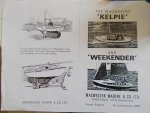
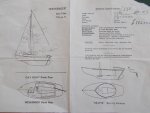
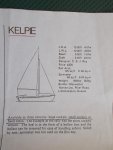
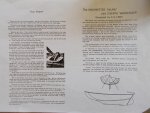
I've had a rake around and found these two pics of the original brochure/ leaflet where it states that the boat hull weighs 320lbs and the ballast should be 420lbs (LEAD) there you go. Please forgive me for the 007 type reproduction.DSCN0387.jpgDSCN0391.jpg
 
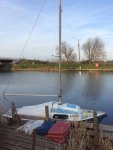
In terms of sail area, I will measure what I have already. Here is a photo of my Kelpie in 'as bought' condition showing with and without sails - notice from the previous spec that the sail area is 115sqft of 125sqftRonda Boat - Full Sail 2.jpgRonda Boat - Berthed.jpg
 
The cockpit cover is very robust and keeps all but a few drops of rain out so that basically when I arrive after a couple of weeks of absence there is barely a bucket full of water in the keel, if that!
 
While I'm on the boil so to speak, here are some more photos of Kelpie literature. Hope you find interesting if not useful. I notice that one gives more detailed information on the sail area
DSCN0394.jpgDSCN0393.jpgDSCN0389.jpg
 
Looks like a sweet little boat. I would suggest that the ballast be as far forward in the keel as possible becuase most small boats sink at the stern with the weight of crew in the cockpit.
The rig seems like a simple dinghy rig. 2 shrouds coming to chain plates aft of abeam the mast. Some show a masthead jib others a fractional rig. Spreaders.
If the chain plates are abeam the mast you might be better off going for something more like a full mast head rig. ie backstay forestay cap shrouds inner side stays and inner side stays.
I think much of the rig design will depend on what sized mast you get. ie dimensions front to back and sideways. A thin dinghy mast might need more stay support. In which case an inner forestay and inner sidestays going to chain plates aft of abeam the mast will be worth whie for the support given to the middle of the mast. This is the part most vulnerable to buckling. Remember that you boat will have a lot more stiffness so ina breeze will put more loading on the mast
If you have chain plates aft of abeam the mast by say about 25cms you could go for a fractional rig style. With cap and intermediate side stays going to the chain plates. This will require stout spreaders that angle aft and are able to force the shroud aft.ie rigidly mounted. This spreader arrangement will mean you don't have have a aby inner forestay. So tacking is much easier. Anyway just waffling good luck with the project. PM me if you want to discuss the rig olewill
 
Hi, I'm very new to this, but am after information about a Kelpie Day boat (open Cockpit) that I've just got.
It is generally all there although all the wooden parts are rotten (except for the rudder and tiller). The thing that is missing is the ballast!
I was wondering if someone could provide details of the lead ingots - are they regular cuboids, or are they shaped and what are the sizes and weight of each one? From BikerBry's photos I presume that there are 12 of them, but this may not be right. Also how are they held in or packed.
I'm in the Northwest of England and would be interested to learn whether there are any others locally!
Thanks in anticipation of receiving some help
 
Top