Macwester Kelpie

macwester_kelpie

New Member
Joined
3 Feb 2014
Messages
10
Visit site
I need some help with pictures, diagrams or plans concerning a old Macwester Kelpie Weekender , especially about sails and rigging systems...I suppose that the mast is around 17" and the boom around 8"...no more data surfing the net...any help will be kindly appreciated...thanks...
 

Attachments

  • IMG_1657.jpg
    IMG_1657.jpg
    88.1 KB · Views: 15
From the 1973 ' Boat World Guide No.2 Sailing Cruisers '.

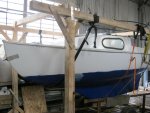
The Kelpie Mk1 looks like yours ?

No spar lengths I'm afraid but I dare say they could be guestimated from the photo's & sail areas; click on the image to enlarge to a useful size.

Macwester_Kelpie, if the image has gone again before you get to see it please PM me and I'll e-mail it to you.

View attachment 39644View attachment 39645
 
Last edited:
I spent a summe4 cruising the south and west in a Kelpie double ender,identical at both end s and the two halves bolted together.a one off ....great little boat.I wonder where it got to?
 
The mast is approx 1.3 times the overall length; however, the Macwester Association should able to help you in more details. Let us know how you are getting on with the project. Macwester boats are great, naturally I a bit biased.
 
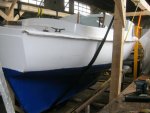
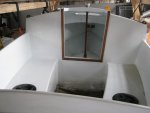
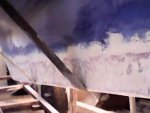
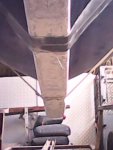
At first, thank you for all the answers...I bought this hull in a poor state; the previous owner wanted to cut the keel and to transform the sailing boat in a fishing boat...The exterior is in a good shape but I found a huge mess inside, especially under the cockpit, everything must be restored, the plywood panels are rotten, there is no lest anymore and the last surprise was a hole in the fiberglass, covered by paint.
I still have some questions:
-I found two outputs for water in the cockpit on the sides but no connections between then and even more, to the stern...I have no idea how would the water be pumped over the board ...?
-I would really appreciate if you could send me some photos, even the old ones, of the sails and the rigging system, showing dimensions and length ...the same with old sailing stories about this boat reflecting qualities and flaws of it.
cockpit_mijloc.jpgIMG_1660.jpgIMG_1662.jpgIMG_1743.jpg
 
As you could see in my pictures, the Kelpie is an early version, MK1 in my opinion (the cabin is not so long)...thanks for the photos...I live a little far away from UK, in Romania.... this boat came last summer to me passing trough Holland (ten years ago) ...I want to switch from a old 420 dinghy class to a day sailer boat...the speed is not so important at 40 years as the passengers' confidence in a solid hull for a week-end trip is ...Additional, Kelpie is easy to be trailered and launched, a strong point for our waters...
 
Last edited:
Still working

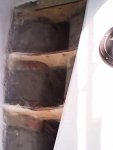
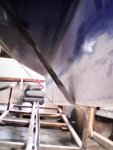
Back in business; new transoms in marine plywood under cockpit; 5 layers of fiberglass+resin on the keel; I'm a little confused about water evacuation from the cockpit: the two outputs still exist inside at 1/2 ft under floating line, so, a pump is mandatory...Any ideas?IMG_20140317_155352.jpgIMG_20140317_155040.jpgIMG_20140317_155136.jpgIMG_20140317_155211.jpg
 
You should have at least 10 30lb ingots of lead to lay into the keel as ballast , very important (removable for trailing).Cockpit was not self draining.Cockpit floor was plywood sheet laid over the cross members.You will need a manual bilge pump to remove rain water.Do you have the rudder?.Do the water drains you refer to, drain outside the hull or just provide limber holes from the space under the cockpit seats into the bilge?.Think about filling the aft lazarette and under the cockpit seats with foam to provide positive buoyancy. Great stable little boat.
 
Hello,
I've just bought a Mk1 Kelpie weekender looking the same as yours. I'll measure the sails and spars this weekend and send them to you along with photos.
Looking at your photos I find it interesting that you have an internal mast support - could you send me photos of the connections, mine appears to be missing.
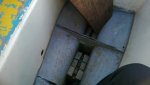
I also note that you have access ports to the two side bouancy panels whereas mine only has the two drain ports on the inside.
My Kelpie is without a rudder, I have photos of what it should look like IMAG0059.jpgIMAG0058.jpgcould you provide a dimensioned sketch for me to make one. I will of course check my own pivot distances. Its the profile I'm really looking for.
Attached are photos of the removable lead ballast - thought you might find it useful
 
Could you send me the spar lengths please, I have an enterprise mast that I plan to use on mine.

If you need a sketch of the rudder I can provide that, or send you a cardboard template..
 
Yes please I would appreciate a cardboard template of the rudder. I have measurements for one but would appreciate a second check. My Kelpie is in the water without rudder and a rotten outboard transom. Need to fix one of these to move her to a lift out point.
I wont be able to take measurements for you until late next week when I visit the boat again.
You need to buy a manual bilge pump and fix it somewhere out of the way. Just attach a soft flex pipe to the output so that you can throw it over the side when you need to drain. make sure the suction pipe is semi rigid that it can pull a vacuum. This boat does not self draiin.
I will be fitting some 10in inspection hatches to the side bouyancy tanks to replace the 'drain' holes leading into the cockpit. For internal inspection, pump out and to access the bolts for the rubbing strake.
I have a drawing for the removable ballast. Mine are made from concrete but I've also heard of them made from lead. So long as the weight is correct it shouldn't matter.
 
I have a drawing for the removable ballast. Mine are made from concrete but I've also heard of them made from lead. So long as the weight is correct it shouldn't matter.

It will make a difference whether you have lead or concrete. Whether it makes enough of a difference to have a practical effect in the case of a Kelpie I don't know.

As the concrete is much lighter, for the same volume, than lead, if you have the same weight it will be significantly larger in volume. In the confines of a boat keel that means that the centre of gravity is higher up. As you have the same weight the boat will float to the same level, but with concrete you will have a lower righting moment - i.e. the boat will heel over more readily, and come upright again more slowly. I don't know in the case of the Kelpie whether the difference will be enough to notice or have any practical effect.

I wonder what the original design called for. An alternative to lead and concrete, very popular in the era of the Kelpie, was steel punchings encased in polyester resin. This will be significantly smaller than concrete for the same weight (and hence lower centre of gravity), but not as small (or low) as lead. You can find the relative weights/volumes on the internet.
 
Top