Low Friction Rings, high load thimbles

Neeves

Well-Known Member
Joined
20 Nov 2011
Messages
14,073
Location
Sydney, Australia.
Visit site
I'm on Allen's mailing list. This might be of interest to those who are considering use of LFRs.

I have no known connection with Allen.

High Load Thimbles – Why, When, Where?

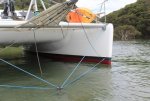
I have used stainless, 2 part threaded, LFRs, custom made (not by Allen - I think they only make 2 part threaded aluminium LFRs)) for my bridle plates (see images), for a catamaran snubber system aka a bridle. My LFRs have an advantage that they increase the scope of a rode - but I'm not sure that is necessary (with a modern anchor) and I am in midst of replacing the LFRs with an alternative.

IMG_4759 3.jpeg

IMG_4782.jpeg

Jonathan
 
I'm on Allen's mailing list. This might be of interest to those who are considering use of LFRs.

I have no known connection with Allen.

High Load Thimbles – Why, When, Where?

I have used stainless, 2 part threaded, LFRs, custom made (not by Allen - I think they only make 2 part threaded aluminium LFRs)) for my bridle plates (see images), for a catamaran snubber system aka a bridle. My LFRs have an advantage that they increase the scope of a rode - but I'm not sure that is necessary (with a modern anchor) and I am in midst of replacing the LFRs with an alternative.

View attachment 126030

Jonathan

The halyards come out of the bottom of the mast on my yacht. Are LFR something I should consider to direct the halyards back to the center cockpit? (If so I better start doing some research.)

On a related matter when looking for "D" shackles for a yacht are there any specific requirements when (say) doing a search on eBay- brands/material/Work Load Limit/? (If I leave it to the rigger to supply gear they will charged an arm and a leg)
 
Last edited:
The halyards come out of the bottom of the mast on my yacht. Are LFR something I should consider to direct them back to the center cockpit? (If so I better start doing some research.)

On a related matter when looking for "D" shackles for a yacht are there any specific requirements when (say) doing a search on eBay- brands/material/Work Load Limit/? (If I leave it to the rigger to supply gear they will charged an arm and a leg.)
Why uninvent the wheel?

Find yourself a length of rope that's aged, to represent a halyard that's been in use on a boat in the sun for a few years.
Compare the friction running around a polished bit of stainless, say 20mm tube, with the friction running through even a basic block with a 50mm sheave.

There is a lot of friction in bending old rope around a tight radius.
 
The halyards come out of the bottom of the mast on my yacht. Are LFR something I should consider to direct them back to the center cockpit? (If so I better start doing some research.)
On any modern / biggish boat, halyards generally come out of the mast 2-3 metres up from the deck, so they can be handled / pulled by a crew at the mast, then diverted back to the cockpit by foot blocks just behind the mast (and often a flat set of sheaves to divert around the hatch etc).
Low friction rings are generally better for lines not moving large distances under load and/or for diverting a small amount from a direct path. For a halyard that gets used (as opposed to a furling jib left up all year) I would use a pulley for the sharp turn at the base of the mast, not a LFR. Whilst the diversion past the hatch would be feasible for a LFR, it would rattle and chip the deck - hence the custom set of flat sheaves generally used would be better also.
 
Why uninvent the wheel?

Find yourself a length of rope that's aged, to represent a halyard that's been in use on a boat in the sun for a few years.
Compare the friction running around a polished bit of stainless, say 20mm tube, with the friction running through even a basic block with a 50mm sheave.

There is a lot of friction in bending old rope around a tight radius.
Thanks for that! (you have just confirmed my intuition)
 
On any modern / biggish boat, halyards generally come out of the mast 2-3 metres up from the deck, so they can be handled / pulled by a crew at the mast, then diverted back to the cockpit by foot blocks just behind the mast (and often a flat set of sheaves to divert around the hatch etc).
Low friction rings are generally better for lines not moving large distances under load and/or for diverting a small amount from a direct path. For a halyard that gets used (as opposed to a furling jib left up all year) I would use a pulley for the sharp turn at the base of the mast, not a LFR. Whilst the diversion past the hatch would be feasible for a LFR, it would rattle and chip the deck - hence the custom set of flat sheaves generally used would be better also.
Thank you!

I have the problem, of halyards coming out of the base of the mast and then having to negotiate a step in the deck before they reach the winches. I tend to think I need two deck organisers with hozontal pulleys and two with vertical pulleys? And maybe some LFR for "fine tuning"?

I don't think I need High Load Thimbles?

Screenshot 2021-11-19 at 19-49-58 halyards bottom of mast - Google Search.png

INKEDScreenshot 2021-11-19 at 20-09-25 _IGP7370.png
 
Last edited:
Thank you!

I have the problem, of halyards coming out of the base of the mast and then having to negotiate a step in the deck before they reach the winches. I tend to think I need two deck organisers with hozontal pulleys and two with vertical pulleys? And maybe some LFR for "fine tuning"?

I don't think I need High Load Thimbles?

View attachment 126045

View attachment 126046
Put a thicker pad underneath the organiser sheaves.
 
Thank you!

I have the problem, of halyards coming out of the base of the mast and then having to negotiate a step in the deck before they reach the winches. I tend to think I need two deck organisers with hozontal pulleys and two with vertical pulleys? And maybe some LFR for "fine tuning"?

I don't think I need High Load Thimbles?

View attachment 126045

View attachment 126046
See if you can change your halyard exits to further up the mast, then use "floating" blocks on strops setup to give the right lead to an organiser on the leading edge of that step. That's going to be the lowest friction approach to the issue.
 
I think rings are fine to divert halyards at the mast base.

If you already have blocks.., there is no reason to change.., unless you are obsessed with the tiny weight savings.

if you are building a new boat, or re-rigging.., they would be something to consider - less weight and lower cost.., the bigger the boat.., and the more halyards.., the bigger the savings. It wouldn't have to be that big of a boat to save enough to buy, say, and AIS...

the bend is typically 90deg - so that's within acceptable range.., and it's not as if the lines are running all the time. If halyards can be jumped at the mast, that makes the case even better. I think most new race boats have rings at the mast base - and they have sails going up and down all day.

I guess if you have a complicated run back to a companionway halyard winch.., that might be a reason to prefer blocks.
 
I thought this thread was about thimbles, not LFRs as blocks?

Yes, conventional cable thimbles will crush under high load and have been known to cut ropes. They shift, because the nylon eye can stretch under load.

I wonder how alloy LFRs do against a small steel pin at high load? I've never seen the testing. How do they wear, once the hard coat fails (and it will quickly against steel).
 
LFR's or high load thimbles, they are the same thing, are made from 2205 aluminium which is much harder, at least 2 times harder than 316 and maybe 3 times harder than 'commonplace' aluminium alloy (say 5083). As correctly mentioned the units are anodised and the coating does wear. The coating usually incorporates teflon, or something similar, that helps reduce friction when new. I have not heard of an LFR failing.

LFRs don'r work well, or don't respond quickly when under load, the ropes tend to stick - though this may be a function of the angle being turned.

For a main halyard, short handed where no-one is pumping at the mast I would use a decent block which will cost factorially more (LFRs are cheap as chips in comparison). But the block will continue to function when you are grinding in the last length of halyard to get the sail right up the track. There will simply be too much friction in a LFR. The winch might overcome the friction - but it would be easier with a decent block.

To illustrate the problem - I am using LFRs in my bridle plate (see pics above). The top rope is long and stretches back to the transom. Under tension the top rope stretches more than the bottom part of the rope which is much shorter, stretch being a function of the length of rope. So the top rope stretch a lot, the lower rope stretches much less and the bridle plate 'lowers'. This improves the scope. If you look at where the lazy loop of chain exits the trampoline and imagine where the anchor is then the scope should be a straight line between bow roller, at the tramp, and the anchor - its not - the scope or the angle is much lower. Basically the individual ropes of the bridle are not running though the LFRs.

Now - as mentioned in this application it improves scope - but modern anchors work well under a 3:1 scope (if push comes to shove) so the difference in scope is not critical.

I don't think the LFRs are necessarily the best answer in this application, neat cheap - but it can be improved. My current plate is the budget answer - nothing wrong with it, it does the job and offers the scope improvement.

I don't know whether its the ropes themselves, nylon cover, the fact they are wet both of which might contribute to the problem - of the end result.

I'm working on an alternative - which is why I'm on Allen Brother's mail list - I queried some of their other products.

LFRs excel for applications like barber hauls where you want to move the lead slightly. If you use a long snubber and run it from the transom then LFRs help you tweak the run (I need to get anchoring into every thread :) ) LFRs are simple, cheap and light. Where the angles are great (I don't know the limits of great) and where the loads are high - I'd think of a way to reduce the angle, first up, and I'd think of a way to reduce the load (pumping at the mast is an example rather than short handed relying on the winch). They are so cheap it merits thinking it through as if you can develop a solution you will save a lot.

I think the anodising will wear, salt and grit will soon remove the coating - but the underlying metal is hard and will self polish (it will be polished already) and though the LFRs might look tatty they will still work (if they worked in the first place).

My LFRs are two part threaded units - they screw together. If you search Allen Bros website you will find they make threaded LFRs used to pass lines through bulkheads - if you are looking at LFRs then maybe running through a solid surface might be an answer rather than trying to run over the top and round a series of corners.

Finally - if you search for LFRs you will find there are a number of suppliers. Ronstan and Antal come to mind. My stainless LFRs were made by the company used by Ronstan in China. If you search the websites of companies you will find they incorporate LFRs into devices (commonly using dyneema, polymers etc to make an amazing range of devices - that may suit your specific needs - they need not be just rings spliced to a line. If you look at Allen Bros website they incorporate LFRs in some of their blocks with stainless pins - pins are not an issue - corrosion might be. the 2205 aluminium will make a much stronger sheave than most polymers and stainless (and there are harder, higher tensile, alloys than 2205) . I'd not worry about wear of 2205 aluminium on a steel pin but I might worry about the pin abrading (unless its a duplex pin). There is a direct relationship between high tensile and hardness, the harder the metal the higher its tensile strength - its a straight line relationship. The harder the metal the higher its abrasion resistance. the 2205 alloy is used in aerospace - they machine, or used to machine, the Airbus wings from a single billet of 2205, reduced joints means less weight and the 2205 is strong.

The uses of LFRs is growing, the limits are your imagination - but think outside the box. Now we all think differently - if you come up with an idea - post it - we might be able to help you improve but it may be a use we had not thought of. I had a thread on LFRs a couple of years back - the answers helped me think through my bridle plate. I did not restrict thinking by declaring the ideas or advising what I wanted to do - I needed ideas outside the box - and if you give too much detail it focusses thought.

But like soft shackles LFRs have become the latest must have - they are a complete waste of money for many applications. Think first, spend later - being fashionable is not necessarily the best idea.

Short handed you will raise a mainsail at the winch. The opposite might occur with a spinnaker. You want it up quickly and raising at the mast is the answer and then cleat off at the mast, clutch. You then have a pile of halyard at the mast base - - here is a good place for an LFR - no tension (its on the mast clutch) - you don't need an expensive block to pull and neaten up a pile of halyard - but you do need to get the spinnaker right up - first time. When you come to drop - pull the halyard through the LFR and have a neat pile 'mast side' of the LFR, grab the sheet, then release the clutch, douse quickly - works short handed (as long as the yacht and spinnaker are not too big). What works for one sail might not work for another.

Take care, stay safe

Jonathan
 
Last edited:
The halyards come out of the bottom of the mast on my yacht. Are LFR something I should consider to direct the halyards back to the center cockpit?

This is something in between a friction ring and a block; I would not use it for a spinnaker sheet being constantly pulled and let go (though some friends do), but I can hardly see a problem with running rigging lines which basically stay put for 99% of their lives.
 
This is something in between a friction ring and a block; I would not use it for a spinnaker sheet being constantly pulled and let go (though some friends do), but I can hardly see a problem with running rigging lines which basically stay put for 99% of their lives.

This gives some examples of how LFRs have developed. Thanks I was too lazy to do the search :(

I think in light air a LFR on a tweaker line is a good idea - if you are racing - you want the wind to propel the yacht - not lift a heavy block.

If you race then you race to win, money (to buy a new sheet) comes down the pecking order of importance

There is no 'one right answer'.

Jonathan
 
Can anyone explain why LFRs are better than a standard stainless ring? I used 30mm 316 rings (3mm wire diameter) as an interim measure for barber hauling, secured by a thin line bowline which allowed a 14mm line to run freely through the ring well within the ring's SWL.
As it was the done thing, I changed to LFRs spliced around the circumference and found their performance inferior. On reflection this is no real surprise as there is more line/ring contact in the latter setup. Am I missing some hidden advantage to LFRs?
 
Can anyone explain why LFRs are better than a standard stainless ring? I used 30mm 316 rings (3mm wire diameter) as an interim measure for barber hauling, secured by a thin line bowline which allowed a 14mm line to run freely through the ring well within the ring's SWL.
As it was the done thing, I changed to LFRs spliced around the circumference and found their performance inferior. On reflection this is no real surprise as there is more line/ring contact in the latter setup. Am I missing some hidden advantage to LFRs?
I would guess because (a) the LFR has a slightly wider radius of curvature for the rope passing through and (b) substantially lighter, for the same diameter of ring. Also can attach with rope spliced round the outside of the LFR.
Having said that, for many purposes on a cruising boat, the s/s ring may be perfectly adequate.
 
A 14mm rope with a softer construction will allow the ring to bite into the cover & possibly cause it to slide on the core. With a LFR there is a much greater bearing surface which will reduce the potential wear on the line.
 
Last edited:
Can anyone explain why LFRs are better than a standard stainless ring? I used 30mm 316 rings (3mm wire diameter) as an interim measure for barber hauling, secured by a thin line bowline which allowed a 14mm line to run freely through the ring well within the ring's SWL.
As it was the done thing, I changed to LFRs spliced around the circumference and found their performance inferior. On reflection this is no real surprise as there is more line/ring contact in the latter setup. Am I missing some hidden advantage to LFRs?

If you delve into Allen Bros website and find the section devoted to LFRs - then find the spreadsheet with the range of LFRs they offer and you will find they make and sell stainless LFRs. I don't recall they advise using one instead of the other but stainless will not lose their coating (they don't have one) and neither will they be as slippery when new as aluminium LFRs have Teflon in the anodising. Stainless don't come in pretty colours.

The major differences are weight, which is important for the performance yacht owner, and cost which is important for non competitive vessels (and an advantage for the competitive owner).

Jonathan
 
... The major differences are weight, which is important for the performance yacht owner, and cost which is important for non competitive vessels (and an advantage for the competitive owner).

Jonathan

And more rigging options. There are more ways to splice in an LFR.

For most of us, the advantage of light weight is less banging around. Barberhauler blocks are a good example--they can make sense even if you don't give a fig about the weight of your boat. For cascades, they are stong and compact. Again, weight is not the main thing.
 
Top