
Lost Flexofold prop!!

A problem I perceive with tab washers is that they are single use, or the ones from Volvo appear to be. When you fold the tab over you weaker the steel, to release the tab you further weaken the steel. I don't know how many cycles the tab will take but I can believe that if you throw the drive from forward to reverse there will be a point when the tab breaks off (from the change in torque).

I know tab washers have extra tabs but if you replace the prop the same way each time it is inevitable you will use the same tab.

How many carry spare tab washers.

I have a preference for belt and braces and use Loctite as well - where appropriate.

Jonathan
 
The owner has located a 25mm prop, and needs to get home. The shaft is 1". I believe a metric shaft has a metric taper of 1:10, and this Imperial shaft will have an imperial taper of 1:12 - making this a tough fit. He needs something to get him the 600 miles or so home else he will lose his crew.

He could get hold of a nut to fit the prop with, use thickened epoxy to even up the tapers, and to fill the keyway? Or is that a bodge too far? I doubt he'd ever get the bleeding prop off again without cutting it off...

I would have thought it would be easier, and more reliable, to find a Imperial prop, even if it were in England, and have it delivered to Amsterdam by the following day, or to remove the existing shaft and replace it with a metric one.
 
I would have thought it would be easier, and more reliable, to find a Imperial prop, even if it were in England, and have it delivered to Amsterdam by the following day, or to remove the existing shaft and replace it with a metric one.

That is what I would do. Put something in that will last and be less liable to fail for the sake of a bit of extra hunting for the right bits now.
 
What has happened is when the new owner has come into port, he has put her hard hard astern, for some reason the taper was not causing enough grip (I'm thinking the taper must have been contaminated with oil perhaps from the lapping process? That's a failure (my failure) of fitting) and its sheered the key. The locking grub screw has clearly failed also, that's a failure of design.

The divers came up empty handed - the mud clearly swallowed the prop taking any evidence sadly with it.

The owner has located a 25mm prop, and needs to get home. The shaft is 1". I believe a metric shaft has a metric taper of 1:10, and this Imperial shaft will have an imperial taper of 1:12 - making this a tough fit. He needs something to get him the 600 miles or so home else he will lose his crew. He could get hold of a nut to fit the prop with, use thickened epoxy to even up the tapers, and to fill the keyway? Or is that a bodge too far? I doubt he'd ever get the bleeding prop off again without cutting it off...
It would come off easily with a puller.
 
He could get hold of a nut to fit the prop with, use thickened epoxy to even up the tapers, and to fill the keyway? Or is that a bodge too far? I doubt he'd ever get the bleeding prop off again without cutting it off...
Provided he takes it easy, and it actually tightens up OK, I would risk the incorrect taper without the epoxy. However, I think that he needs a proper key and epoxy will not be sufficient. An oversize key will do as he could probably have it ground down a little.

Richard
 
Last edited:
If I had a £2k propellor held on with a grubscrew bearing on a rounded surface I'd drill a hole right throught the nut and the shaft and shove a 4mm split pin through it. Now fall off you bugger.
 
If I had a £2k propellor held on with a grubscrew bearing on a rounded surface I'd drill a hole right throught the nut and the shaft and shove a 4mm split pin through it. Now fall off you bugger.

Serves me right for listening to the manufacturer and not my own paranoia :) . Thankfully the new owner is getting a new Flexofold prop sent out
Questions:
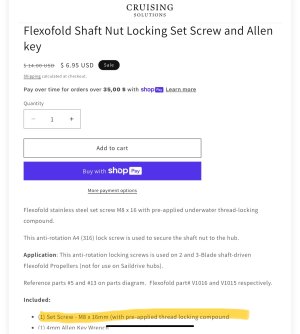
  • Where did I balls this up: Fit a Flexofold propeller - Triola - Albin Ballad #50 ? Following the manufacturer's instructions is clearly not good enough. Note to self, trust yourself more, apply more threadlock (although, note in the documentation from Flexofold, it says "There is an underwater proof thread locker pre-applied on all screws in the installation)".
  • When the prop came off, do we think it would have sheered the key and just unwound itself? viz: The diver will be looking for one prop, not many parts of prop?
  • How does the new owner prevent this happening again when refitting?

Improvements that I can think of:
  • Drill the nut where the locking screw locates so that it can bore into the nut? Or ditch the grub screw and do as Catalina36 suggests and drill right through the sucker?
  • Apply Loctite Blue to the locking screw.
  • Apply Loctite Blue to the prop nut itself.
  • Ensure the tapers are fully degreased and free from contamination.
Shame the old prop wasn't located, as that would have had clues to the nature of the fail.
 
Last edited:


Serves me right for listening to the manufacturer and not my own paranoia :) . Thankfully the new owner is getting a new Flexofold prop sent out

Questions:
  • Where did I balls this up: Fit a Flexofold propeller - Triola - Albin Ballad #50 ? Following the manufacturer's instructions is clearly not good enough. Note to self, trust yourself more, apply more threadlock (although, note in the documentation from Flexofold, it says "There is an underwater proof thread locker pre-applied on all screws in the installation)".
  • When the prop came off, do we think it would have sheered the key and just unwound itself? viz: The diver will be looking for one prop, not many parts of prop?
  • How does the new owner prevent this happening again when refitting?

Improvements that I can think of:
  • Drill the nut where the locking screw locates so that it can bore into the nut? Or ditch the grub screw and do as Catalina36 suggests and drill right through the sucker?
  • Apply Loctite Blue to the locking screw.
  • Apply Loctite Blue to the prop nut itself.
  • Ensure the tapers are fully degreased and free from contamination.
Shame the old prop wasn't located, as that would have had clues to the nature of the fail.
"How does the new owner prevent this happening again when refitting? "

Drill a hole right through etc.
 
He could do as Catalina 36 suggests, but I would have thought drilling a small 'socket' hole in the nut for the grub screw to locate in would be perfectly adequate and rather easier and smarter.

I can't imagine that a grub screw just bearing on an outer circular surface (as I understand you were originally directed to do) would be adequate. Normally the grub screw should take no torque, as that should be transmitted by the taper only, but the whole point of the grub screw seems to me to stop the prop falling off completely if it slips on the taper and drive is lost. If the prop does slip, there will likely be significant pressure on the grub screw, and I think it should locate in a socket, or at least onto the flat of a hexagon.


Serves me right for listening to the manufacturer and not my own paranoia :) . Thankfully the new owner is getting a new Flexofold prop sent out

Questions:
  • Where did I balls this up: Fit a Flexofold propeller - Triola - Albin Ballad #50 ? Following the manufacturer's instructions is clearly not good enough. Note to self, trust yourself more, apply more threadlock (although, note in the documentation from Flexofold, it says "There is an underwater proof thread locker pre-applied on all screws in the installation)".
  • When the prop came off, do we think it would have sheered the key and just unwound itself? viz: The diver will be looking for one prop, not many parts of prop?
  • How does the new owner prevent this happening again when refitting?

Improvements that I can think of:
  • Drill the nut where the locking screw locates so that it can bore into the nut? Or ditch the grub screw and do as Catalina36 suggests and drill right through the sucker?
  • Apply Loctite Blue to the locking screw.
  • Apply Loctite Blue to the prop nut itself.
  • Ensure the tapers are fully degreased and free from contamination.
Shame the old prop wasn't located, as that would have had clues to the nature of the fail.
Stop beating yourself up. It stayed on for 5 years for you. Its like selling a used car, all sorts of things go wrong for the new owner that never caused problems before.
Even if you guaranteed your work, after 5 years all bets are off.
Sam.
 
In support of B Sam's point above...

Several of us have questioned the efficacy of the grubscrew arrangement but also it seems it isn't unique.

If a failure there was common in folding props, wouldn't surveyors know about it and routinely advise it be checked?
 
This winter did I remove my old 3 blade FOF from the shaft.
I read in advance the instructions but when I executed the task did I forget to release the grub screw.
Damaged the surface of the nut.
Asked the prop expert who said it was okay to reuse the big nut.
I used a new grub screw that I got with the 3 new blades I bought.

When mounting the old hub I searched a lot for info blue Loctite Yes/No.

My assumption is the vendor instruction is expecting it is a new hub with a new locking screw.

Suddenly did I find a detailed web page when buying a new screw as a sparepart => I used blue Loctite on locking screw when mounting the hub.
 

Attachments

  • IMG_4342.jpeg
    IMG_4342.jpeg
    246.5 KB · Views: 4
Last edited:
We were sailing in company with another boat many years ago and we berthed first. As the other boat was reversing alongside (Med mooring) I shouted something like "Give her more reverse welly", only to receive the shouted response "This is full reverse welly". The prop had fallen off when he engaged reverse. :(

Sorry I can help but my Flexofolds are fitted to saildrives and there is a tab washer system which, if I recall correctly, would be impossible to undo unless you bend the tabs back.

Richard
Tab washers are one use only, taking them off and re-using them weakens the tabs, as with split pins

In critical applications I simply would not think about it - I'd use Loctite to secure all and anything.

Tab washers and Loctite are hardly expensive

Jonathan

Edit

I'd like to see reasons from members and the manufacturers why using Loctite would be disadvantageous.
 
Top