Looking for Advice: Replacing Outboard Motor on Hunter Formula One Sailboat

Be careful relying on hp “equivalent” figures with electric outboards.
Mathematically/scientifically 1kW is 1.35hp. 1.44kW is 1.9hp.


Sure a good prop and low end torque can make an electric outboard seem good at low speeds. But when things get tough, it can’t beat the physics and both are under 2hp.
Hence for example my ancient 2.5hp two stroke could get our tender planing solo at 6 knots, which an electric “3hp equivalent” never would.

So electric are good for low end torque - but bear in mind the real hp figures, not the marketing “equivalent” ones.
+1 for that. When I was at school 746 watts = 1hp. 🥴
 
(I appreciate the "so called" experts will have you believe things won't float if they're denser than water but that's an issue for the tech people to overcome. 🧑‍🔬)
It doesn’t need an expert to make it less dense than water, just increase the volume and keep the mass the same.

An expert might be handy to make it less of a death trap, than if I tried to knock one up in my cellar
 
Hi Concerto, I hardly dare to ask... However, could you scan the paperwork (anonymized of course) or take some pictures and send them via a personal message. It would be amazing to have this part of history of the boat. And in possible future, if you were to ever consider parting with the physical paperwork please let me know.
Here are the photos you might like.

Formula I brochure 1.JPG
Formula I brochure 2.JPG
Formula I brochure 3.JPG
Formula I brochure 4.JPG
Formula I brochure 5.JPG
Formula I brochure 6.JPG
Formula I brochure 7.JPG
Formula I brochure 8.JPG

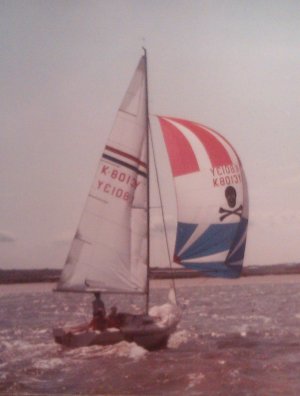
This is Jolly Roger, my Formula 1, under spinnaker in her first race. Sorry it in that clear but it is a digital image of an old photograph. I do have some more photos in an album which is still in a box after moving last year.

Jolly Roger under spinnaker.jpg
 
Be careful relying on hp “equivalent” figures with electric outboards.
Mathematically/scientifically 1kW is 1.35hp. 1.44kW is 1.9hp.

Sure a good prop and low end torque can make an electric outboard seem good at low speeds. But when things get tough, it can’t beat the physics and both are under 2hp.
Hence for example my ancient 2.5hp two stroke could get our tender planing solo at 6 knots, which an electric “3hp equivalent” never would.

So electric are good for low end torque - but bear in mind the real hp figures, not the marketing “equivalent” ones.
Little to do with torque of the motor. It is all to do with the propeller - please read post#29 which explains it in detail. Powering your lightweight inflatable at just about planing speeds is exactly what little petrol outboards with the small fast turning props are designed to do. Completely different from powering a very much heavier boat at displacement speeds as in the OP's case where what is needed is a large slow turning propeller. The amount of HP required is actually very low. I suspect you are old enough to have some experience of Seagull outboards which were excellent at powering displacement boats with very low power output engines simply because of the large slow turning props. As I explained the small electric outboards are almost the same in terms of power output, shaft speed and prop size to the equivalent Seagull engines and produce similar thrust. It is thrust that is required for powering displacement boats, not HP potential of the power source.
 
Tohatsu 2T 3.3hp long shaft?

Mine pushes my Corribee and is a total joy to use and carry around.
I have the Tohatsu 3.5 two-stroke...just looking for a Corribee to put it on. 😄

Crossing the Channel in a small boat with no inboard is something of a conundrum. F3 is likely too little, F5 is likely too much. So F5-6 would likely be a no goer (unless it's behind you) whereas a F3-4 will have you worrying you'll have 16 hours of engine buzz!
I so want a Corribee despite the tiny cabin, even if I'm obliged never to cross the Channel in it...but is it really that poor a performer? I admit, I used to sail rings round them in my dinghy but I always hoped that some sort of long, low gaff rig set-up could increase the sail area without overpowering the shallow bilge keels' ability to keep her reasonably upright. If F3 isn't enough under the standard sloop rig, is she just unfortunately under-canvassed?

I just saw that Tohatsu released the new 6 to 9.9 2-cylinder models with electronic fuel injection and optional electric start. I would guess these got to be the smoothest running, easiest starting small capacity engines on the market today. It's just that they are a bit heavy at about 40 kilo.
Yachtsmen do like to say smallest-is-best for outboards, because as sailors we start out hoping it's only for temporary inshore assistance...slightly delusional. For my next small cruiser I'll deliberately pick a 9.8 four-stroke mounted on a reinforced transom, because if 5hp gives the boat hull speed, a 9.8hp will deliver the same pace at much lower revs, and as I will likely motor often, an unstressed 2-cyl four-stroke will make those miles a pleasure.

Of course, demounting the engine will be an ordeal...once a season at most. I had a Mariner 5hp two-stroke in my Achilles 24 and at only 20kg, I thought it disagreeably heavy, though it really was light.
.
 
Here are the photos you might like.

Formula I brochure 1.JPG
Formula I brochure 2.JPG
Formula I brochure 3.JPG
Formula I brochure 4.JPG
Formula I brochure 5.JPG
Formula I brochure 6.JPG
Formula I brochure 7.JPG
Formula I brochure 8.JPG

This is Jolly Roger, my Formula 1, under spinnaker in her first race. Sorry it in that clear but it is a digital image of an old photograph. I do have some more photos in an album which is still in a box after moving last year.

View attachment 200567
Hi Concerto, Thank you soooo much for taking the time and effort to post this. I really appreciate it, this is so cool to have!

That same spinaker is still with the boat (Although the stiching has had its best time and is letting go)
 
Yachtsmen do like to say smallest-is-best for outboards, because as sailors we start out hoping it's only for temporary inshore assistance...slightly delusional. For my next small cruiser I'll deliberately pick a 9.8 four-stroke mounted on a reinforced transom, because if 5hp gives the boat hull speed, a 9.8hp will deliver the same pace at much lower revs, and as I will likely motor often, an unstressed 2-cyl four-stroke will make those miles a pleasure.
Just a thought on buying a much bigger outboard.

Leaving the unique properties of the Seagull range aside, modern outboards are designed to work at much higher speeds than say a diesel donk . Running them for long periods at low revs is likely to produce problems in the longer term.
 
Hi Concerto, Thank you soooo much for taking the time and effort to post this. I really appreciate it, this is so cool to have!

That same spinaker is still with the boat (Although the stiching has had its best time and is letting go)
It is great to know you have my old boat and you will certainly enjoy sailing her. When I locate some other photos, I will post them for you. If you have not downloaded those files, then please do. Finding the original owner is very rare. When I had my 1980 Westerly Fulmar as the Westerly Owners Association boat at the Southampton Boat Show in 2021, the daughter of the original owner was shocked to see Concerto at the show and the excellent condition she is in. She was able to supply a few photographs from when they owned it, but would not let me have the original invoice so photographed it for me to complete the full record of ownership from new. If you follow the link in my signature you will find a video of my boat at the show plus many other links to presentations and videos.
 
Just a thought on buying a much bigger outboard.

Leaving the unique properties of the Seagull range aside, modern outboards are designed to work at much higher speeds than say a diesel donk . Running them for long periods at low revs is likely to produce problems in the longer term.
Modern 4 stroke outboards are happy running at low revs but like any engine do need to be 'run in' at variable revs and power load to start with. I've happily run my Honda 30 at 2000 rpm for many hours.
 
It is great to know you have my old boat and you will certainly enjoy sailing her. When I locate some other photos, I will post them for you. If you have not downloaded those files, then please do. Finding the original owner is very rare. When I had my 1980 Westerly Fulmar as the Westerly Owners Association boat at the Southampton Boat Show in 2021, the daughter of the original owner was shocked to see Concerto at the show and the excellent condition she is in. She was able to supply a few photographs from when they owned it, but would not let me have the original invoice so photographed it for me to complete the full record of ownership from new. If you follow the link in my signature you will find a video of my boat at the show plus many other links to presentations and videos.
Sailing her is indeed a joy and everyone who goes along is always pleasantly surprised. I have immediately saved everything onto my hard drive next to the review and manual posted by @ridgy . I consider myself very lucky to have come across this forum with all of you on here. Just watched your video on the Westerly, looking indeed brand new.

I have been contemplating doing something similar to the F1. Sanding and polishing is unfortunalty not possible as the gelcoat is getting thin at some points and a little cracked so to get it looking like new it would be a full sand, primer/filler and 2 component colour coat. First things first though as at present from about 5 meters away freshly washed she still looks quite smart, painting is not on the top of my list just yet.
 
Yachtsmen do like to say smallest-is-best for outboards, because as sailors we start out hoping it's only for temporary inshore assistance...slightly delusional. For my next small cruiser I'll deliberately pick a 9.8 four-stroke mounted on a reinforced transom, because if 5hp gives the boat hull speed, a 9.8hp will deliver the same pace at much lower revs, and as I will likely motor often, an unstressed 2-cyl four-stroke will make those miles a pleasure.

Of course, demounting the engine will be an ordeal...once a season at most. I had a Mariner 5hp two-stroke in my Achilles 24 and at only 20kg, I thought it disagreeably heavy, though it really was light.
.
They say that for very good reasons. A 9.8hp on a Corribee is just wrong. Totally unnecessary when the maximum it was designed for is 5hp. The boat's speed is limited to about 5.5 knots because of its waterline length and this is achieved with less than 3hp. The big constraint with boats like that is that the outboard is mounted on the end of a long counter and really only suitable for use in relatively calm waters because the propeller cannot be kept deep enough. Even worse if you hand an even heavier motor on the back.

If you plan doing a lot of motoring then buy a boat that is more suitable for that kind of use. It is difficult to achieve good motoring with an outboard on a sailing boat although some designs with wells in the cockpit are reasonable. Inevitably though such boats are usually larger than a Corribee. An inboard diesel is the way to go if you want good motoring performance, but again rare in boats that small.
 
Last edited:
Just a thought on buying a much bigger outboard.

Leaving the unique properties of the Seagull range aside, modern outboards are designed to work at much higher speeds than say a diesel donk . Running them for long periods at low revs is likely to produce problems in the longer term.
It is not just Seagulls. There are a number of high thrust outboards made that use the same slow turning large diameter concept, although not in the sub 5hp where the demand would be very low. However the "normal" small outboards, particularly the newer 4 strokes are a reasonable compromise for most small yachts. electric is of course better if you can cope with the range issue (and the cost of course!)
 
So for a Formula One is the Suzuki 6hp with remote tank at 24 kilo, about two thirds the weight of a 9.9 so easily liftable and said to be quiet, a good choice or is there a catch
 
They say that for very good reasons. A 9.8hp on a Corribee is just wrong. Totally unnecessary when the maximum it was designed for is 5hp. The boat's speed is limited to about 5.5 knots because of its waterline length and this is achieved with less than 3hp. The big constraint with boats like that is that the outboard is mounted on the end of a long counter and really only suitable for use in relatively calm waters because the propeller cannot be kept deep enough. Even worse if you hand an even heavier motor on the back.
All you say, I already knew well from long hours reading here and elsewhere. I am thinking of wilfully defying the popularity of running a noisy lightweight engine that assumes I'll switch off and get sails up as soon as possible. On a good day I might do that, but I don't want to feel obliged to sail just because running the engine is disagreeable.

I'm much more likely to back away from the 9.8hp idea, not because it's bigger than it needs to be, but because it may not be as quiet as I'm hoping. I was thinking a two-cylinder 10hp will give a Corribee hull speed at under 2,500 rpm. I'm not kidding myself the hull will go faster driven by 10hp; I just want adequate performance (and effortless worry-free range) without the usual accompanying racket.

I had an Achilles 24 with an engine well, and I didn't like it much. For decent sailing it required the hefty engine's removal from the well, stowing below the cockpit floor, and the well's plugging (and total readiness to reverse that process at any time the engine even might be needed). Definitely not my preferred situation, although I admired the alternative concept. Nor was I alone in not liking the engine in the Achilles' well...

54847214608_4f06a1e0e8_z.jpg


...that chap had added a bracket to an Achilles 24 for what I believed at the time was an absurdly overweight, overpowered motor. Having actually owned an A24, I know I'd have liked that arrangement far better myself. It may be far from ideal, but not as far as the alternative the designer picked.

I haven't bought a Corribee, and I may still not...I certainly could have picked up a clean example cheaply and close to home nine years ago, and declined the opportunity for separate reasons. I sometimes wonder if I would still have her, had I bought that one. 🤔
.
 
It is not just Seagulls. There are a number of high thrust outboards made that use the same slow turning large diameter concept, although not in the sub 5hp where the demand would be very low. However the "normal" small outboards, particularly the newer 4 strokes are a reasonable compromise for most small yachts. electric is of course better if you can cope with the range issue (and the cost of course!)
In the 5hp range the only offer I am aware of available with a high thrust prop is the Tohatsu 6hp sailpro.
 
I like the look of the Tohatsu 6 Sailpro. Did they actually reduce the final gearing, or is it just an alternative prop, beefier alternator and sailor-bait decals?
 
With all tips, comments, experience and suggestions shared for my situation I am going to take the leap and go for a Haswing protuar 3.0 trolling motor in combination with a Litime 24V 100ah Bluetooth battery. range should be about 1,5 hrs full throttle operation or 3 hours of half throttle. That should be enough for my use case and if not a second battery can easily be fitted. 2 batteries and motor would then come pretty close to the 1500 euro budget I initially set.

The above would mean 10 kg on the transom and another 21 to 42 kg below the cockpit floor, can't ask for much better weight distribution then that.

I want to thank all and will post and share on my findings in the new season!
 
I like the look of the Tohatsu 6 Sailpro. Did they actually reduce the final gearing, or is it just an alternative prop, beefier alternator and sailor-bait decals?
I believe all the sailpro version adds is a Micky mouse ears high thrust prop, addition of a alternator spool and regulator (other models don't have this at all) and the option to go for a ultra long shaft (also not offered for the regular models) the prop is differently pitched thus gearing does not need to change.
 
Top