Looking for Advice: Replacing Outboard Motor on Hunter Formula One Sailboat

I bought a Hunter Formula 1 new in 1983. I had a 4.5 Hp long shaft 2 stroke outboard with a separate fuel tank. That what was recommended and it worked well. I would use this information to revise your idea of what you need to buy.
Hi Concerto, thanks for pitching in! The Hunter mentioned was your old one to be exact.
 
That thought crossed my mind too. I do have a tendency to go a bit overboard with these things—already pictured myself crossing the Channel to the UK, justifying a 6hp Tohatsu with grand sea adventures. Realistically though, my sailing will be limited to inland lakes for the foreseeable future. A smaller engine would free up budget for other upgrades like a rodkicker, mast track, new sails, or even an autopilot—the list is endless.

Still, the 600 euro difference for the bigger engine isn’t a dealbreaker. So now I’m trying to find a more rational reason to go with a smaller or electric motor—something that would work just as well and help avoid an overkill purchase.

Hmmmm. I'm a strong vote for the lightest engine you can get away with *but* refueling is a PITA - so if you plan to go further afield the facility for an external fueltank is a god send. Even for short trips refuelling roulette can be a pain.

Crossing the channel in a small boat with no inboard is something of a conundrum. You really want enough wind to sail all the way but you really don't want a lumpy sea state in a tiny boat. F3 is likely too little, F5 is likely too much. So F5-6 would likely be a no goer (unless it's behind you) whereas a F3-4 will have you worrying you'll have 16 hours of engine buzz! That's a wafer thin range! Let me know if you find a solution, I never have.
 
Hmmmm. I'm a strong vote for the lightest engine you can get away with *but* refueling is a PITA - so if you plan to go further afield the facility for an external fueltank is a god send. Even for short trips refuelling roulette can be a pain.

Crossing the channel in a small boat with no inboard is something of a conundrum. You really want enough wind to sail all the way but you really don't want a lumpy sea state in a tiny boat. F3 is likely too little, F5 is likely too much. So F5-6 would likely be a no goer (unless it's behind you) whereas a F3-4 will have you worrying you'll have 16 hours of engine buzz! That's a wafer thin range! Let me know if you find a solution, I never have.
An external tank would definitely be handy—at least 12 hours of continuous operation without needing to refuel.

As for wind conditions, the Hunter Formula One has an almost absurd amount of sail area combined with a lightweight and sleek hull. With full main and genoa, she hits around 4 knots in Force 2. I usually start reefing around Force 3 to 4, as she gets overpowered quickly. Since I sail solo, I prioritize comfort over speed or thrills for now. Even reefed down with just the jib, she still manages 5 to 6 knots. In Force 5 to 6, I drop the jib and sail under a double-reefed main, still doing 5 to 6 knots boat speed.

I will probably get roasted for sailing this little racer with so little courage but I highly enjoy reaching big boat speeds in my little Hunter whilst still being fully in control and at ease.
 
An external tank would definitely be handy—at least 12 hours of continuous operation without needing to refuel.


Even on a 40 minute jaunt up a harbour, if you're among moorings it's not always convenient to drift and refill and there's often a sense of taking a punt on a total loss of power at an inconvenient moment. My bias is always towards a lighter engine but the advantage of an external fuel tank should not be ignored! (As I'm sure you know!)


As for wind conditions, the Hunter Formula One has an almost absurd amount of sail area combined with a lightweight and sleek hull. With full main and genoa, she hits around 4 knots in Force 2. I usually start reefing around Force 3 to 4, as she gets overpowered quickly. Since I sail solo, I prioritize comfort over speed or thrills for now. Even reefed down with just the jib, she still manages 5 to 6 kn

That's the solution I hadn't considered - have a boat that sails well rather than a sluggish bilge keeler. I may try it one day!
 
You don't size your OB for deaf flat dead calm on a lake. And the range of the electric would be too short.

What if the wind blows up unexpected shock horror that happens. What if the wind dies completely and you are 10NM from the harbour. Will the electric OB have the range to get you back?

I would choose a 4HP 4 stroke for that, probably Tohatsu. The smaller ones even if enough power, rarely have reverse gear, if any gears at all.
 
So what is the smallest 4 stroke motor which can have a remote tank now - essential really.

And which is the quietest 4 stroke in the sub 10hp range now they are mainly single cylinder and seem to be noisier than my 9.9hp 4 stroke - if I am thinking of a smaller engine which is easier to lift, but don't want to hear it when I put the lid down on the locker?
 
So what is the smallest 4 stroke motor which can have a remote tank now - essential really.

And which is the quietest 4 stroke in the sub 10hp range now they are mainly single cylinder and seem to be noisier than my 9.9hp 4 stroke - if I am thinking of a smaller engine which is easier to lift, but don't want to hear it when I put the lid down on the locker?
The 4 to 6hp single cylinders are the smallest with a remote tank.

In just saw that Tohatsu released the new 6 to 9.9 2 cilinder models with electronic fuel injection and optional electric start. I would guess these got to be the smoothest running, easiest starting small capacity engines on the market today. It's just that they are a bit heavy at about 40 kilo. But the 6hp electric start long shaft is 2250 euros and whilst expensive compared to the single it is a nice machine for the money. With 12 liter remote tank included.
 
It comes back to what you are equipping her for. For your original in and out of the marina and getting home when the wind stops 2hp or electric equivalent is absolutely fine. If you are changing the specification to salty seadog adventures singlehanding across the north sea , then more grunt and a remote tank would be better. Nothing to stop you having both and fitting the appropriate one
 
I agree—my current 4hp does the job well. The thing is, the Tohatsu 4 to 6hp models are essentially the same engine. But only the 6hp version comes with a high-thrust prop, extra-long shaft (which helps with cavitation issues in choppy water), and a charging alternator for the batteries. Given that the price difference is minimal, the 4hp doesn’t seem all that compelling.

Stowing the motor inside the boat when not in use is definitely preferable—out of sight, out of mind (and out of reach for thieves). The lighter the motor, the easier that becomes.

As for charging, I’d rely on shore power.
Horse power is a poor measure of suitability for powering small displacement boats. It is the propeller that moves the boat and the best type of propeller is large diameter flat pitch 3 blade - exactly what electric motors. Electric outboards usually have shaft speeds of around 1100rpm maximum compared with petrol outboards of over twice that. The Haswing has a 10" propeller. A Petrol 2.5 or 3.5 will be limited to a maximum of 7" and a 4hp to 9".

Thrust is the key measure, not HP of the engine driving the propeller. Petrol engine manufacturers do not publish thrust figure because it would not show their engines in good light for displacement boats. Electric makers always use thrust with a "equivalent" HP and as you see the equivalent is between 2 and 3 times the nominal output of the motor. For example This is probably the smallest Haswing that will suit your boat
haswingmotors.co.uk/wp-content/uploads/2023/05/Protruar-2.0-12V_Spec_EN.pdf roughly equivalent to the Suzuki 2.5. Its rated output of 720W is roughly 1hp but the thrust at 85lbs I would estimate as probably 30lbs higher. In another life many years ago I worked for an outboard maker and campaigned to get thrust adopted as a standard measure but was unsuccessful. Our outboards were all high thrust as a result of our low shaft speeds and therefore well suited to small displacement boats. Our recommendation for your boat would have been a 3.5hp equivalent with an 11" propeller and a shaft speed of 1200. Thrust was measured at 80lbs. The actual engine produced nowhere near 3.5hp! It would not be a good recommendation today as it was a rather horrid engine to use - although there are many who still love them.

Hence my suggestion to go electric Ideal for your use, but you will need to consider range. A 100Ah lithium will give you probably 2-3 hours which seems more than enough for your typical day sails. Of course as others have pointed out if you want to go cruising and be more independent , spending nights away at anchor and rely on the engine to get you back if you can't sail then petrol starts to come into the frame. However you have a good sailing boat that just needs a bit of help getting out to where you c an sail then back again and electric is perfect for this.
 
Which modern 4 stroke motors in the sub 10hp range can you easily access and change the jet - if it gets blocked - on the transom out at sea - that used to be mother's job with nimble fingers - shocked it is not so easy with many of the smaller motors - some needs a major strip down to access carburettor bowl.
 
Last edited:
Horse power is a poor measure of suitability for powering small displacement boats. It is the propeller that moves the boat and the best type of propeller is large diameter flat pitch 3 blade - exactly what electric motors. Electric outboards usually have shaft speeds of around 1100rpm maximum compared with petrol outboards of over twice that. The Haswing has a 10" propeller. A Petrol 2.5 or 3.5 will be limited to a maximum of 7" and a 4hp to 9".

Thrust is the key measure, not HP of the engine driving the propeller. Petrol engine manufacturers do not publish thrust figure because it would not show their engines in good light for displacement boats. Electric makers always use thrust with a "equivalent" HP and as you see the equivalent is between 2 and 3 times the nominal output of the motor. For example This is probably the smallest Haswing that will suit your boat
haswingmotors.co.uk/wp-content/uploads/2023/05/Protruar-2.0-12V_Spec_EN.pdf roughly equivalent to the Suzuki 2.5. Its rated output of 720W is roughly 1hp but the thrust at 85lbs I would estimate as probably 30lbs higher. In another life many years ago I worked for an outboard maker and campaigned to get thrust adopted as a standard measure but was unsuccessful. Our outboards were all high thrust as a result of our low shaft speeds and therefore well suited to small displacement boats. Our recommendation for your boat would have been a 3.5hp equivalent with an 11" propeller and a shaft speed of 1200. Thrust was measured at 80lbs. The actual engine produced nowhere near 3.5hp! It would not be a good recommendation today as it was a rather horrid engine to use - although there are many who still love them.

Hence my suggestion to go electric Ideal for your use, but you will need to consider range. A 100Ah lithium will give you probably 2-3 hours which seems more than enough for your typical day sails. Of course as others have pointed out if you want to go cruising and be more independent , spending nights away at anchor and rely on the engine to get you back if you can't sail then petrol starts to come into the frame. However you have a good sailing boat that just needs a bit of help getting out to where you c an sail then back again and electric is perfect for this.
Thanks for you elaborate reply and professional experience, much appreciated! This is something I suspected to be happening with the thrust numbers indeed not shared on petrol engines and most standard props seemingly being rated for planing inflatables instead of displacement boats with a 5 or 6 knots hull speed.

As @oldbloke said, nothing stopping me to go for the electric experiment now and buy petrol later on if I feel like I need it for bigger adventures.
 
Next question - which modern 4 stroke motors in the sub 10hp range can you easily access and change the jet - if it gets blocked - on the transom out at sea - that used to be mother's job with nimble fingers - shocked it is not so easy with many of the smaller motors.
Well with the fuel injected models you won't have to worry about blocked jets as fuel is forced through them with the high pressure of the fuel pump. One of the main advantages of fuel injection is no more dirty carbs and blocked jets.
 
I also have an F1 in the fleet and for sea usage I have an old Yamaha 5hp 2 stroke which is quite adequate and 20kg. Sometimes I use it on a reservoir where petrol outboards are not permitted and have a cheap bison trolling motor which is also fine for the purpose.

I also happen to own a tohatsu 6hp 4 stroke for my catamaran and there is no way I would put that on the F1, too heavy.

Give a trolling motor a go.and see how you get on. Always useful as a spare if you end up with an outboard and much easier to get on and off the stern.
 
Horse power is a poor measure of suitability for powering small displacement boats. It is the propeller that moves the boat and the best type of propeller is large diameter flat pitch 3 blade - exactly what electric motors. Electric outboards usually have shaft speeds of around 1100rpm maximum compared with petrol outboards of over twice that. The Haswing has a 10" propeller. A Petrol 2.5 or 3.5 will be limited to a maximum of 7" and a 4hp to 9".

Thrust is the key measure, not HP of the engine driving the propeller. Petrol engine manufacturers do not publish thrust figure because it would not show their engines in good light for displacement boats. Electric makers always use thrust with a "equivalent" HP and as you see the equivalent is between 2 and 3 times the nominal output of the motor. For example This is probably the smallest Haswing that will suit your boat
haswingmotors.co.uk/wp-content/uploads/2023/05/Protruar-2.0-12V_Spec_EN.pdf roughly equivalent to the Suzuki 2.5. Its rated output of 720W is roughly 1hp but the thrust at 85lbs I would estimate as probably 30lbs higher. In another life many years ago I worked for an outboard maker and campaigned to get thrust adopted as a standard measure but was unsuccessful. Our outboards were all high thrust as a result of our low shaft speeds and therefore well suited to small displacement boats. Our recommendation for your boat would have been a 3.5hp equivalent with an 11" propeller and a shaft speed of 1200. Thrust was measured at 80lbs. The actual engine produced nowhere near 3.5hp! It would not be a good recommendation today as it was a rather horrid engine to use - although there are many who still love them.

Hence my suggestion to go electric Ideal for your use, but you will need to consider range. A 100Ah lithium will give you probably 2-3 hours which seems more than enough for your typical day sails. Of course as others have pointed out if you want to go cruising and be more independent , spending nights away at anchor and rely on the engine to get you back if you can't sail then petrol starts to come into the frame. However you have a good sailing boat that just needs a bit of help getting out to where you c an sail then back again and electric is perfect for this.

These are very good points.

My 5hp 2T Mariner has external fuel tank, reverse gear and a high thrust metal propellor. (Which wasn't cheap!)

None of those are available on my 3.3 2T Tohatsu.

As it happens I can manage without but they are all undeniably useful.
 
Hi Concerto, thanks for pitching in! The Hunter mentioned was your old one to be exact.
Yes. Sold that boat in 1987. I just checked the original paperwork I still have, which includes the original brochure, specification, coy of the order, delivery sheet, and my selling specification.

If you intend to cross the Channel, I would only suggest force 4 and below. The reason in strong winds the Formula 1 can go so fast plow into a wave and sink. That is why most are now only sailed on inland waters
 
Last edited:
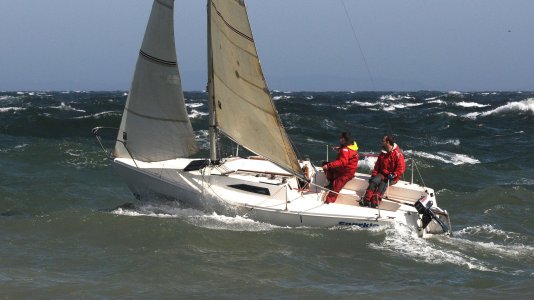
Oh I don't know,.this is my F1s previous owner doing the round Isle of Man race in some hefty conditions. They also sailed there and back from Morecambe bay. Bravely carrying full main in what must be 20 knots but luffing like crazy.
The outboard is the old 5hp 2 stroke Yamaha that I referred to earlier.
 

Attachments

  • cor03.jpg
    cor03.jpg
    410.2 KB · Views: 20
Last edited:
Yes. Sold that boat in 1987. I just checked the original paperwork I still have, which includes the original brochure, specification, coy of the order, delivery sheet, and my selling specification.

If you intend to cross the Channel, I would only suggest force 4 and below. The reason in strong winds the Formula 1 can go so fast plow into a wave and sink. That is why most are now only sailed on inland waters
Hi Concerto, I hardly dare to ask... However, could you scan the paperwork (anonymized of course) or take some pictures and send them via a personal message. It would be amazing to have this part of history of the boat. And in possible future, if you were to ever consider parting with the physical paperwork please let me know.

Crossing the Channel is still some time and experience away (when it comes to small sailboats that is). First I want to get the boat completely sorted and kitted out and building my experience with some fair weather coastal hops on the Dutch and Belgium waters and a force 4 would be the maximum I would feel comfortable to do so at this stage indeed.
 
Oh I don't know,.this is my F1s previous owner doing the round Isle of Man race in some hefty conditions. They also sailed there and back from Morecambe bay. Bravely carrying full main in what must be 20 knots but luffing like crazy.
The outboard is the old 5hp 2 stroke Yamaha that I referred to earlier.
That's an amazing picture of a F1 with 2 seemingly very capable sailors in those kind of seas. Still lots of training and practice away before I would consider to go out in those conditions.
 
That's an amazing picture of a F1 with 2 seemingly very capable sailors in those kind of seas. Still lots of training and practice away before I would consider to go out in those conditions.
To fair they did end up retiring to Peel having got half way round after conditions continued to worsen to NE7 and they got flattened afew times. Someone got a message to them that coming round the bottom of the island probably wouldn't end well.

Here's a better picture 😁

I have the F1 manual somewhere, I've posted a pdf on here before if you search for F1 related posts.
 
To fair they did end up retiring to Peel having got half way round after conditions continued to worsen to NE7 and they got flattened afew times. Someone got a message to them that coming round the bottom of the island probably wouldn't end well.

Here's a better picture 😁

I have the F1 manual somewhere, I've posted a pdf on here before if you search for F1 related posts.
I don't blame them at all for retiring, it did make for nice pictures though. The manual you indeed posted in a previous thread (Hunter Formula One experiences please!) Thanks again!
 
Top