Longer term crusing and internet access to earn a crust

Any nice "marine home-office" pics to let the mind wander?

Thoughts that jump to mind:
1. With all the video conferencing going on I imagine the need for having concurrent calls. Maybe make sure the cabin has space to sit.
2. Heat of summer might make working on board miserable (in warmer climes...)
3. Where would the 32 footer fall short? Curious because I'd hope this would be feasible (pre-kids) on something in the 35ft range!

Great idea...
 
Any nice "marine home-office" pics to let the mind wander?

Thoughts that jump to mind:
1. With all the video conferencing going on I imagine the need for having concurrent calls. Maybe make sure the cabin has space to sit.
2. Heat of summer might make working on board miserable (in warmer climes...)
3. Where would the 32 footer fall short? Curious because I'd hope this would be feasible (pre-kids) on something in the 35ft range!

Great idea...

We're looking at doing this with a 36 ft. The forepeak would become the office with a pull out table so that I can get away from the kids

I don't personally believe that video conferencing is going to be such a big requirement in the future, but online collaborative tools will be. Think about 3 people sitting around a table discussing something on paper or on a whiteboard.. how would you do that online?
 
We're looking at doing this with a 36 ft. The forepeak would become the office with a pull out table so that I can get away from the kids

I don't personally believe that video conferencing is going to be such a big requirement in the future, but online collaborative tools will be. Think about 3 people sitting around a table discussing something on paper or on a whiteboard.. how would you do that online?
Zoom allows it, as do other video conferencing systems.
 
Think about 3 people sitting around a table discussing something on paper or on a whiteboard.. how would you do that online?

Video conference + Google/MS Doc is the conventional approach. There are white boarding apps but I can't comment on how effective they are. A lot is sacrificed to avoid being colocated, that is certain.

I've worked with distributed teams for a few years and the above approach works, but requires pretty stable internet connection. A lot of it relates to the company culture, with varying levels of productivity depending on what is mandated by the leadership team.

This article from the CEO of Wordpress is quite insightful regarding the varying levels of distributed work, skewed to tech.
 
Any nice "marine home-office" pics to let the mind wander?

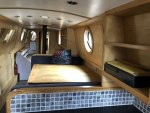
A floating one at least. New boat has a ..smaller dinette but they are fine for laptop & a bit of electronics. On winter pontoon I will use cafes. Also I can't believe that bloody broker used a picture with the bloody binbag on the seat.

valhalla-58ft-trad-built-2006-reeves-kate-boats-2006-for-sale-east-midlands-nottingham-notting...jpg
 
Last edited:
Zoom allows it, as do other video conferencing systems.

Zoom allows as poor representation of this scenario, as do many other systems, but none replace the physical and social dynamics of being able to turn a piece of paper around.. or 3 people trying to discuss something easily.

It's also not as easy as turning to the person next to you and sketching something... the system has to be logged into... enabled... the technology is not yet at a place where it is instantaneous and fluid in the way that human interaction is.
 
Zoom allows as poor representation of this scenario, as do many other systems, but none replace the physical and social dynamics of being able to turn a piece of paper around.. or 3 people trying to discuss something easily.

Having spent a few years failing to introduce programmer like tooling to the production of medical guidance (plain text, version control, automatic validation) I came to the conclusion that we ..think very differently about how to do this. Most of our tooling originated on primitive networks where this was the only possible way of doing things.

A visualisation of changes to the linux kernel source code. Very few of these people are in the same room and this is one of the most complex artefacts created by mankind where a misplaced '*' could cause untold chaos.

 
Last edited:
Having spent a few years failing to introduce programmer like tooling to the production of medical guidance (plain text, version control, automatic validation) I came to the conclusion that we ..think very differently about how to do this. Most of our tooling originated on primitive networks where this was the only possible way of doing things.

A visualisation of changes to the linux kernel source code. Very few of these people are in the same room and this is one of the most complex artefacts created by mankind where a misplaced '*' could cause untold chaos.


As I programmer I completely understand this perspective, but there are some industries where this approach doesn't work as effectively with the technology we currently have.

We are constantly trying to find ways to enable people to move away from traditional workflows or find ways that technology can enhance those workflows, but it's not always as simple as it seems.
 
We are constantly trying to find ways to enable people to move away from traditional workflows or find ways that technology can enhance those workflows, but it's not always as simple as it seems.

For sure, the backend for this is mostly driven by a semantic markdown. Originally the tooling I designed was also all git based (so it could also easily track provenance, an important part this sort of stuff), reasonable concessions to normal humans by using web tooling on top etc. Incredible levels of user (mostly middle management user) resistance to that. The markdown still drives everything but the workflow had to be very different, breaking the provenance stuff which was still being done with giant excel spreadsheets last time I asked. Users.
 
Zoom allows as poor representation of this scenario, as do many other systems, but none replace the physical and social dynamics of being able to turn a piece of paper around.. or 3 people trying to discuss something easily.

I've just come out of a two hour meeting of eight people using Teams, which is really rather good for a MS product. Unlike Skype for Business, which we used before, it allows multiple people to talk at once, which allows much more natural discussion than the who-shouts-loudest-gets-the-audio model.
 
I've just come out of a two hour meeting of eight people using Teams, which is really rather good for a MS product. Unlike Skype for Business, which we used before, it allows multiple people to talk at once, which allows much more natural discussion than the who-shouts-loudest-gets-the-audio model.

I'm going to sound like a luddite soon, but I can assure you that is far from the truth!

One of the issues surrounding these sorts of meetings is the way we are designed as humans. We can turn our heads to face another person and our ears focus on what that person is saying, but we are still aware of what the other people around us are saying

Whilst teams is an improvement, we are still a way off from a natural environment.

AR of some sort would enhance this as it would be possible to detect who we were looking at and dim all other speakers apart from them.
 
I'm going to sound like a luddite soon, but I can assure you that is far from the truth!

One of the issues surrounding these sorts of meetings is the way we are designed as humans. We can turn our heads to face another person and our ears focus on what that person is saying, but we are still aware of what the other people around us are saying

Whilst teams is an improvement, we are still a way off from a natural environment.

AR of some sort would enhance this as it would be possible to detect who we were looking at and dim all other speakers apart from them.
My experience of using various remote conferencing techniques is that whatever the medium (and I've used voice-only conference calls mostly!), there needs to be a strong chairperson, and that normal committee rules should be used - that is, people speak when invited to do so by the chair, etc. The additional rule for voice only conferences is that people identify themselves each time they speak. Even things like Zoom can break down when several people attempt to speak at once. It isn't and can't be as spontaneous as a face-to-face meeting, but with the right rules and chairing, it can be very productive in a different manner.

We've been using Zoom for church services recently, and it works fine in a structured environment like that. But if several people try and speak at once, it breaks down very easily.
 
I guess from the OP's perspective, a silver lining to this Covid 19 crisis will be progress in what's possible as regards working from home (or yacht), both in people's acceptance of the idea and also in improvements to the technologies available as experience learned filters down.
 
I guess from the OP's perspective, a silver lining to this Covid 19 crisis will be progress in what's possible as regards working from home (or yacht), both in people's acceptance of the idea and also in improvements to the technologies available as experience learned filters down.

This is a hope yes. I was already reasonably set up for remote work, but nothing lasts forever. Unless I am stupid enough to try another startup I would rather earn less than an office based role and be able to cruise. Also have a friend who lives in Bulgaria who tends to bait and switch his clients by coming back to the UK, being useful and then negotiating full remote. Great for people with young children, better for the environment, reduces stupid house price pressure in cities etc etc. Government would be insane not to point this out when it's all over.
 
I'm going to sound like a luddite soon, but I can assure you that is far from the truth!
I'm betting against co-location as a requirement for productivity over the next decade. Our workflows will adapt, and the notion of working on a boat will be a newly reasonable compromise. The lockdown will bring the future forward. New technology will emerge to fulfil the need.

I guess from the OP's perspective, a silver lining to this Covid 19 crisis will be progress in what's possible as regards working from home (or yacht), both in people's acceptance of the idea and also in improvements to the technologies available as experience learned filters down.

Certainly captures what is interesting about this thread.
 
deffo to a printer - sometimes we have to post the odd letter as still some organisations think a wet signature has meaning (but very few of them thankfully). But it helps to have printed matter to tick and look at when doing something complicated.......and the hourly rates mean that printing makes sense as the marginal cost is peanuts compared with the lost time and efficiency of not being able to put a little red tick somewhere
If youre going to hotter places, look for a small laser printer. The ink in an inkjet dries quickly in the Med, I used to wrap the cartridges in cling film between uses till I changed to laser. Many things are being superseded by apps, flight check ins for example, but sometimes theres no substitute for paper and being self sufficient takes much of the angst away.

Also echoing others views, between 2011 and 2018 mostly in the Med the wifi extender rarely came out after the change enabling mobile contracts to cross borders in the EU and elsewhere.
 
We've been using Zoom for church services recently, and it works fine in a structured environment like that. But if several people try and speak at once, it breaks down very easily.
I'm running a film club every week by Zoom, and you're right about multiple speakers. The issue seems to be that Zoom only gives the loudest audio, so if more than one person speaks at once the sound moves between them, which makes it very hard to have a smooth discussion. The merged audio on Teams is more natural and allows turn taking to be easier without constant chair's intervention. On the other hand, the gallery view in Zoom is lovely.

Have you seen this, by the way?

 
I'm betting against co-location as a requirement for productivity over the next decade. Our workflows will adapt, and the notion of working on a boat will be a newly reasonable compromise. The lockdown will bring the future forward. New technology will emerge to fulfil the need.
I've been working at home unofficially for twenty years and officially for five. The big change I am seeing now is from systems which reasonably let one or two remote people join a physical meeting (Skype for business is OK at that) to systems which work well when everybody is online. Previously systems for that have been very clunky (Blackboard, Adobe Connect) but the new generation is much easier to use, in all senses.
 
Top