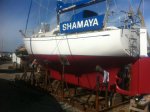
Long Keeler going astern

It would have been nice if I had a quick removable bow thruster that drops at one side near the bow and then lift up and pack away; but I don't and there is none in the market.

In one of John Goode's three books "Handling under power" there are some photos of a long keeled boat with a propellor on the quarter being turned in a marina by a crewmember on the bow using a long oar.

My Old Guvnor did not respond well to my suggestion that she might try it.
 
I have heard it said that the rudder size on this particular boat is small so I am tempted to add a bit more area. This can be a long term experiment as the boat only comes out of the water for two weeks in the summer. .

As has been said, enlarging the rudder is a bad idea. You only use small rudder movements (angle) going astern otherwise it acts as a brake. So to overcome this you then have to use more throttle which means more prop walk: quite possibly exactly what you don't need. An even larger rudder will exacerbate this.

Once the wind picks up, long keelers are at no more a disadvantage than any other vessel. In fact the long keel can be an advantage in some cases.
 
>Forget ALL the above ...... just get bigger fenders!

Indeed. We had six fenders each side but it doesn't always work. We were slowly approaching the holding pontoon (for clearing in) in Lagos marina with a 35 knot wind blowing us on the pontoon. We hit the pontoon hard the fenders popped up and the paintwork was scraped. A sailing school yacht came in and the same happened, then a Dutch cruising boat arrived and the same happened. At least that made us happy that there was nothing else we could have done. Cross winds are kin nightmare.
 
i have the same problem, when going astern. better result with following - once the boat move astern, the engine is put on neutral and steer only with rudder! once the rudder is not affective, correct the direction with short kick with engine ahead and tiller in the direction, where i like the stern to go! if the speed drop a lot, engage again the engine astern and repeat the above! the result is better with more speed astern !
 
The more information I get the more I feel its time to change the boat! Well, no not really I like the boat and have suffered the problem for a number of years having tried most of the suggestions .. including getting more and bigger fenders! To compound the problem I have to go through a lock to get out to sea. So using the bucket or a bow weight is a non starter. Going out means mooring to starboard in the lock, the boat bow veers to starboard when going astern so helps moor up. Coming back in is the big gamble, if there are no other boats in the lock we have a chance to get it right mooring to port. If there are other boats in already with a tail wind and we have to moor alongside this can be when things get out of hand! I'm sure you are already getting a mental picture of the situation and big grins are forming!

I have considered fitting a bow thruster but this means a negative effect on the sailing performance with the loss of 'bite' on the bow. Would be interested to hear opinions from anyone who has gone this route.

For now I think that in view of the comments I will stick to the current rudder. The boat has been sailed round Ireland and the West coast of Scotland then out to Brittany. The designer must have got something right!
 
...... I have considered fitting a bow thruster but this means a negative effect on the sailing performance with the loss of 'bite' on the bow. Would be interested to hear opinions from anyone who has gone this route. .....

I don't have one fitted but have looked into it for my Rival and I have sailed a few boats with them fitted, the last being a Bavaria 45 Cruiser. The position of the tunnel and the area lost will have negligible impact on "bite" (the vast majority of "bite" comes from the fin anyway). There is a loss of performance but the amount is entirely dependent on the tunnel fairings. If the tunnel has no fairing on the hull immediately forward of the tube, then the turbulence is significant with the associated drop in performance; if the fairing profile is large enough then the turbulence is at a minimum and the loss in performance is not that much. A good installer will know this.

There is this external mounted thruster http://www.yachtthruster.com/advantages which claims to have less than 0.05% loss in power, the same as a folding propellor according to their tests. Of course being external it has aesthetic as well as potential failure from collision risks. Its worth a consideration if you are going down this road.
 
The concept of running the engine while tied to the dock is to get a general water flow around the boat. Hence when you start to move, the rudder will have more effect in comparison to the prop walk. I like the idea of using an electric outboard on the stern. It could be set up just to counter the prop walk, so could be mounted at the side of the stern. You would need lots of hands to handle everything simultaneously though. Thinks,... maybe a cable connection to link the boat throttle with the outboard throttle... This is like the tail rotor of a helicopter.
 
Last edited:
Yes there is a solution. When going astern don't keep power on blip the throttle and the boat will go straight. If you have gone bows to on a pontoon then before leaving tie a slip spring from a centre cleat to a cleat on the pontoon level or close to the stern. Run the engine for 4 minutes at 1,200 rpm that gets water flowing over the rudder and the boat will go straight. I'm amazed this has never been published in a sailing mag and it isn't common knowledge among the long keel community. It's easy and not a rudder issue, all long keel boats do the same as you say.

I wonder if the skittish behaviour has something to do with the bilge keels perhaps they don't like going slowly, I've never known in a single keel boat be skittish unless it's vey lightweight. Hopefully another bilge keel owner will be along soon and knows the answer.

Fine for reversing out straight, but most have problems mooring stern to, unless I have misunderstood your method, quite possibly!!
 
How your words fit my experience to, reversing my Nic 38, likewise embarrassment and amused onlookers, I have never heard of the galvanized bucked method, but thinking about it must be similar to reversing with anchor out where no bow lines available so she goes back straight.
Would a lead weight in the bucket, 20lbs or so a combination of temporary anchor and bucket be effective? I will do anything to be able to reverse like some of my neighbours do with seeming ease, just like a car..
I have practiced in all conditions, had some good results with cross wind by using my mizzen to counter the prop-walk, so long as it is favourable of course.
 
How your words fit my experience to, reversing my Nic 38, likewise embarrassment and amused onlookers, .

Nic' 38' great little ship! I've sailed a few hundreds of miles in my friends and although I do like to drop the hood and screen away and feel at one with the environment, I nearly bought one a couple of years ago.

However, I digress...... get a bow thruster and you can reverse down most marina ally ways just like an awb.

I did just that this last week when I found myself wrong way round down a dead end at St Peterport.

It makes that horrid noise but hey, it solves a major problem in seconds.
 
Nic' 38' great little ship! I've sailed a few hundreds of miles in my friends and although I do like to drop the hood and screen away and feel at one with the environment, I nearly bought one a couple of years ago.

However, I digress...... get a bow thruster and you can reverse down most marina ally ways just like an awb.

I did just that this last week when I found myself wrong way round down a dead end at St Peterport.

It makes that horrid noise but hey, it solves a major problem in seconds.

Yes they are, love mine to bits, except in reverse of course.
I am actively looking for a thruster on here and ebay, just missed one this week.
Funny you mentioned Guernsey, St. Peterport my home town, was evacuated as a kid just before Mr Hitler decided to invade.
If you know of a suitable thruster let me know.
Mike
 
Still learning to reverse in

Lovely boat.

I think I get more prop wash off the rudder than yourself .

Just some feedback. I tried trailing a builder's bucket from the port aft side, going astern, in the hope of springing the bow to starboard.

Result. The bucket filled with water nicely but quickly made it's way to the boat's waterline near the bow with no noticeable benefit.

There was some benefit in chucking the bucket as far as I could and then man hauling the line . I ended up getting very wet in the cockpit.
 
Amulet steers like supermarket trolley in astern. The method of tying her by the bow, revving up astern and casting of with a bang doesn't work usefully.

Mostly, as far as I can see, long keelers with transom hung rudders are not designed for the kind of multitasking involved in going backwards AND steering.

In fact what you learn to do is exploit tide and wind, and many situations can be finessed that way. She will settle stern to wind it left to her own devices.
If the tide is flowing into my berth I can back out gently letting the wind keep the boat pointed in the right direction. With the wind in the other direction, provided I get the boat turned enough to get it on the correct bow, I can just steady the boat with the engine and wait for the wind to do the steering.
It is actually usually soluble, and although I still cock it up fairly regularly, postmortems of most cock-ups indicate that there was a solution which I didn't find.

On a small boat like mine you can perch someone on the pulpit with a oar and have them paddle the bow sideways as a kind of human bow-thruster.

(Haven't tried the bucket. I assume the reason for specifying a galvanised bucket was that it will sink easily, unlike a plastic one, and people who splash out on stainless steel buckets can afford bow thrusters.)
 
My experience, acquired after years of failure and embarrassment, is that my Twister is more affected by the wind than prop walk when trying to manoeuvre astern.

She generally tries to seek the wind with her stern but does not do so very accurately and follows a gentle curve due to prop walk until she has put the wind sufficiently on one side to push the bow back again. Thus she follows a sort of oscillatory path. So, if leaving a finger berth with a wind dead aft, there is a chance of getting clear of the finger, and other boats, before going ahead and making as tight a turn as possible towards open water with a burst of ahead power and the rudder well over.

But if the wind is not dead aft when leaving the finger then, depending on its direction, it will either try to push the bow into the pontoon or into the neighbouring boat. This can be countered initially by the use of warps (or a shove) but once clear of the pontoon the bow will blow off. If that points me towards open water then it's my lucky day. If it points me towards the dead end, and there is not room to make a 180 degree turn (and there often isn't :(), then I have to do something to force the bow to face the wind. The only ways I know are to use a riding sail (which I don't have), a lead weight on a line from the bow (works very well) or, following advice from Vyv Cox, stream a bucket from the bow (not it yet tried but it seems a good idea).

The disadvantages of the riding sail or the bucket is that the boat will be moving astern, although facing the wind, and there may not be room to go very far if you are near the dead end.

The lead weight acts as a temporary anchor and holds the boat where she is. A 25lb weight will hold the bow of my 28' Twister in place in a force 6. The disadvantages of the lead weight technique are:
- you end up with a dirty mess on the foredeck and on your clothes from the mud and God knows what else is in the marina,
- someone has to manhandle the weight, but this is easier than dealing with a 25lb anchor because a 25lb lead weight is very compact
- you are sailing around with a 25lb weight that is no use for anything else except, occasionally, as a kellet.

Suggestions about building up speed astern are useless to me. If I have room to reach 3 knots astern then I have room to turn round; and there is no way I am going to risk charging astern at that sort of speed between two lines of expensive and shiny boats :eek:
I have a Twister. Enough said!
 
(Haven't tried the bucket. I assume the reason for specifying a galvanised bucket was that it will sink easily, unlike a plastic one, and people who splash out on stainless steel buckets can afford bow thrusters.)

The galvanised bucket statement was made to deter anyone from trying a plastic one, which could well be too weak. I imagine that my rubber one with the steel handle would work well, although your sinking comment is well made. I emphasise that I have never tried the method myself but I have seen others use it with considerable success. Only over the bow though, never seen it attempted over the side.
 
Top