
Lone mast climbing?

I use prusik knots (loops)

So do I, but it's hard work. Did it twice a couple of weeks ago on a 40' mast. Nearly killed me!

I use the Prusik (Klemheist, actually) knots on the main halyard after tying it off around the base of the mast (it's an internal halyard), with a climbing rope tied to the spinnaker halyard (hauled up and tied off) as a backup - it runs through a descender on my climbing harness and I just tie knots underneath it as I ascend. I use it to abseil down again afterwards, too.

I take a sling up with me to hang from when I get to the top.

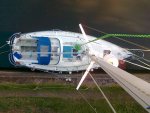
The view from the top....
19042013247.jpg
 
THe secure harness was the selling point for me but the mastaclimba combined with a climbing harness would probably be just as secure although the cost for the two combined might be more than the topclimber.

The big difference is that with the MastaClimba you hug the mast. With the Topclimber your hands are on the ascent line. If you hug the mast, you do not swing about much and, maybe more importantly, the thrust from your legs is directed vertically downwards. If you hold onto the ascent line, you swing about and the thrust is vectored into downwards and outwards losing a lot of the useful effort.

We have found that most MastaClimba purchasers already have a bosun's chair thus buying a harness is not necessary. However, bosun's chairs are designed to be sat in (and some are comfortable) but when you lower your legs to stand, you tend to slide out. I tried one harness which didn't have this problem but the straps precluded long stays sitting on arrival.

What I need is something like an adult padded nappy. One day?!
 
One of these http://www.petzl.com/en/outdoor/descenders/stop and one of these http://www.petzl.com/en/outdoor/ascenders-0/ascension Suggested to me by the local climbing shop a while ago.

The "ascension" I use for a foot loop. The "stop" I use with the harness. the setup is a bit fiddley to use but works well since I need to go up as well as down. A pair of ascenders is fine for going up, but be prepared for a bit of wait at the top....... The stop is on the rope below the ascender. To go up, I stand in the foot loop & pull the rope through the stop. Then I sit in the harness & move the acsender up. Repeat, puff & pant & I'm up. I can lock off the stop & hang in the harness. Then to descend, remove the ascender & sqeeze the stop to control the descent rate.
 
I just bought a Deffee Mast Ladder for the mast head work we needed to do this refit and can recomend it very highly. An excellent product which is well made, easy and comfortable to use. No problems , just make sure you have a good full body harness and provision for a belt strop to put round the mast and lean back on once you're up there. I used a petzl shunt device as a safety which ran up another halyard made off taut to the deck going up and coming down.
 
Before getting diverted into sailing I was a pretty serious climber and have ended up jumaring (ascending a rope with clamps like the Petzl) on some very big and exposed walls. These gadgets are brilliant but the vital principle is that they are not foolproof and can fail or come off the rope. A good method of protection is to tie an overhand or fig 8 loop in a bight below you and clip this into your harness. You renew the backup tie-on every ten feet or so to minimise the potential length of fall.

The disadvantage of this is that the weight of the rope no longer keeps it under a slight tension and so moving up the clamp is more awkward. Ascending one rope under tension and protecting yourself with loops tied in another is maybe the optimum.

As someone points out above, the clamps are awkward in descent but they do work. However, it is very easy to get out of synch and find yourself holding the clamp open at exactly the moment you want it to grip. Therefore it is doubly important to have the backup system in place.

If you don't have clamps, prussik and klemheist knots as mentioned above are effective but very difficult to loosen and move up the rope after they have been loaded. I recommend trying a Penberthy knot - make a 4 or 5 turn wrap around the rope with a thinner length of line to leave one long end and one shorter end. Tie the shorter bit into the longer as though finishing a bowline and attach the load to the longer line. When unloaded, there is lots of slack in the wraps and the knot is fairly easy to move.

I agree with the above comment that a link to a foot loop plus a second direct link to the harness is the best method.

Finally, climbers are rightly paranoid about dropping things onto the person below. Tie on your big spanner!
 
Top