MathiasW
Well-Known Member
In another thread of mine, which got a litte hijacked, the discussion got a bit heated when it came to the question whether the vessel is held in place by the anchor chain only (and not the anchor), or the system of anchor chain plus anchor.
It was claimed that the maritime academics and professionals would always view the vessel being moored to the chain and not the anchor, whilst others opposed this as entirely non-sense. I am part of the latter camp.
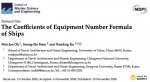
Now, I have been made aware of a recent paper written by some folks in the Korean Naval School of Architecture, which can shed some light on where maritime academics actually stand in this matter. I guess we all agree with the Korean commercial fleet being as big as it is, they can be taken to be dead serious in the matter.
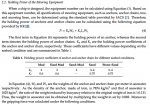
Now, when you look at equation 4, you will find that they characterise the load share between anchor and chain in a very simple way. The first term is the anchor load, the second is the load the chain takes. This 2nd term is essentially friction of the part of the chain that is lying on the seabed. In essence, they say that the chain lying on the seabed contributes with 3/4 of its own weight towards the load. Finally, when you use their table, you will see that this 2nd contribution is normally much smaller than the load the anchor takes. And obviously it vanishes when the anchor chain is completely off the seabed.
Also to note is that the factor Ka given here is for the relatively poor anchors used for commercial vessels. A Spade or Rocna or Mantis has a much higher value (not 3-4 but 12 or even higher) and so for our leisure vessels, the load sharing between chain and anchor is even more tipping towards the anchor.
But it is always the system of both together, not the chain alone. Maritime academics see it entirely in the same way as most of us on this forum do.
The full paper can be found online when you search for the title.
I guess this may help to explain the different views a little.
Cheers, Mathias
It was claimed that the maritime academics and professionals would always view the vessel being moored to the chain and not the anchor, whilst others opposed this as entirely non-sense. I am part of the latter camp.
Now, I have been made aware of a recent paper written by some folks in the Korean Naval School of Architecture, which can shed some light on where maritime academics actually stand in this matter. I guess we all agree with the Korean commercial fleet being as big as it is, they can be taken to be dead serious in the matter.
Now, when you look at equation 4, you will find that they characterise the load share between anchor and chain in a very simple way. The first term is the anchor load, the second is the load the chain takes. This 2nd term is essentially friction of the part of the chain that is lying on the seabed. In essence, they say that the chain lying on the seabed contributes with 3/4 of its own weight towards the load. Finally, when you use their table, you will see that this 2nd contribution is normally much smaller than the load the anchor takes. And obviously it vanishes when the anchor chain is completely off the seabed.
Also to note is that the factor Ka given here is for the relatively poor anchors used for commercial vessels. A Spade or Rocna or Mantis has a much higher value (not 3-4 but 12 or even higher) and so for our leisure vessels, the load sharing between chain and anchor is even more tipping towards the anchor.
But it is always the system of both together, not the chain alone. Maritime academics see it entirely in the same way as most of us on this forum do.
The full paper can be found online when you search for the title.
I guess this may help to explain the different views a little.
Cheers, Mathias



 , but it dragged under the conditions. He set up a box, told the on watch crew to keep the ship in 'the box'. They spent the night motoring to the windward edge of the box, dragging back to the leeward end, retrieving the anchor, motoring up and dragging back.... They keep the engines running, obviously, full time in slow ahead as the master was unsure that the chain lock for the windlass would be sufficient to take the strain - so the ground tackle was always being supported in part by the engines (we still dragged)