Load considerations when replacing forward bulkhead

merjan

Well-Known Member
Joined
21 Jun 2022
Messages
134
Visit site
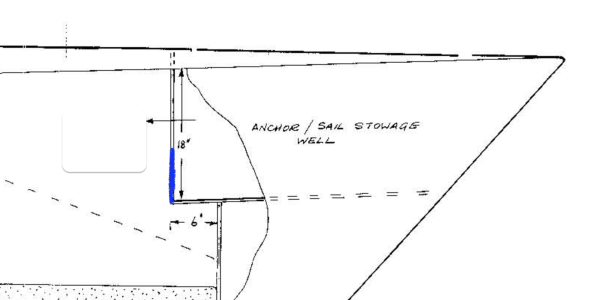
I need a bit of a sanity check about the replacement of a water-damaged forward bulkhead between the chain locker and the forward cabin. I am intending to do this with the boat ashore and the deck-stepped mast on. That means that there is some tension on the forestay I am wondering if the forward part of the hull will flex considerably when I remove the old bulkhead.

The boat is 28' GRP. The chain locker is about 600mm deep below the deck level and 1200mm wide at the bulkhead. Its sole is horizontally tabbed to the inside of the hull.

In an extreme scenario I can imagine the force due to the forestay tension will want to make the hull "open up" outwards (imagine pinching a yogurt tub). However I consider this to be negligeable, and expect the deck and the sole of the chain locker to give the hull enough rigidity whilst I tab in the new bulkhead. Does that make sense to anyone who has an idea about the loads on GRP hulls and the strength thereof? Should I loosen the rig in the process?

Also I'm planning to use CT1 instead of foam. If anyone has any objection to that, I'd like to find that out as well. Thanks in advance!
 
Loosening the rig might be wise to reduce the stress loading. But no so much that it sways about of course. You've removed sails and the boom already I expect.

I can't see why CT1 would be a problem. A fillet of thickened epoxy might be better though? The fillet could be shaped to give smoother 'u' shaped joins as the fibres you lay up won't like tight angles.

Just watch the current low temperatures and leave it until its warm enough for epoxy to cure ok.
 
Loosening the rig might be wise to reduce the stress loading. But no so much that it sways about of course. You've removed sails and the boom already I expect.
I wouldn't have removed the boom if I hadn't had this discussion. That's a good idea.
I can't see why CT1 would be a problem. A fillet of thickened epoxy might be better though? The fillet could be shaped to give smoother 'u' shaped joins as the fibres you lay up won't like tight angles.

Just watch the current low temperatures and leave it until its warm enough for epoxy to cure ok.
I thought epoxy would defeat the purpose of eliminating hard spots in the joint. I was thinking, CT1 right under the plywood, peanut butter epoxy fillet and then laminate. I won't be strarting the job until March, and even then I might run a heater in the boat for a bit.
 
You could also wrap the outside of the hull with old duvets to insulate the area being worked on if its a bit on the cold side.
 
How soggy is the water damaged bulkhead. Is the water damage mainly at the bottom?

If it is really bad then it long gave up on transmitting both tensile or compressive loads.
If the top few inches is still good it may be helping transmit some tensile loads in which case why not leaving it in. Just replace the damaged section below it.

I would template a new bulkhead before any further action.

Take the tension off rig and measure any movement on template and or the external beam at the bulkhead position.
A further check might be to monitor the water line with a laser level before rig tension taken off to check for sagging.

Can you share the class of your 29 foot boat as some may have direct experience and if it is a problem to worry about?
 
How soggy is the water damaged bulkhead. Is the water damage mainly at the bottom?
The top part seems sound. However I was thinking I'd replace the whole thing for peace of mind. That also seemed like an easier job than doing a good scarf joint between the old and new plywood. However if the loads are a real worry, it might be worth that extra effort to leave the top section in tact.
I would template a new bulkhead before any further action.
Take the tension off rig and measure any movement on template and or the external beam at the bulkhead position.
The template is ready but I didn't expect the hull's flex to be measurable with a template that has 2-3mm tolerances?
Can you share the class of your 29 foot boat as some may have direct experience and if it is a problem to worry about?
She's a Hunter Impala. She feels very lightweight, but I might be worrying for no real reason.
 
Ease tension on fore and back stays - but only enough to allow you to feel tension is less - let the side stays take the mast ....

If the top section of the bulkhead is good - then why remove it ? Cut out the bad ... leaving top section in place. Set in new section - then thin ply face over complete bulkhead to clean up visually.
 
If the top section of the bulkhead is good - then why remove it ? Cut out the bad ... leaving top section in place. Set in new section - then thin ply face over complete bulkhead to clean up visually.
When I say it's good, it's only a guess after tapping on it and prodding it with a screwdriver. I thought it would be a safer option to replace the whole thing as it's only 600mmx1200mm, even though the damage is more likely to be localised at the bottom due to gravity. I also didn't want to worry about the joint beetween the two plywood parts. However I am beginning to think that a local repair might indeed be a better plan.
 
When I say it's good, it's only a guess after tapping on it and prodding it with a screwdriver. I thought it would be a safer option to replace the whole thing as it's only 600mmx1200mm, even though the damage is more likely to be localised at the bottom due to gravity. I also didn't want to worry about the joint beetween the two plywood parts. However I am beginning to think that a local repair might indeed be a better plan.
A butt joint with epoxy resin will be ok. Could cover the bulkhead in grp just to make sure. Use of peel ply and a roller with give a smooth finish if required.
 
Loosening the rig might be wise to reduce the stress loading. But no so much that it sways about of course. You've removed sails and the boom already I expect.

I can't see why CT1 would be a problem. A fillet of thickened epoxy might be better though? The fillet could be shaped to give smoother 'u' shaped joins as the fibres you lay up won't like tight angles.

Just watch the current low temperatures and leave it until its warm enough for epoxy to cure ok.
One good thing about epoxy is that unlike polyester it does still cure at low temperatures. Obviously takes a bit longer - most chemical reactions are time and temperature dependant. But it does cure - I successfully installed a bulkhead and stern tube into a Hunter 26 with snow on the ground.

On the other hand I wouldnt do what you are considering with the mast up and the forestay under tension. The forward part of the hull will distort further when you remove the existing bulkhead unless its already absolutely shot.
 
The damaged area is in blue. I am still wondering if the floor of the chain locker would not provide enough rigidity. There is also the lower half of the bulkhead / collision bulkhead, and the deck. I could even put ratchet straps between stanchion bases across the deck to further support the hull.

In any case I might opt for a local repair as advised. I will need to poke the bulkhead more seriously when I am on the boat again to make the call.
Screenshot 2025-02-08 at 16.55.58.png
 
With a bulkhead like that, whilst it gives strength, its not the same as one that goes from deck to keel. That is more to support the deck and the hull from flexing.
I would cut of the rotten section and let in a new piece. If still worried about strength clean up the anchor locker side and put a new bit against the old bonding together with epoxy and sealing edges with thickened epoxy.
West Systems do a very good book and it shows how to avoid 'hard' edges, etc with bulkheads is really concerned.
 
You have not shown that the anchor locker base sits on bonded horizontal stringers on the inside of the hull on an Impala. Those bonded stringers will give tremendous strength to the hull shape.

I would think you could hack the base out completely whilst leaving the two vertical bulkheads for later replacement. The gradual replacement of all 3 parts might give reduced "anxiety" of deformation during complete reconstruction.

I would contact Ben Meakins lately a PBO editor. His family had a long standing relationship with the Impalas (Polly) and is active on their Facebook closed group.

I am sure he could advise you on any proposed replacement or repair of the anchor locker.

Impala 28 | Close reaching! | Facebook
 
You have not shown that the anchor locker base sits on bonded horizontal stringers on the inside of the hull on an Impala. Those bonded stringers will give tremendous strength to the hull shape.

I would think you could hack the base out completely whilst leaving the two vertical bulkheads for later replacement. The gradual replacement of all 3 parts might give reduced "anxiety" of deformation during complete reconstruction.

I would contact Ben Meakins lately a PBO editor. His family had a long standing relationship with the Impalas (Polly) and is active on their Facebook closed group.

I am sure he could advise you on any proposed replacement or repair of the anchor locker.
Yes, that's a good point about the stringers. It's only the top vertical bulkhead that needs to be replaced. And I agree it would be good to see if Ben Meakins has any comments.
 
Top