Lithium battery packs deterioration

LadyInBed

Well-Known Member
Joined
2 Sep 2001
Messages
15,222
Location
Me - Zumerzet Boat - Wareham
montymariner.co.uk
I recently heard this (no indication as to it's veracity)
"Lithium battery packs deteriorate quicker when stored at a full charge.
They last the longest when they're stored at around 30-50% state of charge."
Does anyone know if it's true or myth?
 
I recently heard this (no indication as to it's veracity)
"Lithium battery packs deteriorate quicker when stored at a full charge.
They last the longest when they're stored at around 30-50% state of charge."
Does anyone know if it's true or myth?
Far as I know, that's true. In the long lithium thread, there is some discussion of this
 
Not sure about percentages, but electric car owners are sometimes recommended to charge to about 80% to get a good combination of range and battery life.
 
The guidance I have seen (my e-bike and E Propulsion) has been don't store at 100 % Long term storage at approx 70-80% is much preferred, and I believe E propusion battery packs have gizmos built in to ensure this happens
 
In a similar way to getting longest life from Lead Acid by keeping between 50% and 100%, then lithium batteries get longest life from 30%-80%. So both have longest life with exactly the same amount of rated capacity but lithium are much more resilient to abuse so say 15%-100%. They don’t last nearly as long but remain near perfect when abused for a long while before their holding capacity starts reducing.
 
I recently heard this (no indication as to it's veracity)
"Lithium battery packs deteriorate quicker when stored at a full charge.
They last the longest when they're stored at around 30-50% state of charge."
Does anyone know if it's true or myth?

Completely true, and one of the greatest differences to lead acid where 100% SOC is its happy place. I have a storage setting on my Victron solar controller which is 13.3 volts for bulk and float. This is arrived at my trial and error (since the charging curve is very flat and an extra 0.5 volts could make a big % difference) and this keeps the pack at around 60% state of charge. Fortunately lithium packs take as much charge as you can throw at them so I can quickly increase the charge if motoring. There's no problem in then charging to 100% as long as the pack doesn't hang around fully charged for long. In practice most people including me are happy to charge to 85-90 percent (and discharge to 15-20%) as this helps with longevity. The extra capacity can of course be used as needed, but because my 270ah pack has a usable capacity equivalent to more than 600 ah of lead acid then 20- 85% is generally plenty. I should add that because of the high energy density of LFP, my pack size is equivalent to a singe 80 ah lead acid battery.
 
Last edited:
Does anyone have any data on what the impact on lifespan actually is, of storing a li battery at 100% charge?

There's a Will Prowse video on this subject in my long thread - linked below. It is not encouraging viewing for those who have been storing full but I don't recall the details and the thread is too long to browse - even for me. The other great enemy of longevity is heat. If you store your LFP at 100% SOC in a Caribbean summer the degradation rate is frightening.
 
Last edited:
As you can imagine this is a hot topic on the Tesla forum...there are different battery compositions...but as a rule, the lower the storage voltage the better...there is cyclic deterioration but time is the bigger enemy...especially in hot countries...this is the opposite to lead acid batteries...short charging cycles if possible. Also (and this is slightly more controversial) keep it above zero.
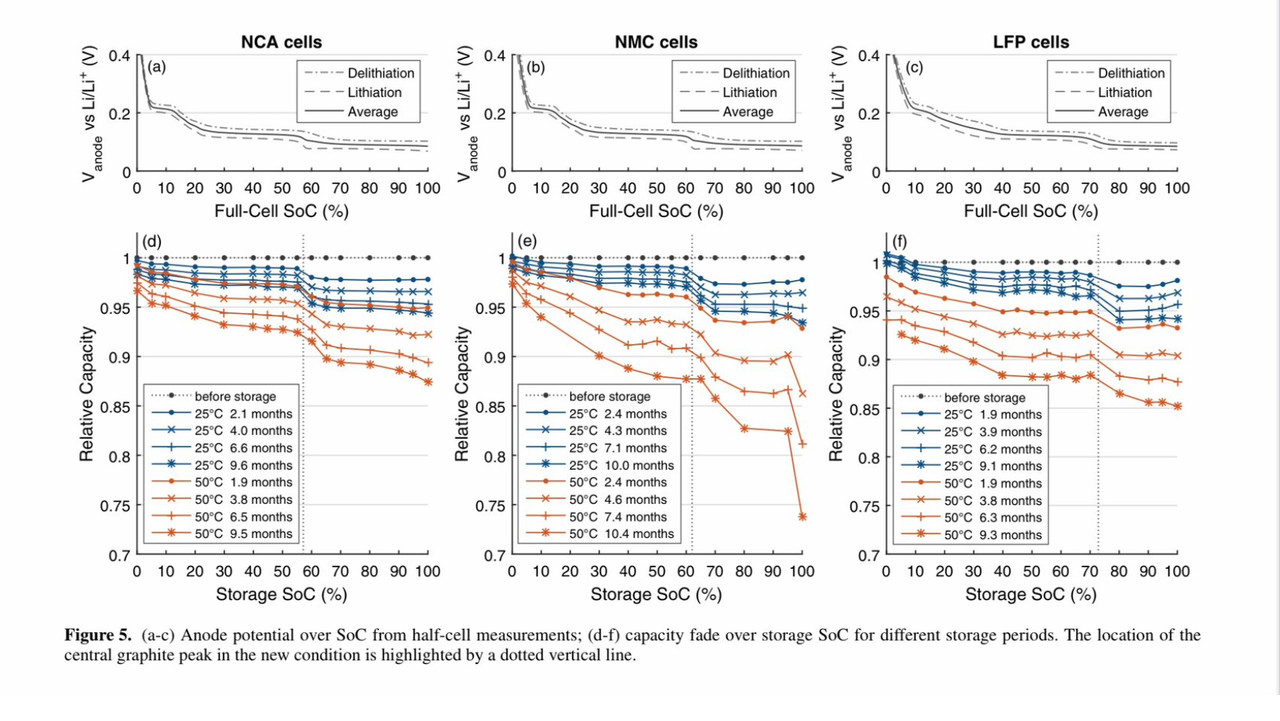
Here is a chart of different battery technology and their storage deterioration based on ambient temperature and state of charge
 
Ps...based on the above chart I only charge my electric car to 55% ...this means that I have some deterioration but I also keep a useful range (300 km)...it’s a trade off....I will charge higher (including 100%) but it’s timed so that I drive immediately after charging
 
Ps ps...a lot of people may not realize but when you charge an electric car to 100%...there is no regenerative charge when slowing, braking or going downhill, because there is no spare battery capacity to receive the charge. This can leave a newbie a bit shocked as the car won’t slow and stop as expected...so you have to use the brakes (ie no one pedal driving)...until you have been down the road for a couple of miles...
I should add...that in many EVs the car’s computer will add in some braking to make up for any lack of regen...so the driving experience (and one pedal driving) remains constant...for reasons unbeknown (to me) the French Government won’t allow me to have this option ☹️
 
Last edited:
RC Modellers have been placing Li batterys at storage level since they first appeared.

Two factors come into play :

1. Cell damage is reduced when charge level is reduced to 30 - 50%. The best storage level is actually the lower 30% ... but many store nearer 50% to reduce the charge up time. Usual damage that occurs is increasing Internal Resistance - that then creates voltage drop under load. Damage accumulates if repeated storage at full charge and causes higher voltage drop. There is NO cure for it.
Storage voltage for 4.2V cells lies between 3.7 and 3.85V. Same ratio applies to the lesser voltage LiIon / LiFePo cells.

2. In terms of LiPo cells - storage charge is safer .... it is not unknown for LiPo cells left at full charge to catch fire. It is one reason why for 'hazardous' use - they are often 'Hard Case'.

LiFe ... LIFePo are less subject to damage when left fully charged ... but even so - its not good policy. It reduces the life of the batterys.

Even with BMS boards built into many battery packs - user intervention to reduce charge level for storage is beneficial.
 
Top