Lithium battery fire extinguisher???

They are far safer than lead acid batteries
The detail of this comment might make interesting analysis, but perhaps a rabbit hole for another time.
The authors created an entirely unrealistic scenario
Prejudgement rarely provokes a healthy nursery for new information. No surprises there.

Nobody has yet shown a real example of a problem,
In your experience. Not mine.
Safety is one of the advantages over lead, not the other way around.
OP asked about fire control for LFP, not how it compares with LA.
 
I have Victron Lithium batteries on my boat and was looking to upgrade the fire protection with a special lithium battery fire extinguisher.
However on reading the information about them I dont see how it would work on my boat as the contents need to smother the battery.
The batteries are housed in a strong plywood box with a few fairly inaccessible holes in the sides for wire access.
If the worst happened and the batteries do catch fire how would the 'special 'foam in the extinguisher smother the battery fire when the box is surrounding them.
If the fire is bad enough to have burnt the box away there is no way I would be lifting the floor boards up to gain access to the compartment
I think instead of considering the batteries the source of the fire perhaps the solution should be to protect the lithium batteries from a fire originating elsewhere .
 
Thank you all for your thoughts, they have confirmed my own doubts about the need for a lithium specific extinguisher.
I will install a second automatic extinguisher in the engine compartment to give better protection as the single 2kg one already fitted probably does not have enough volume for the space.
 
Thank you all for your thoughts, they have confirmed my own doubts about the need for a lithium specific extinguisher.
I will install a second automatic extinguisher in the engine compartment to give better protection as the single 2kg one already fitted probably does not have enough volume for the space.
It would be better to fit one auto extinguisher with suffucient capacity for the space.
If you have two separate auto extinguishers and only one might be triggered.
However the first thing would be double check whether the extinguisher you already have is sufficient, since you seem uncertain.
 
Rather than aiming to extinguish any fire, how about mounting them on an ejector seat? :cool:

It could be propelled using a small lithium ion battery and a big charger...

Not entirely a joke. Enclosing in a fireproof box with an externally vented exhaust could also work. It might make the boat easier to insure even if it has no real world benefit.
 
Thank you all for your thoughts, they have confirmed my own doubts about the need for a lithium specific extinguisher.
I will install a second automatic extinguisher in the engine compartment to give better protection as the single 2kg one already fitted probably does not have enough volume for the space.
Do not do this. You should only have a single auto extinguisher in the engine space. With two small ones a fire could start and set one off, which isn't big enough to extinguish it, the fire then spreads and sets the other one off, which also isn't big enough to extinguish it. One bigger extinguisher will give it everything it's got.

EDit; oops, beaten to it by Momac
 
They are far safer than lead acid batteries
It depends on what criteria you use. If H2 gas release and potential for explosion is your concern then LA are clearly worse. If direct substitution* for a system designed for LA is your priority then LA are probably better.

But there’s clearly been a missed trick by the LiFePO4 industry in marketing these. They wanted to jump on a “Lithium is amazing” bandwagon and so let them be called Lithium batteries - but they could have called them anything, only electrochemists care about the ions in the battery - when you stick a AA in your torch you don’t care if it’s a NiCad, alkaline, ZnC etc… they would have been better marketing as Lead Free batteries! The consumer and their insurers would have been blissfully ignorant of those pesky Li ions that make them work!

*as in disconnect the terminals lift out the LA, put LFP in and fit the terminals.
 
It depends on what criteria you use. If H2 gas release and potential for explosion is your concern then LA are clearly worse. If direct substitution* for a system designed for LA is your priority then LA are probably better.
I’m struggling to think of a criteria by which they’re less safe?
 
The detail of this comment might make interesting analysis, but perhaps a rabbit hole for another time.
In a correctly specified and installed LFP system the BMS will provide protection for many things, including (but not limited to):

Overcharge/Over-discharge Protection: Cuts off power if any cell exceeds its maximum (e.g., 3.65V for LiFePO4) or falls below its minimum voltage.
Overcurrent Protection: Limits charge/discharge currents (up to 300A continuous) and triggers a shutdown if these limits are breached.
Short Circuit Protection: Instantly disconnects the battery in the event of a short to prevent fire or cell damage.
Thermal Cut-offs: Stops charging if the battery is too cold (low-temp cutoff) or discharging if it becomes dangerously hot.

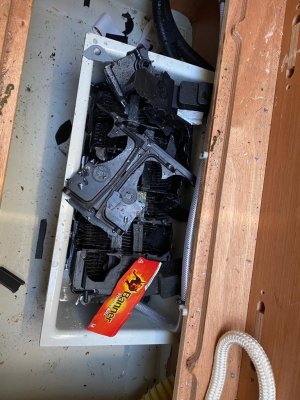
None of those are found in a typical lead acid installation, in fact, the vast majority of boats with LA systems don't even have battery fuses. Over charging can have serious consequences for any battery and it's surrounding. With LFP the BMS will shut charging down, with LA there is no such protection so you can easily end up with this:

IMG-20210626-WA0000.jpg

In your experience. Not mine.
Care to share what your experience of LFP problems are ?
 
It depends on what criteria you use. If H2 gas release and potential for explosion is your concern then LA are clearly worse. If direct substitution* for a system designed for LA is your priority then LA are probably better.

*as in disconnect the terminals lift out the LA, put LFP in and fit the terminals.
It's obvious that an incorrectly installed LFP system might be less safe than a correctly installed LA system, but it's far from a reasonable argument against LFP.
 
Interesting that the attempts at risk comparison LFP versus LA consider either/or.... and not 'both together'.
Like others, I suspect, I now have a pro-installed LFP battery plus attendent accessories adjacent to a new LA/AGM battery.

What is the risk profile there?
Is it 'additive'?

What are the possible failure modes...?
 
It's obvious that an incorrectly installed LFP system might be less safe than a correctly installed LA system, but it's far from a reasonable argument against LFP.
I think what's obvious to you may not actually be obvious to the average DIY'er about to replace their batteries who reads some vague marketing material about new lighter, higher capacity "LA replacement" batteries. Since most insurers don't prohibit Li entirely but just want an installation they can trust it seems this is actually the concern. Obviously there are some people who are just convinced that Li ions are a death sentence, ironically some Li advocates have similar repulsion to gas cookers, probably not grounded in a rational risk assessment - but that is to some extent human nature and internet fora tend to polarise opinion rather than reaching common ground.
 
Interesting that the attempts at risk comparison LFP versus LA consider either/or.... and not 'both together'.
Like others, I suspect, I now have a pro-installed LFP battery plus attendent accessories adjacent to a new LA/AGM battery.

What is the risk profile there?
Is it 'additive'?

What are the possible failure modes...?

The failure modes for each battery remains the same, it is the cause which creates the failure mode that is relevant. You have to do an interdependency assessment e.g. a fire in LA and its impact on LiFePO4 battery, an explosion of a LA and impact on the LiFePO4 for your set up. Once you establish the consequence, the probability depends on whether you are looking for the probability of one event "and" another occurring (multiplication) or one event "or"another occurring (addition).
 
I’m struggling to think of a criteria by which they’re less safe?
Really - in the context I described?

Here's the first hit for "LiFePO4 lead acid replacement" Lithium leisure battery drop in replacement
I'm not qualified to say if their battery really is suitable for a direct swap as they claim but the expert advice seems to be that you shouldn't rely on the battery's internal BMS to protect anything other than the battery itself. Nigel Calder seems quite convinced there's a risk of destroying your alternator
. If it was just a case of dropping in a new box paul wouldn't be making any money because almost every owner would feel perfectly capable of swapping like for like batteries.

Puncture consequences are dramatically different - on a boat that bounces around at sea that means not being an idiot (1/2 of the public do have below average intelligence though!), and making sure you don't do something stupid with a power drill when installing something the other side of the plywood! You'll find videos of cells off gassing and even burning if punctured without much difficulty.

Would that be better or worse if its in a small closed box? If your BMS is the weakpoint - and it fails then it seems to be possible to overcharge/discharge cells spectacularly. I've only seen "tests" of single cells in the outdoors - if someone is willing to volunteer their boat we can bypass the BMS and see if we can can force them to fail? Either way its sure to be youtube gold.
 
I have just bought a boat with an aftermarket lithium installation of 4 x 100ah LiFePO4 batteries (charged (DC to DC) from the lead acid engine battery) and I have the receipts to show it was installed by a marine electrician. My insurance (GJW) states I need a lithium extinguisher so I have bought a AVD one which I will install nearby.

I was also planning to put a heat alarm in the battery compartment which will alert me in the event of heat over over about 180 which is below the thermal runaway start so I can then flood the battery compartment with the AVD extinguisher through a hole.

I appreciate all very unlikely and may not be sufficient but £130 for an extinguisher and £20 for a heat alarm seemed small beer in comparison and also gives me something to go against fires from batteries in phones etc (probably more likely) if I can't through them overboard.

Not sure what more I can do without a full commercial firefighting setup which is overkill. I am probably dead anyway because I am going from a 1977 MAB to a 1998 (semi) AWB so the keel will fall off, the rudder will be ripped out of its housing and the mast will probably fall down.
 
Really - in the context I described?

Here's the first hit for "LiFePO4 lead acid replacement" Lithium leisure battery drop in replacement

That's a lot of old cobblers.
I'm not qualified to say if their battery really is suitable for a direct swap as they claim
It isn't.
but the expert advice seems to be that you shouldn't rely on the battery's internal BMS to protect anything other than the battery itself.
The BMS is a failsafe and should not be used to regulate charge etc. Even if you tried to, you cannot reliably get it to control alternator charge and temp's.
Nigel Calder seems quite convinced there's a risk of destroying your alternator.
He's right, it's virtually guaranteed to destroy your alternator, if it's a standard one.
If it was just a case of dropping in a new box paul wouldn't be making any money because almost every owner would feel perfectly capable of swapping like for like batteries.
I've been here a lot longer than people have been wanting LFP on their boats and i do a lot of other things too.
Puncture consequences are dramatically different - on a boat that bounces around at sea that means not being an idiot (1/2 of the public do have below average intelligence though!), and making sure you don't do something stupid with a power drill when installing something the other side of the plywood! You'll find videos of cells off gassing and even burning if punctured without much difficulty.
How about if the idiot drill a hole in a gas pipe then uses a blowtorch for leak detection ? Or drill a hole in his petrol tank while he's smoking a cigar ?

Anyway, companies and organisations have tested LFP cells to destruction by all sorts of unlikely scenarios, including knocking nails in them and drill holes in them, none of them caught fire or exploded.
Would that be better or worse if its in a small closed box? If your BMS is the weakpoint - and it fails then it seems to be possible to overcharge/discharge cells spectacularly.
The BMS is a last ditch safety device, in addition to failing you would need faults with additional equipment.
I've only seen "tests" of single cells in the outdoors - if someone is willing to volunteer their boat we can bypass the BMS and see if we can can force them to fail? Either way its sure to be youtube gold.

Why would you do that ? How about if we stab a hole in your life jacket and then throw you overboard, see if you drown ?
 
That's a lot of old cobblers.

It isn't.

The BMS is a failsafe and should not be used to regulate charge etc. Even if you tried to, you cannot reliably get it to control alternator charge and temp's.

He's right, it's virtually guaranteed to destroy your alternator, if it's a standard one.
Right so we seem to be in agreement that amatuer people blindly following instructions from a supplier claiming to offer a drop in solution could at the very least damage your other kit.
How about if the idiot drill a hole in a gas pipe then uses a blowtorch for leak detection ? Or drill a hole in his petrol tank while he's smoking a cigar ?
Of course - but Lusty wanted examples of situations where LFPs *could* be riskier than LAs. The issues of hydrogen from LA's has been widely reported for decades but people still occasionally manage to fall foul of them, whilst others persist in saying it almost never happens, or it won't happen if people just use their brain.
Anyway, companies and organisations have tested LFP cells to destruction by all sorts of unlikely scenarios, including knocking nails in them and drill holes in them, none of them caught fire or exploded.
There's video footage on youtube of an LFP cell having a big spike put through it and then emitting huge quantities of fumes, glowing red inside and then catching fire.
Why would you do that ? How about if we stab a hole in your life jacket and then throw you overboard, see if you drown ?
Not sure I understand the analogy. The immediate consequences of a punctured lifejacket are 100% known, it would make a dull video. I've not seen any LFP damaged whilst insitue in a typical installation - only in an isolated cell in an open field. If the single cell fumes a lot and gets really hot does it get hot enough to damage its neighbours? Does it or the hot can trying to get our of it damage a typical enclosure or effectively "explode" our of an enclosed box? If it doesn't then it would be a great "LFPs are safe" video.

I'm not arguing against LFPs - I'm just sceptical when someone says they are SAFER than LA.
 
Right so we seem to be in agreement that amatuer people blindly following instructions from a supplier claiming to offer a drop in solution could at the very least damage your other kit.

Of course - but Lusty wanted examples of situations where LFPs *could* be riskier than LAs. The issues of hydrogen from LA's has been widely reported for decades but people still occasionally manage to fall foul of them, whilst others persist in saying it almost never happens, or it won't happen if people just use their brain.

There's video footage on youtube of an LFP cell having a big spike put through it and then emitting huge quantities of fumes, glowing red inside and then catching fire.

Not sure I understand the analogy. The immediate consequences of a punctured lifejacket are 100% known, it would make a dull video. I've not seen any LFP damaged whilst insitue in a typical installation - only in an isolated cell in an open field. If the single cell fumes a lot and gets really hot does it get hot enough to damage its neighbours? Does it or the hot can trying to get our of it damage a typical enclosure or effectively "explode" our of an enclosed box? If it doesn't then it would be a great "LFPs are safe" video.

I'm not arguing against LFPs - I'm just sceptical when someone says they are SAFER than LA.
Because they are.

Making up scenarios with idiots doing stupid things applies to virtually anything, anywhere.

Fact is, there is not a single published example of a properly installed LFP system doing any of the things you talk about. Fitting "drop in" batteries without making appropriate changes isn't a failing of the technology, it's just people doing stupid things. Hence some insurance companies insisting on pro installs only.

As far as i am concerned a properly specified and installed LFP system is safer and more reliable than a typical LA system.

End of, for me.
 
It's obvious that an incorrectly installed LFP system might be less safe than a correctly installed LA system, but it's far from a reasonable argument against LFP.
I don’t think I agree, even with none of the safety features they’re very safe as a chemistry. Obviously nobody sensible would install without but under/overcharging will just harm the battery rather than be dangerous (unlike lead). Short circuit is about the same danger wise.
 
Top