Light wind sails advice

andylipsberg

Active Member
Joined
11 Feb 2021
Messages
58
Visit site
Hi all,

Been sailing now my first season with 50m2 sails (mainsail and overlapping genoa). Above 12 knots AWS I get good speed in all sailing angles 5 or above 5 knots with the current set-up. There is no doubt I can increase the speed by added more sails in the mentioned wind speed, but I'm more concerned about getting good boat speed below 12 knots of wind.

I'm considering code zero for AWA: 60-120 which could cover wide angles, but there are more options as well with different sail cuts.

code zero AWA: 40-100, AWA: 80-130 and there is also gennaker which could cover 90-140 AWA.

Based on your experience with both code zero and gennaker, what would be your observations and recommendations for me to consider. With limited crew onboard I'm not considering spinnaker at this stage.

Thanks.
 
You may not go faster, the lighter sails just flap less and stay full more so are less frustrating in my experience. A lot of the time I don’t bother as it’s easier to use normal sails and deal with the issues.
 
My first piece of advice is to stop thinking in AWA and AWS. Think in TWA and TWS, as picking a sail to move your boat at specific angles to the true wind is actually what you're trying to do... Otherwise you will get rather confused as to if your new sail is going to help in any given situation. For example, if you're setting off on a course that gives a 80 TWA reach, when you accelerate to hull speed then that AWA could well be as tight as 50 if the breeze is say 8 knots. But when you're setting up and only going slowly you'll be looking at an AWA more like 75, so you might think your sail would work, when it won't...
Racing sail selection charts are only ever given in TWA and TWS for a reason, it makes the situation clear.

That said, also consider where the biggest hole in your performance profile is. If you're using an overlapping genoa it's unlikely to be at the tighter angles. Whereas at deeper angles you will definitely be short of horsepower. For that reason, if you're only considering 1 sail, then I would get the Gennaker, or if you are thinking that maybe you will add a spinnaker at a later date, then maybe the bigger, deeper code zero.
 
Tell us what your plans for the boat are? Just cruising or some racing too? Your options are many but it would be very easy to spend a lot of money for relatively little gain (especially if you're not racing).

An immediate improvement would be to invest in some light airs sheets, and experiment with halyard tensions.
 
Tell us what your plans for the boat are? Just cruising or some racing too? Your options are many but it would be very easy to spend a lot of money for relatively little gain (especially if you're not racing).

An immediate improvement would be to invest in some light airs sheets, and experiment with halyard tensions.

I do not plan racing on this particular boat, just looking for cruising at higher speeds in light air and using less engine thus the question.
 
Our fat, wide and very heavy Motorsailer goes great in 12-20 knots true with its small SA unless it is close to the wind. She will not move in under 8 knots true.

I added a second furler and a Pete Sanders Code Zero and we were doing 5.5 kts in 6 knts of true wind in Belfast Lough between Ballyholme Bay and Carrickfergus.

We have only had suitable conditions to deploy it half a dozen times so far, but it is going to be a very useful sail, especially with the cost of fuel!
 
You do not tell us what your boat is - fitting a feathering prop is likely to be more beneficial across all wind speeds
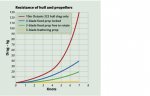
I’ve been meaning for years to go down that route but the recentish test on YBW on fixed prop versus spinning versus feathering showed 80-90% of drag reduction came from letting it spin with only a marinal extra from feathering/folding.

Regarding the light wind sails - it’s just so nice to be able to sail in calm weather we go ourselves an asymmetric 10 years ago and it’s been joyful when winds are 5-12 knots and we are not in a hurry. Best piece of advice from the Crusader sailmaker before ordering was that almost all light wind cruising sails are used once then live in a locker for 10 years before being thrown out. His cure was to hoist, snuff and hoist again a dozen times on the first go so it would be untangled and just routine to hoist it each time.
 
My first piece of advice is to stop thinking in AWA and AWS. Think in TWA and TWS, as picking a sail to move your boat at specific angles to the true wind is actually what you're trying to do... Otherwise you will get rather confused as to if your new sail is going to help in any given situation. For example, if you're setting off on a course that gives a 80 TWA reach, when you accelerate to hull speed then that AWA could well be as tight as 50 if the breeze is say 8 knots. But when you're setting up and only going slowly you'll be looking at an AWA more like 75, so you might think your sail would work, when it won't...
Racing sail selection charts are only ever given in TWA and TWS for a reason, it makes the situation clear.

That said, also consider where the biggest hole in your performance profile is. If you're using an overlapping genoa it's unlikely to be at the tighter angles. Whereas at deeper angles you will definitely be short of horsepower. For that reason, if you're only considering 1 sail, then I would get the Gennaker, or if you are thinking that maybe you will add a spinnaker at a later date, then maybe the bigger, deeper code zero.

True, I have been using data from one sailmaker, therefore mentioned AWS. On other company website they use TWS as a reference. Will stick to that when looking for options. Thanks for the comment. Gennaker makes sense from this perspective.
 
I’ve been meaning for years to go down that route but the recentish test on YBW on fixed prop versus spinning versus feathering showed 80-90% of drag reduction came from letting it spin with only a marinal extra from feathering/folding.
You should come and had a chat with me. With the new folding prop I have an extra 1/2 knot, on average, and no whirring when the prop started spinning at 4.8 knots, speed through the water or boat speed. Not having that noise is priceless.
 
You should come and had a chat with me. With the new folding prop I have an extra 1/2 knot, on average, and no whirring when the prop started spinning at 4.8 knots, speed through the water or boat speed. Not having that noise is priceless.
But it is pricey and another complex thing to manage - I’ve got close to a knot faster by letting it spin. I‘ll let you know how I feel once it’s spun all the way to the Caribbean - I might change my mind.
 
But it is pricey and another complex thing to manage - I’ve got close to a knot faster by letting it spin. I‘ll let you know how I feel once it’s spun all the way to the Caribbean - I might change my mind.
May be pricy but why is it a "complex thing to manage" when it just works? Stop the engine and the prop folds or feathers, start the engine put into gear and the blades open. Have difficulty in accepting that a spinning fixed blade prop adds a knot over a locked fixed blade. Never seen any reliable data that claims that. Plenty of real world data that confirms a feathering or folding prop adds speed, whether it be racing where such aprop incurs a rating penalty or recorded increased daily runs on long passages.
 
May be pricy but why is it a "complex thing to manage" when it just works? Stop the engine and the prop folds or feathers, start the engine put into gear and the blades open. Have difficulty in accepting that a spinning fixed blade prop adds a knot over a locked fixed blade. Never seen any reliable data that claims that. Plenty of real world data that confirms a feathering or folding prop adds speed, whether it be racing where such aprop incurs a rating penalty or recorded increased daily runs on long passages.
Just look up the Yachting Monthly article on fixed versus spinning.

Complicated because it has moving parts and special anodes not complicated becuae it’s had to operate. Our boat moves ffrom country to country so we never have a known reliable boat yard, quick access to known suppliers snd rarely have the boat out of the water - maybe every 2 to 3 years for a week. So simplicy of maintenance is key.
 
Just look up the Yachting Monthly article on fixed versus spinning.

Complicated because it has moving parts and special anodes not complicated becuae it’s had to operate. Our boat moves ffrom country to country so we never have a known reliable boat yard, quick access to known suppliers snd rarely have the boat out of the water - maybe every 2 to 3 years for a week. So simplicy of maintenance is key.
My boat had a folding propeller (a Gori) when I bought her, 15 years ago; I believe it was fairly new at that point. In all that time it has had minimal maintenance (I have stripped it down once!) and doesn't have a separate anode. There are precisely two moving parts, and even when completely stripped down, I make it 7 parts in total - including two grub-screws! It still works perfectly, and I expect it to continue to do so; there are no signs of wear or other deterioration. The mechanism is exceedingly robust and it's difficult to see how it could go wrong, short of serious electrolytic corrosion which would be evident long before there was damage to the mechanism. She has often gone 2-3 years in the water.

Folding props are robust, pretty much maintenance free and they just work.
 
My boat had a folding propeller (a Gori) when I bought her, 15 years ago; I believe it was fairly new at that point. In all that time it has had minimal maintenance (I have stripped it down once!) and doesn't have a separate anode. There are precisely two moving parts, and even when completely stripped down, I make it 7 parts in total - including two grub-screws! It still works perfectly, and I expect it to continue to do so; there are no signs of wear or other deterioration. The mechanism is exceedingly robust and it's difficult to see how it could go wrong, short of serious electrolytic corrosion which would be evident long before there was damage to the mechanism. She has often gone 2-3 years in the water.

Folding props are robust, pretty much maintenance free and they just work.
I could say the same for my Bruntons Autoprop. Only two blades move although there are internal bearings (which I have never seen). I bought it more than 20 years ago, since when it has performed perfectly.

My memory of the YM testing was that folding and feathering exhibited similar drag, but a good deal less than a spinning fixed prop.
 
Top