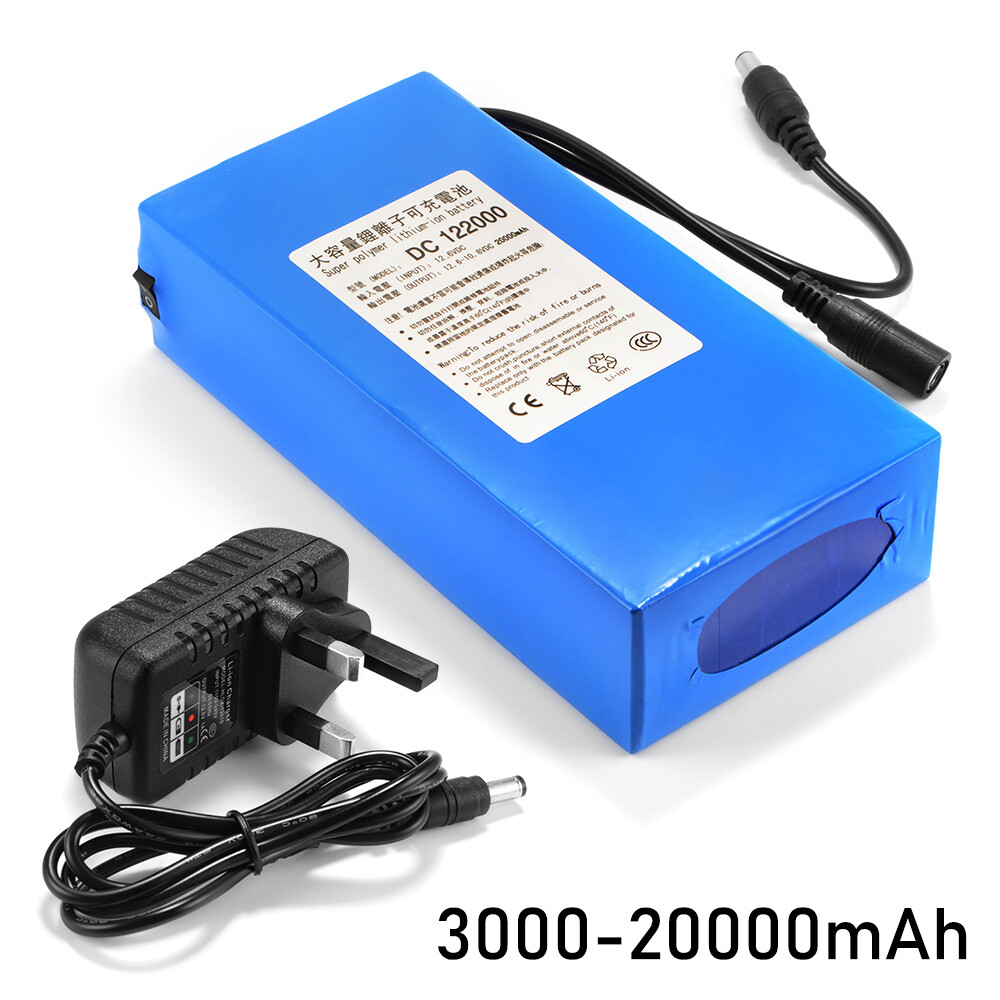
LiFePo4 small battery - anyone tried one?

Oh that's tempting, Ta. Getting a little carried away here, might need a beer and mull over that, but would be handy - and don't even have a starter battery at the moment so need something.
As an interim step to LFP, if you install a separate start battery then the B2B can be used to smart charge a lead acid house bank so still valuable. The Marine How To page has all details.
 
If all you are doing is testing small electronics etc, do you need such a big battery??? I bought one of these off ebay to run a little
s-l1600.jpg
pump that I use to empty the dinghy after a rain storm. Outputs 12v and perfectly adequate

TudorSailor
 
If all you are doing is testing small electronics etc, do you need such a big battery??? I bought one of these off ebay....
?? Most of those are bigger? The one i went for is only 6ah, will be handy for running 12v guitar/ipod amp at bewch parties etc.
So just how end of the world your gonna die dangerous are they .......... Love the guys standing back a bit as the nail gets hammered in. :)
 
For anyone planning on installing LiFePO4 (LFP) as a domestic bank it may be worth snapping up one of these battery to battery chargers from Sterling. There are a few left. They are second hand, cosmetically marked, but tested, updated with software and are being sold with 6 months warranty for £129 which is a £200 reduction on new. Mine arrived today and the case is pretty much unmarked.

Battery to Battery Charger (used) 6 months warranty- several remaining

I don't actually move about much, so the engine isn't run very often. Thus most of my charging is done with a genny via a stand alone 240V battery charger, (Sterling Pro Charge Ultra 60A).

However, I do also have a Sterling 2500W inverter charger which is currently powered by my LA bank, and which I intend to retain. So my plan, (if ever I need to charge my Lithium bank when the engine is running), is to do it by plugging the stand alone charger into the boat 240V system, thus charging it from the alternator, via the LA bank and the inverter charger.

This obviously wont suit everyone, and it merely happens to fit with the system I already have - but it is an option.

Having said that, there may come a day when I want the inverter bit to be supplied by the Lithium bank, in which case I will have to rethink the alternator charging of the Lithiums.
 
The simplest way to charge Lithium format batterys if you do not plan to have them power the engine start side ... is to just use a Programmable Lithium Charger .... (they also have settings for Lead Acid ... NiCd ... NiMh ... as well as LiPo / LiFe).
They run of 12v direct .... stepping up / down voltage as required.

What would need though is a proper change over switch to isolate engine side from LiFe system ... but allow either to power domestics.
 
The simplest way to charge Lithium format batterys if you do not plan to have them power the engine start side ... is to just use a Programmable Lithium Charger .... (they also have settings for Lead Acid ... NiCd ... NiMh ... as well as LiPo / LiFe).
They run of 12v direct .... stepping up / down voltage as required.

What would need though is a proper change over switch to isolate engine side from LiFe system ... but allow either to power domestics.

Can you suggest/recommend a programmable lithium charger? and a suitable changeover switch?

In fact, doesn't the Sterling B to B do what you are suggesting?
 
In fact, doesn't the Sterling B to B do what you are suggesting?

Yes, that is exactly what it does: alternator-start battery-B2B-domestic bank. No switching back and forth required. Both the lead acid starter and the domestic banks get charged automatically. The control systems for LFP are what makes this more complex. But the fully customisable charging parameters of the B2B should really help with LFP.
 
Last edited:
If you want to acquire knowledge regarding these batteries, look up Will Prowse on Youtube. Very thorough and informative.
 
Can you suggest/recommend a programmable lithium charger? and a suitable changeover switch?

In fact, doesn't the Sterling B to B do what you are suggesting?

There are so many on the market that to suggest one would not be fair. It depends on size of battery .. charge rates you need etc. Also any that I use are user start systems and need me to decide to charge. I have plug in Low Voltage alarm units (about 5 euros) that plug into the battery cell leads ... once a cell drops below a set figure - it beeps telling me I need to either stop discharge or charge.

I am not a great believer in using Lead Acid chargers for other battery types ... unless the battery has an interface board to control the charge applied to it. I've seen too many Lithium batterys damaged (LiFe and LiPo).
 
There are so many on the market that to suggest one would not be fair.

That would be true of mains chargers but not of charge management devices operating off the alternator. The Sterling B2B is class leader among those according to the MarineHowTo guy who seems to know.
 
That would be true of mains chargers but not of charge management devices operating off the alternator. The Sterling B2B is class leader among those according to the MarineHowTo guy who seems to know.

Please - my post about so many was in reply to that of Programmable Chargers ... not any B2B charge systems.

I also said clearly that if the Lithium battery has a charge management board - then Lead Acid system is fine. I would not like to connect any Lead Acid based device to a Lithium battery without.
 
I also said clearly that if the Lithium battery has a charge management board - then Lead Acid system is fine. I would not like to connect any Lead Acid based device to a Lithium battery without.

A lot of so called 'drop in' replacement LFP batteries (with BMS inside the batteries) are being marketed under the assumption that a lead acid charging system will be OK as long as the bulk charging is not too aggressive. But a float setting of e.g. 13.6V - 13.8V will effectively overcharge and degrade a lithium battery. The BMS will not kick in due to overcharging from float since the emergency faults that would trigger the BSM will not occur. Just a slow overcharge that will degrade the cells. Also a lot of users now seem to be avoiding their 'Lithium' charging settings on mains chargers finding them too high.
 
For anyone planning on installing LiFePO4 (LFP) as a domestic bank it may be worth snapping up one of these battery to battery chargers from Sterling. There are a few left.
One less left now :) Ta for the link, that will get stashed for now but one day I reckon at least 100aH of lithium would be very nice to have :cool:

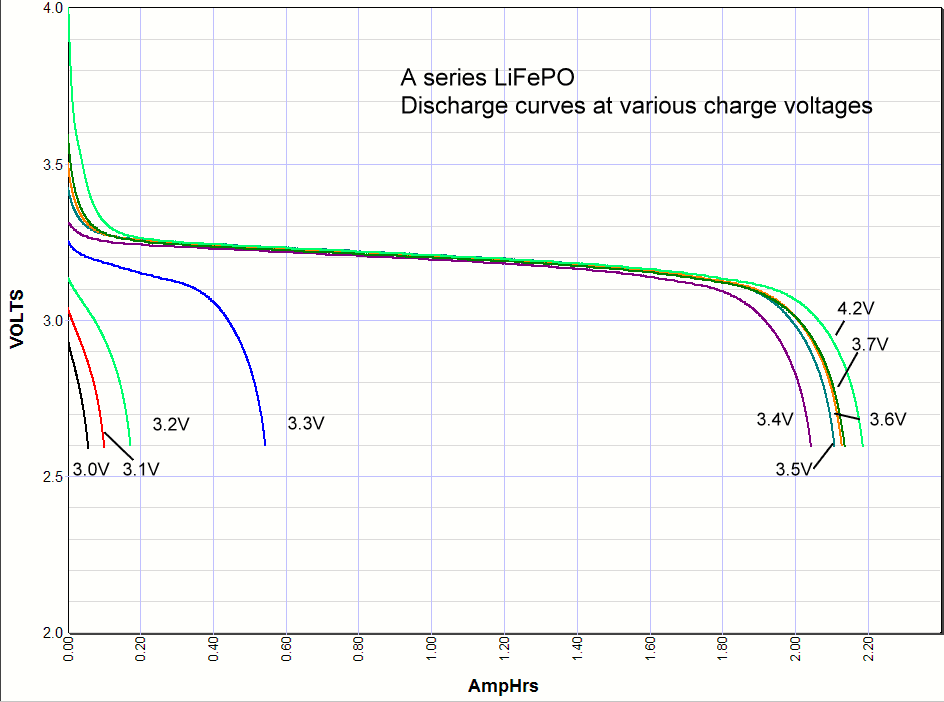
For charging the little 6aH one looks like about 3.4v is the magic number, little to be gained going higher. Not much detail on the ebay listing but their charger says 14.6v, so 3.65v per cell. already CV/CC buck/boost dc converters onboard to do that.
Charge voltage experiments with lithium iron phosphate batteries showing how capacity varies with charge voltage and higher cycle live with lower charge voltage

life-discharge-series-a.png


Doesn't say if the BMS does cell balancing though presumably must do??
"PCB Protection - Over-Charge, Over-Discharge, Overcurrent and Short Circuit".
 
But a float setting of e.g. 13.6V - 13.8V will effectively overcharge and degrade a lithium battery. The BMS will not kick in due to overcharging from float since the emergency faults that would trigger the BSM will not occur. Just a slow overcharge that will degrade the cells. Also a lot of users now seem to be avoiding their 'Lithium' charging settings on mains chargers finding them too high.
Seems a bit vague, any links/data ?

LiFePO4 Batteries On Boats
Floating LFP is a certainly a complex subject with scant data. Bottom line is to avoid floating LFP banks if you can, but a standby or storage voltage setting can be used.. For a typical standby voltage you would be best to be below 13.6V or 3.400VPC. Some have argued that a continual standby voltage of 3.35VPC or lower (13.4V for a 12V nominal bank) is not badly damaging over the long haul, but it may be so a storage voltage should also be considered as an option.

Any voltage below the 100% SoC point of the LFP battery would not be considered “floating” it. If using a standby voltage at say 3.35V per cell, the current into the battery will end up at 0A and be below the 100% SoC point.

Unfortunately, we don’t have enough data, across all cells, to confirm any capacity losses due to using a standby voltage that is held at or near 100% SoC. There is very little research and literature on holding LiFePo4 near 100% SoC. If a standby voltage is high enough it keeps you in the upper SOC range for long periods of time and these batteries, according to every LFP cell maker we know of, prefer to sit at a mid-range SOC when not being used. This is where a storage voltage comes in. These cells were originally designed to be actively cycled.

Can you hold a standby voltage at 3.400VPC or 3.35VPC or lower? Absolutely, but we don’t really know the long term affects other than to say it is it may shorten the life of some cells and may cause little to no harm to others. The premium cylindrical cells we tested at 3.400VPC (using a very expensive very linear power supply), lost no quantifiable capacity but some of the cheap cells lost as much as 16% in the same time frame using the identical charge source. Do you or will you know the quality of the cells inside your own battery and how they actually handle a “standby voltage“?
 
One less left now :) Ta for the link, that will get stashed for now but one day I reckon at least 100aH of lithium would be very nice to have :cool:

Mine's also put away for a rainy day. I reckon I've got another 3 years on my lead acids and already have a Sterling A2B to boost those. That will give me three years to plan for Lithium, for prices to come down and for good DIY marine systems to emerge. LFP is definitely the future but not yet the present, I think.
 
Mine's also put away for a rainy day. I reckon I've got another 3 years on my lead acids and already have a Sterling A2B to boost those. That will give me three years to plan for Lithium, for prices to come down and for good DIY marine systems to emerge. LFP is definitely the future but not yet the present, I think.
Think I'll end up one day with both, 100ah of LiFePo4 should be handy to make use of spare solar in the afternoon when the trojans are slowly getting up to 100% and hopefully make better use of alternator power again when the trojans just accept little current.
 
Just to clear up something that seems to be creeping in ...

LiFePo is max charged at 3.6V per cell. This is a fixed figure regardless of capacity.

To charge to this requires a slight over-voltage of 3.65V per cell. If you charge at 3.4V as per a previous post - the LiFe will never reach full charge and in fact will be barely over nominal level of 3.3V.
 
ALL Lithium batterys do not appreciate being charged continuously, they are designed to charge - discharge then recharge. They also if going to be idle for any length of time prefer to be at nominal balanced cell state - for LiFe that is 3.4V per cell.

This is well known and proven in the biggest consumer base of Lithium batterys - the RC community.

It is also why many Notebook Computers have the battery management mode where the mains power connected continuously has option of restricted to charging the battery to about 70 - 80% only until you decide to full charge.
 
Think I'll end up one day with both, 100ah of LiFePo4 should be handy to make use of spare solar in the afternoon when the trojans are slowly getting up to 100% and hopefully make better use of alternator power again when the trojans just accept little current.

Actually that is a really good idea as there is no requirement to get an LFP battery up to full charge to avoid sulfation (I know you know this but others may not). Such a battery would happily operate between 20 to 80% SOC for a very long time.
 
Top