LiFePo volts importance?

vic008

Well-Known Member
Joined
18 Aug 2007
Messages
507
Location
CHCH. NZ
Visit site
All Victron setup. Have always watched the battery SOC to tell when engine charging needed. But believe SOC hard to keep calibrated and not accurate. So should one be watching the volts and if so , what do you want to see? (100amp battery, balmar regulator,)
 
What you really want to see are the 4 individual cell voltages. Ideally they should all be the same within single figure millivolts. When discharging 3 to 3.1V means it's time to charge, when charging 3.5 to 3.6 means time to stop charging.
 
What you really want to see are the 4 individual cell voltages. Ideally they should all be the same within single figure millivolts. When discharging 3 to 3.1V means it's time to charge, when charging 3.5 to 3.6 means time to stop charging.
Wrong. You need a Smart shunt. Voltage profile is almost identical between 20-80% SOC
 
All Victron setup. Have always watched the battery SOC to tell when engine charging needed. But believe SOC hard to keep calibrated and not accurate. So should one be watching the volts and if so , what do you want to see? (100amp battery, balmar regulator,)
It's the other way around. The voltage tells you very little about the state of charge. The shunt should be keeping track of the power going in and out of the battery, and should be far more accurate.
 
agree with previous posters on shunt and monitor.
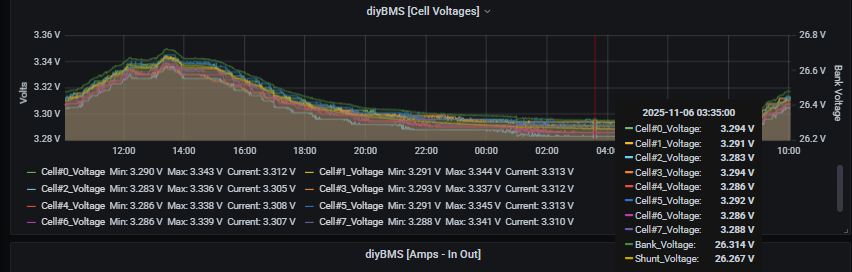
FWIW, this is the state of my 8S 24V EVE304Ah cell bank today. cursor on last night bank discharging constantly at 1.4A, and values under are current values, system charging at ~3A on an heavily overcast day. SOC overall between 55-59%. Left is cell values, right is bank and shunt values (0.05V variation, never bothered to fix on that...).
You cannot get anything meaningful by checking voltage alone on lifepo4 tbh...

1762416817013.png
All that data come on 1min intervals (yes I know an overkill but it's free so why not) and stored on my office server on an influx DB from diyBMS (which is a non-transistor based BMS, featuring simple passive balancing when fully charged) Cells are typically on a 7-11mV range.
 
The Smart Shunt is not very accurate - like the Pirate's Code it's more sort of guidelines really. For safety purposes the cell voltage is important - a good reason why I never fit the over priced Victron batteries or many other brands ; I want to see the cell voltage and balance . For day to day not running out of power the shunt is fine - it's accurate to a couple of percent out of true from my experience and that's good enough. LiFePo is notoriously difficult as 13.2v covers about 70% of the range.

So the the OP if you have the shunt and monitor then just keep an eye as before. You may be 1-2% out but that's no big deal with Lithium
 
Unless you regularly charge the batteries to 100%, which syncs the Smartshunt the SOC will slowly drift further and further out. It may only be 1-2% off in a day, but that's compounded for every day you don't charge them to 100%.
 
Last edited:
  • Like
Reactions: vas
Unless you regularly charge the batteries to 100%, which syncs the Smartshunt the SOC will slowly drift.
+1

during the whole 2025 summer season here, I didn't manage to get them to 100% to balance even once - drifted a 5-6% due to the v.accurate shunt used in the installation.
Did it last month following turning off the fridges with boat in port (no shorepower in my mooring!)

V.
 
The Smart Shunt is not very accurate - like the Pirate's Code it's more sort of guidelines really. For safety purposes the cell voltage is important - a good reason why I never fit the over priced Victron batteries or many other brands ; I want to see the cell voltage and balance . For day to day not running out of power the shunt is fine - it's accurate to a couple of percent out of true from my experience and that's good enough. LiFePo is notoriously difficult as 13.2v covers about 70% of the range.

So the the OP if you have the shunt and monitor then just keep an eye as before. You may be 1-2% out but that's no big deal with Lithium
1 or 2% is very good compared to every other way of monitoring. You can't tell if you battery are 30% charged or 70% charged without a shunt. Who cares if they are 31% or 69%. It's irrelevant if all you want to know is do i need to charge. The problem I have come across is that if you don't occasionally get the battery to 100% charge, the shunt will wander away from a true reading. Assuming 3.6v per cell is 100%, it would be useful to occasionally get the 12v battery to 14.4v and reset the smart shunt. If you set 14.4v as the 100% figure in the shunt, it will automatically reset to 100%
 
Last edited:
agree with previous posters on shunt and monitor.
FWIW, this is the state of my 8S 24V EVE304Ah cell bank today. cursor on last night bank discharging constantly at 1.4A, and values under are current values, system charging at ~3A on an heavily overcast day. SOC overall between 55-59%. Left is cell values, right is bank and shunt values (0.05V variation, never bothered to fix on that...).
You cannot get anything meaningful by checking voltage alone on lifepo4 tbh...

View attachment 201694
All that data come on 1min intervals (yes I know an overkill but it's free so why not) and stored on my office server on an influx DB from diyBMS (which is a non-transistor based BMS, featuring simple passive balancing when fully charged) Cells are typically on a 7-11mV range.
I don't suppose you get a lot of work done in your office, with all these distractions.
 
  • Haha
Reactions: vas
I don't suppose you get a lot of work done in your office, with all these distractions.
I usually work from home but the screen capture you saw is available over the web from wherever I am (pc/tablet/mobile) :p
On a serious note, I set everything up during the covid lockdown, now it just works no input required.
I may check the screen/log once every couple of days just to make sure nothing odd (saves me visiting the boat which is a 10min walk away...)
It is useful for debugging odd behaviour of subsystems and in order to better understand how boat electrics behave in real time.

V.
 
Wrong. You need a Smart shunt. Voltage profile is almost identical between 20-80% SOC
But at around 20% it starts to tail off so it's time to charge and at about 90% starts to rise so time to stop charging. A useful guide if you don't have a battery monitor.
 
Last edited:
But at around 20% it starts to tail off so it's time to charge and at about 90% starts to rise so time to stop charging. A useful guide if you don't have a battery monitor.
It all happens so quickly that you would need to be watching it all the time to catch it. It really not a great way to monitor SOC on lithium
 
Top