
Lifeboats .... Again

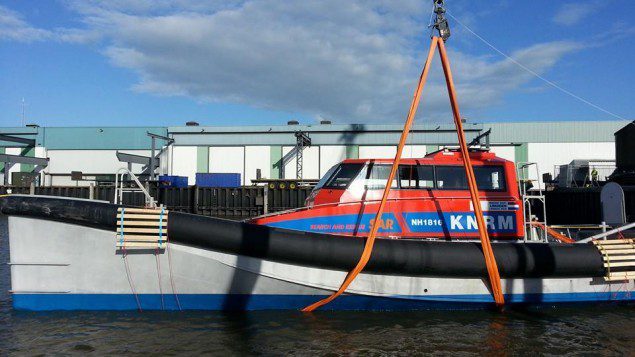
Oh, and look. The Dutch are planning some new boats. An off the shelf hull? With props?

Er… no.
1379715_158010607741715_1433622870_n-635x357.jpg


1385999_158011381074971_107385351_n-635x396.jpg


Can't imagine this spec comes cheap.

Length overall: 19.30 m.
Beam: 6.54 (including heavy duty ‘D’ shaped fenders)
Draft: 1.10 m. (reduced draft for operation in shallow waters)
Weight: 32.5 tonnes
Minimum Crew: 6
Fuel oil: 4.9 m3, 4.16 ton
Carrying max. 120 people (25 inside)
Construction: Marine grade light alloy chined hull and mechanical mounted composite wheelhouse
Classification: Lloyds Register, notation: ✠ 100 A1, SSC Patrol, HSC, G3[✠] LMC
Typical endurance: 12 hours at 25 Knots plus 4 hours at 12 Knots, giving a 348 Nautical miles range.
Max. speed at trial conditions: 31 Kts.
Propulsion: 2 x MTU 8V2000M84L engines with Hamilton 571 water-jets and ZF 2000 gearboxes
Electronics: integrated bridge (SIMS, Ships Information and Management System) with multifunctional, touch screen based system, covering navigation, communication, operational information and signalizing of equipment. Five compatible touch screens mounted for the 3 front row crew positions.
Voyage Data Recorder, several CCTV units, wireless intercom, etc.
Picking up people in horizontal position from the water with hydraulic rescue platform
Two stretchers for patient transport
Towing of small pleasure and fishing craft (bollard pull 7 ton)
Fire fighting on small craft
Technical assistance for small craft.
Significant noise reduction. Set at max. 75 Db
Focus on restricted emission (meet IMO tier 2 – 3 emission standards) and other environmental aspects (outside noise

http://youtu.be/igVY3hkbgVY

(At no point during the whole film do we hear from an accountant)

How much does it cost and how much is their trailor? :p

PS Lovely boat too.
 
OK Fat Cats is an emotive expression and and the employment rates are probably not out of sync with those of the City of London. However the French have shown that there is another model which works, where not only the crews volunteer but also the administrators.

I think now that I have said as much as I can or need to say on the subject - much to the relief of many I'm sure. I'll leave you to judge - unless somebody starts spouting something again....!!

And I'll welcome peace breaking out at this point ...and I fully accept you are only being mischievous in comparing RNLI salaries with fat cat city wages.

PS: If you want to wage a war against excessive City costs for managing folk's pensions - I'll happily change colours and support you in full :)

THE END
 
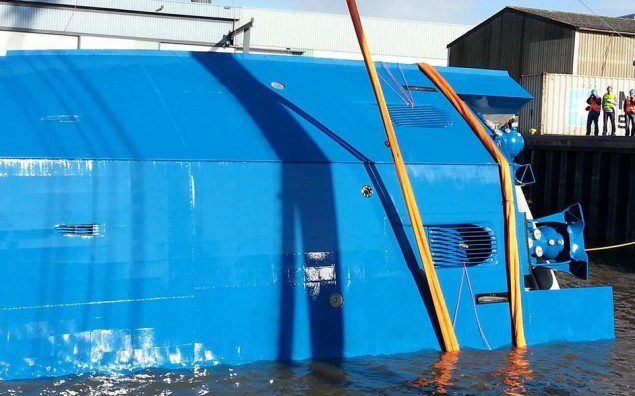
Oh, and look. The Dutch are planning some new boats. An off the shelf hull? With props?

Er… no.
1379715_158010607741715_1433622870_n-635x357.jpg


1385999_158011381074971_107385351_n-635x396.jpg


Can't imagine this spec comes cheap.

Length overall: 19.30 m.
Beam: 6.54 (including heavy duty ‘D’ shaped fenders)
Draft: 1.10 m. (reduced draft for operation in shallow waters)
Weight: 32.5 tonnes
Minimum Crew: 6
Fuel oil: 4.9 m3, 4.16 ton
Carrying max. 120 people (25 inside)
Construction: Marine grade light alloy chined hull and mechanical mounted composite wheelhouse
Classification: Lloyds Register, notation: ✠ 100 A1, SSC Patrol, HSC, G3[✠] LMC
Typical endurance: 12 hours at 25 Knots plus 4 hours at 12 Knots, giving a 348 Nautical miles range.
Max. speed at trial conditions: 31 Kts.
Propulsion: 2 x MTU 8V2000M84L engines with Hamilton 571 water-jets and ZF 2000 gearboxes
Electronics: integrated bridge (SIMS, Ships Information and Management System) with multifunctional, touch screen based system, covering navigation, communication, operational information and signalizing of equipment. Five compatible touch screens mounted for the 3 front row crew positions.
Voyage Data Recorder, several CCTV units, wireless intercom, etc.
Picking up people in horizontal position from the water with hydraulic rescue platform
Two stretchers for patient transport
Towing of small pleasure and fishing craft (bollard pull 7 ton)
Fire fighting on small craft
Technical assistance for small craft.
Significant noise reduction. Set at max. 75 Db
Focus on restricted emission (meet IMO tier 2 – 3 emission standards) and other environmental aspects (outside noise

http://youtu.be/igVY3hkbgVY

(At no point during the whole film do we hear from an accountant)

and the SIMS package adopted after I believe was a visit to Ijmuiden where Dutch LB HQ is by a Tamar lifeboat visit some years ago. Cost of new Dutch boat is about "m euros perhaps abit less.
 
Dear Sybarite,
My oh my, what a stream of insults. Do you have some personal vendetta against the RNLI?

Dogleg drives these things in F10 winds tells you that he (and his son) are happy with the boats, and you imply he has not noticed the fact that fat cats are skimming off oodles of cash and that his jet drives are rubbish.

I tell you that the RNLI's investment reserves are entirely consistent with good practice and you lay into me. Incidentally your comparison of capital returns and dividend income as like comparing "apples and oranges" is just flat wrong.

You casually dismiss the ICSA sponsored research I quoted as the result of them ...not looking as closely as you.

Your point on endowments confuses individual endowments with a charity following an "endowment model", whereby it seeks to raise a substantial part of its income from investment sources. Your logic respect to the RNLI's excess investable reserves would be dismissed outright by the Charity Commission. Perhaps they too need some accounting lessons?

Finally, you sneeringly quote Oscar Wilde at the very chap we'd all pray to appear out of the spray when things go pear shaped on a stormy night - so here’s a quote from Mark Twain:

“It ain't what you don't know that gets you into trouble. It's what you know for sure that just ain't so!!”

Dogleg drives these things in F10 winds tells you that he (and his son) are happy with the boats, and you imply he has not noticed the fact that fat cats are skimming off oodles of cash and that his jet drives are rubbish.


We don't have jet drives and of course we know what the top men are paid jobs are advertised throughout the RNL and there is criticism from people at the sharp end but generally resulting from the RNLI cutting costs. We are not daft or unquestioning
 
Examples please - other than preparing a 10 year plan.


Excellent, no discussion.


Some is but some would appear not to be.


Well run and efficient : not on the face of it or it depends on your definition of efficiency. Sufficiently solvent : £613m reserves and bringing in nearly half a million pounds a day - and spending net £10m on boats - that merits a triple A rating.


Did you know what the figures were? You were wrong on the beneficiaries of pensions.


There was a significant reduction in legacies and an increase in costs linked to restructuring to reinforce communication and fund raising.[/QUOTE]

the RNLI therefore with its extensive reserves (your opinion) would be immune to this. I do read the accounts incidentally and have a first class degree from a leading university so please credit me with some intelligence rather than being an unquestioning sheep being led astray. I have asked you if you have been on a Severn or Tamar and compared their level of equipment with a French boat. Until you have a comparison is difficult. I have been on both. One example might be the inflatable carried by the larger French boats. The Y Class carried by RNLI boats is possibly superior.
 
[

the RNLI therefore with its extensive reserves (your opinion) would be immune to this. I do read the accounts incidentally and have a first class degree from a leading university so please credit me with some intelligence rather than being an unquestioning sheep being led astray.

It's not just a question of intelligence; it's also of experience and knowing what to look for. My ex is a Cambridge first (the brightest student she had ever had, her headmistress told me) but she hasn't a clue about finance.

I have asked you if you have been on a Severn or Tamar and compared their level of equipment with a French boat. Until you have a comparison is difficult. I have been on both.

Have you been on the new generation Classe 1's or the new CTT?
 
the boat being launched from the beach is a37ft Valentijn class beach launched boat similar identical to the Caister volunteer lifeboat. On the North Sea coast I believe I am correct in thinking that the Dutch CG do not class the Valentijn as an all weather lifeboat. All Arie Vissier class lie afloat eg Breskens Hook of Holland Imuiden Den Helder Ameland.


I have been on the French lb at Boulogne and Oiusterham and a smaller verdette in the Med at the mouth of the Rhone. I have not been on the newer boats which hull wise look impressive but I am not being critical of the French boats conversely you may know about finance but you may not be an expert at running a SAR organisation.

You really ought to write to Poole and put your points to them I am sure you will receive an illuminating reply
 
In the clip they are using a trailor to launch an Arie Visser. It looks like a more straight forward design.

the boat being launched from the beach is a 37ft Valentijn class beach launched boat identical to the Caister volunteer lifeboat. On the North Sea coast I believe I am correct in thinking that the Dutch CG do not class the Valentijn as an all weather lifeboat. All Arie Vissier class lie afloat eg Breskens Hook of Holland Imuiden Den Helder Ameland.


I have been on the French lb at Boulogne and Oiusterham and a smaller verdette in the Med at the mouth of the Rhone. I have not been on the newer boats which hull wise look impressive but I am not being critical of the French boats
conversely you may know about finance but you may not be an expert at running a SAR organisation.

You really ought to write to Poole and put your points to them I am sure you will receive an illuminating reply
 
I have been on the French lb at Boulogne and Oiusterham and a smaller verdette in the Med at the mouth of the Rhone. I have not been on the newer boats which hull wise look impressive but I am not being critical of the French boats
conversely you may know about finance but you may not be an expert at running a SAR organisation.

Absolutely not an expert concerning the running of an SAR organisation. As I said before when I audited a company I wasn't an expert on that either but a basic deliverable on each audit was a special report relating to internal controls and efficiency. No matter what the activity, experience of other operations could suggest perhaps alternative and better ways of doing things. The reports were never dismissed out of hand. We were careful too what we put into them because we had to incorporate the directors' response.

The thread last year started when I dared to compare the new Classe 1 Vedette with the Shannon, because on paper they appeared similar: size, speed, etc except the Shannon was twice as expensive. It was explained to me that the Shannon was so much better at sustaining high speeds in heavy seas (http://www.youtube.com/watch?v=QpSQejLKDNw --- 00:20 oops! ) and could work in shallow water, had special seats to cushion the G forces, etc etc.. I said that the French would probably use a large RIB to rescue people in the sea off a beach and leave the boat until later. They also have good helicopter coverage where I am.

You really ought to write to Poole and put your points to them I am sure you will receive an illuminating reply

I would be surprised if they are not aware of this thread. In fact it would be very interesting if they responded to the points on this forum for my benefit and for the vindication of those who criticize my intervention. I don't think they will though.
 
Last edited:
Absolutely not an expert concerning the running of an SAR organisation. As I said before when I audited a company I wasn't an expert on that either but a basic deliverable on each audit was a special report relating to internal controls and efficiency. No matter what the activity, experience of other operations could suggest perhaps alternative and better ways of doing things. The reports were never dismissed out of hand. We were careful too what we put into them because we had to incorporate the directors' response.

The thread last year started when I dared to compare the new Classe 1 Vedette with the Shannon, because on paper they appeared similar: size, speed, etc except the Shannon was twice as expensive. It was explained to me that the Shannon was so much better at sustaining high speeds in heavy seas (http://www.youtube.com/watch?v=QpSQejLKDNw --- 00:20 oops! ) and could work in shallow water, had special seats to cushion the G forces, etc etc.. I said that the French would probably use a large RIB to rescue people in the sea off a beach and leave the boat until later. They also have good helicopter coverage where I am.


I would be surprised if they are not aware of this thread. In fact it would be very interesting if they responded to the points on this forum for my benefit and for the vindication of those who criticize my intervention. I don't think they will though.

Is the Verdette Class classified as an all weather lifeboat by Crossma the French CG?

The video of the Shannon under trials was taken well before it was published in the yachting magazine, it was I think the first rough weather trials in the Portland Race SW 8 wind against tide. Note the word trials, the boat was wired up with monitors to record pitch, slamming, acceleration, etc especially important was transverse stability. The 2 Arie Vissier Dutch lifeboats that have capsized did so bow over stern. The new Dutch boat has a vastly different bow and fender. The Dutch are also adopting SIMS used by the RNLI in Tamars and now Shannons although they are calling it by another name.

The Shannon is of course an all weather boat, you talk of ribs being used for shallow water work, you may be forgetting that there are many areas of sandbanks around the BI well offshore, even inshore conditions may preclude use of an ILB. Since the initial trials modifications have been made to weight distribution etc after all that is what trials are for. Most RNLI stations these days have an inshore boat as well as an all weather boat not forgetting the ILB only stations so inshore work is well catered for, indeed ILBs do 60% of the work.

Now to the seats, being old enough to remember being tossed around in a 9 knot Watson and Barnett class lifeboat hanging on to anything you could hooray for the seats. The RNLI Medical Committee has some of best brains in the business of body stresses and much else besides. Now doing 25 knots or perhaps even 18 to sit in a seat with suspension that takes away the shock of wave impact allowing you to go out on deck to do what ever in a far fitter state is to be welcomed. I suspect the hand of Health and Safety which the RNLI cannot ignore legally, is not so overbearing in France.

Finally RNLI boats often go 50 miles or more especially in Scotland and the Irish west coast in all weathers. An Irish boat recently went 100 miles in 7/8
taking 17 hours to tow in a trawler.

I do think you should consider writing to Poole they will I'm sure answer your questions and explain their reasons for operating the way they do.

Finally Finally can you please answer this simple question? Have you been on board a Severn or Tamar class lifeboat to judge its equipment level against the newer French boats.


I shall now have to leave this discussion firstly to take my dog out in the pouring rain, being a Golden Retriever he of course doesn't care and then to leave for a passage down to the Canaries for an owner who doesn't fancy Biscay in winter. We will probably even call in somewhere in Brittany.
 
Is the Verdette Class classified as an all weather lifeboat by Crossma the French CG?

The video of the Shannon under trials was taken well before it was published in the yachting magazine, it was I think the first rough weather trials in the Portland Race SW 8 wind against tide. Note the word trials, the boat was wired up with monitors to record pitch, slamming, acceleration, etc especially important was transverse stability. The 2 Arie Vissier Dutch lifeboats that have capsized did so bow over stern. The new Dutch boat has a vastly different bow and fender. The Dutch are also adopting SIMS used by the RNLI in Tamars and now Shannons although they are calling it by another name.

The Shannon is of course an all weather boat, you talk of ribs being used for shallow water work, you may be forgetting that there are many areas of sandbanks around the BI well offshore, even inshore conditions may preclude use of an ILB. Since the initial trials modifications have been made to weight distribution etc after all that is what trials are for. Most RNLI stations these days have an inshore boat as well as an all weather boat not forgetting the ILB only stations so inshore work is well catered for, indeed ILBs do 60% of the work.

Now to the seats, being old enough to remember being tossed around in a 9 knot Watson and Barnett class lifeboat hanging on to anything you could hooray for the seats. The RNLI Medical Committee has some of best brains in the business of body stresses and much else besides. Now doing 25 knots or perhaps even 18 to sit in a seat with suspension that takes away the shock of wave impact allowing you to go out on deck to do what ever in a far fitter state is to be welcomed. I suspect the hand of Health and Safety which the RNLI cannot ignore legally, is not so overbearing in France.

Finally RNLI boats often go 50 miles or more especially in Scotland and the Irish west coast in all weathers. An Irish boat recently went 100 miles in 7/8
taking 17 hours to tow in a trawler.

I do think you should consider writing to Poole they will I'm sure answer your questions and explain their reasons for operating the way they do.

Finally Finally can you please answer this simple question? Have you been on board a Severn or Tamar class lifeboat to judge its equipment level against the newer French boats.


I shall now have to leave this discussion firstly to take my dog out in the pouring rain, being a Golden Retriever he of course doesn't care and then to leave for a passage down to the Canaries for an owner who doesn't fancy Biscay in winter. We will probably even call in somewhere in Brittany.


No I have never been in a Severn nor a Tamar. However perhaps you would indicate what essential equipment they have that the French boats don't. I seem to remember that that the French boats had heat seeking cameras which the Uk boats didn't. Whatever, I think the French boats have the equipment to do their job.

As far as seats are concerned I liked what they said in the Dutch clip where they analysed that the crew were subject to 6 or 7G in the brutal decelerations especially when the bow lifted to a wave. Their solution to this was to consider the blade bow to slice through the wave instead of going over them. This means that the boat stayed much more on an even keel. Their architects are de Vries Lentsch.

I was reading an article on French lifeboats in an October yachting magazine. The service is coordinated by the seven "CROSS" centres in France who link up to the Affaires Maritimes, the Navy, the Douane, the Gendarmerie Maritime and any or all of these services may be called upon in an emergency. Normally the SNSM are called upon for emergencies within 20 miles of the coast.

Talking about the new Classe 1 boats, they operate at 24 knots with two 460hp Iveco diesels and have a 24 hour range. They are not officially classed as AWB's but that's not what their crews say. They are unsinkable and self-righting.

When are you likely to be in Brittany? If I'm there then I'll buy you a beer...
 
No I have never been in a Severn nor a Tamar. However perhaps you would indicate what essential equipment they have that the French boats don't. I seem to remember that that the French boats had heat seeking cameras which the Uk boats didn't. Whatever, I think the French boats have the equipment to do their job.

As far as seats are concerned I liked what they said in the Dutch clip where they analysed that the crew were subject to 6 or 7G in the brutal decelerations especially when the bow lifted to a wave. Their solution to this was to consider the blade bow to slice through the wave instead of going over them. This means that the boat stayed much more on an even keel. Their architects are de Vries Lentsch.

I was reading an article on French lifeboats in an October yachting magazine. The service is coordinated by the seven "CROSS" centres in France who link up to the Affaires Maritimes, the Navy, the Douane, the Gendarmerie Maritime and any or all of these services may be called upon in an emergency. Normally the SNSM are called upon for emergencies within 20 miles of the coast.

Talking about the new Classe 1 boats, they operate at 24 knots with two 460hp Iveco diesels and have a 24 hour range. They are not officially classed as AWB's but that's not what their crews say. They are unsinkable and self-righting.

When are you likely to be in Brittany? If I'm there then I'll buy you a beer...

taking a break form drying the dog he did of course go in the sea
u r right about the new Dutch boat
the RNLI did the same experiments when developing the Tamar seating Tamar is a planning hull basically glides through the water very little slamming
been on one Arie Vissier going out of harbour in heavy swell bow lifted alarmingly new boat will be improvement


as to Brittany don't know really waiting for weather window and depends on crew maybe Lorient or Etel or Cameret would like to go to ST Nazaire some father knew it well in WW2
 
No I have never been in a Severn nor a Tamar. However perhaps you would indicate what essential equipment they have that the French boats don't. I seem to remember that that the French boats had heat seeking cameras which the Uk boats didn't. Whatever, I think the French boats have the equipment to do their job.

As far as seats are concerned I liked what they said in the Dutch clip where they analysed that the crew were subject to 6 or 7G in the brutal decelerations especially when the bow lifted to a wave. Their solution to this was to consider the blade bow to slice through the wave instead of going over them. This means that the boat stayed much more on an even keel. Their architects are de Vries Lentsch.

I was reading an article on French lifeboats in an October yachting magazine. The service is coordinated by the seven "CROSS" centres in France who link up to the Affaires Maritimes, the Navy, the Douane, the Gendarmerie Maritime and any or all of these services may be called upon in an emergency. Normally the SNSM are called upon for emergencies within 20 miles of the coast.

Talking about the new Classe 1 boats, they operate at 24 knots with two 460hp Iveco diesels and have a 24 hour range. They are not officially classed as AWB's but that's not what their crews say. They are unsinkable and self-righting.

When are you likely to be in Brittany? If I'm there then I'll buy you a beer...

SIMS on Tamar and Shannon not sure about heat seeking equipment will try and see a French lb somewhere
 
SIMS on Tamar and Shannon not sure about heat seeking equipment will try and see a French lb somewhere


I note that each crew member has a screen in front of him. Is this just for information or can the crewman input and act from his seat?


Here is what they say about French boat equipment in their last annual report.


Nos bateaux sont dotés d'équipements modernes sans cesse optimisés :

Systèmes d'aide à la navigation : radar, sondeur, GPS et traceur de route.

Equipements de recherche et localisation des naufragés : radio goniomètre VHF permettant d'identifier la localisation de l'origine du signal de détresse, jumelles, jumelles à vision nocturne, projecteur de recherche à lumière chaude ou à lumière froide, systèmes Wavefinder et Seareka, qui permettent de localiser précisément un homme tombé à la mer.

Systèmes de communications : radio VHF/ASN, canaux 16/70, appareils SMDSM - système mondial de détresse et de sécurité en mer et les bateaux sont dotés d’équipements AIS -Automatic Indentification System - permettant d'identifier un bateau grâce à son numéro MMSI (Maritime Mobile Service Identity).

Matériel de premiers secours : chaque bateau reçoit une dotation médicale dont la réglementation a changé en mai 2011 comprenant un matériel de secourisme premiers soins, DSA, défibrillateur semi-automatique et de l’oxygène.

Actuellement l'équipe travaille sur :
les casques sauveteurs embarqués et nageurs-sauveteurs ;
les intercoms ;
les lampes frontales ;
les combinaisons sèches ;
les combinaisons humides ;
les équipements SNB2 (sauveteur nageur de bord de niveau 2) ;
et de nombreux autres produits.


The International Maritime and Rescue Organisation of which all (?) the lifeboat services are members pool their information with the intention of coming up with the best solutions. IMHO this is the way to go.

http://www.international-maritime-rescue.org/index.php/projects/rescue-boat-guidelines
 
I note that each crew member has a screen in front of him. Is this just for information or can the crewman input and act from his seat?


Here is what they say about French boat equipment in their last annual report.


Nos bateaux sont dotés d'équipements modernes sans cesse optimisés :

Systèmes d'aide à la navigation : radar, sondeur, GPS et traceur de route.

Equipements de recherche et localisation des naufragés : radio goniomètre VHF permettant d'identifier la localisation de l'origine du signal de détresse, jumelles, jumelles à vision nocturne, projecteur de recherche à lumière chaude ou à lumière froide, systèmes Wavefinder et Seareka, qui permettent de localiser précisément un homme tombé à la mer.

Systèmes de communications : radio VHF/ASN, canaux 16/70, appareils SMDSM - système mondial de détresse et de sécurité en mer et les bateaux sont dotés d’équipements AIS -Automatic Indentification System - permettant d'identifier un bateau grâce à son numéro MMSI (Maritime Mobile Service Identity).

Matériel de premiers secours : chaque bateau reçoit une dotation médicale dont la réglementation a changé en mai 2011 comprenant un matériel de secourisme premiers soins, DSA, défibrillateur semi-automatique et de l’oxygène.

Actuellement l'équipe travaille sur :
les casques sauveteurs embarqués et nageurs-sauveteurs ;
les intercoms ;
les lampes frontales ;
les combinaisons sèches ;
les combinaisons humides ;
les équipements SNB2 (sauveteur nageur de bord de niveau 2) ;
et de nombreux autres produits.


The International Maritime and Rescue Organisation of which all (?) the lifeboat services are members pool their information with the intention of coming up with the best solutions. IMHO this is the way to go.

http://www.international-maritime-rescue.org/index.php/projects/rescue-boat-guidelines

yes any crew member can input from seat idea is to minimise movement within the boat when underway every function available on all screens except the tea maker mechanic seat has some additional controls I think my French is not perfect but I think the French equipment spec is similar to RNLI AWLBs
 
No dogleg you are incorrect.From memory,any Crew can view any 'screen' but input into the system is govererned by a hierarcy.Coxswain's screen 'can access all areas',Mech's screen can access areas relevent to engines/bilges etc only,Navigator can access plotter/radar etc only and so on.This protects the system/boat from having the settings altered by someone who does'nt really know what they are doing when sitting in a Crew seat.This was the set up on the Shannon I did a passage on last March.I also have not been on a Tamar but I believe that this set up is used aboard.
Going back to impellor/prop changes.I once(eleven years ago) changed an impellor on Odin which was the test bed for the jet units.It took about 45 minutes using basic tools.Changeing a prop on a Mersey takes about an hour and involves drilling and tapping a hole to secure the 'boss' to the prop so not much in it time wise.
Cheers
 
Last edited:
Top