Lifeboats .... Again

They did charge here
[

It would not appear that life was at risk here. They performed a tow job and requested payment for it.


We are talking about an incident happening probably more than ten years ago. I'm referring to the policy today.

Incidentally in this 2004 post I already was pointing out the differences between the RNLI and the SNSM finances.

Another two cases here from 2008, when did it change?
http://www.ybw.com/forums/showthread.php?172773-French-Lifeboat-tow
Either way I prefer a voluntary donation system rather than partly state funded with payments for recovery. Perhaps selfish but I do make a point of contributing to the RNLI and have not needed to call on them yet.
 
Another two cases here from 2008, when did it change?
http://www.ybw.com/forums/showthread.php?172773-French-Lifeboat-tow
Either way I prefer a voluntary donation system rather than partly state funded with payments for recovery. Perhaps selfish but I do make a point of contributing to the RNLI and have not needed to call on them yet.

When their total operating budget is perhaps 10% of that of the RNLI then it is perhaps appropriate to request that those directly benefitting contribute. The contribution only covers out of pocket expenses for the service, no profit element is concerned. The charge is on a sliding scale depending on the size of the asset mobilised.

It's also worth noting that the % contribution by the state has and is being gradually being diminshed. 24% in 2012.
 
Last edited:
Aha I see the problem - in fact perhaps two:

First A Charity's Reserves: The £600m you mention in post #47 is indeed consistent with the £612m stated in the RNLI's stated reserves in its 2012 accounts. But, the "reserves" word is accounting terminology and NOTHING TO DO WITH THE RNLI'S FREE CASH RESERVES, WHICH ARE £251m (note 7 /2012 accounts). £612m is simply the total of the liability side of the B/S which definitionally equals total assets.

Dear oh dear: accounts aren't your thing....

The £612m = NET assets ie assets less liabilities = Reserves. (In a commercial operation it would be Net assets = the ownership interest consisting of capital, reserves and retained profits.)

The reserves have different conditions of liquidity but that does not mean that they are not reserves.


Moreover, the accounting entries you state, whilst correct, miss the step whereby fixed assets are depreciated. Were they not, the RNLI would not be correct in stating £612m of total assets and would be in contravention of UK accounting regulations as amended by relevant international treaties.

Where do I miss this? Depreciation is included in the figures I presented.

Cost of Fixed assets = £639m
Less accumulated depreciation -£295m
Net Fixed assets £344m (of which boats = £80m)
Investments £257m
Net current assets £ 42m
Less LT liabilities -£ 31m (staff pensions 24.9, dependants 5.7)
Net assets represented by reserves £612m

(Please somebody : I would appreciate knowing how to align figures or to insert a table .....)

With respect to your note about accounting regulations, it is NOT ALWAYS appropriate to charge depreciation in a charity. Depreciation has two basic functions: to provide comparability of operating results from one year to the next by spreading the cost of a fixed asset over its effective life and, to retain funds in the business in order to be able to replace those assets when the time comes.

However a charity can vote a budget from one year to the next . The budget that they vote and intend to fund may not necassarily have any comparability with previous years.

Trivia : the RNLI depreciation charge is greater than the total operating budget of the SNSM.

Secondly, the RNLIs 2012 £175m income is augmented by a paltry £3.8m contribution from investment income; the rest comes from fundraising, legacies, etc.

You have only included investment income for the year but not the net gains on disposal of stocks (which is an essential part of portfolio management) of £12.1m.

Your point re 1x Shannon = 3 day's box shaking

I didn’t say box shaking. Legacies contributed by far the largest slice at £101m.

is precisely why the RNLI is correct in attempting to slowly slowly build its reserves
.

You call a £38m increase in one year "slowly slowly"...!!?? I wonder what happens when they get into gear?
 
Last edited:
I’m perplexed. Earlier in this thread you wrote: “If I'm wrong, challenge me with facts. I don't accept I'm wrong just because you say so. I may well be wrong but justify why.”

I tried to justify why and am met with a rapidly rising soufflé of insults, irrelevancies and ground shifting! Given the well deserved gold standard reputation of the RNLI, please answer:

1. Do you agree that £251m and not £612m is the value of the RNLI’s investment fund? The £612m you keep mentioning is simply total assets and a big red herring! The RNLI made close to zero additions to its investment portfolio in 2012. Do you accept that the £38m increase in reserves you keep referring to is in fact an increase in net assets and nothing to do with investment reserves?

2. Including net disposals, the RNLIs investment income of £12m represented a 4.6% yield on its £251m investment portfolio. This represents 10% of the RNLI’s lifesaving activities of £116.8m. Do you find this excessive?

3. Do you have any view as to what the appropriate endowment/annual-cash-raising ratio should be? Why do you imagine so many other charities are going down the endowment route?

4. Why are you so confident current legacy levels won’t start to fall off due to social and demographic shifts in the UK?

And finally; the specialist publication “Governance & Compliance” recently wrote:
“The research, carried out on behalf of ICSA by the Reputation Institute, ranked the RNLI as the best regarded charity in the UK, based on areas such as innovation, leadership and performance. The RNLI averaged a score of 94.7 per cent across all categories. This is the second year in a row that the RNLI has topped the charts.”

Is that just a case of “Dear oh dear: accounts aren't their thing either!”
 
Last edited:
Aha I see the problem - in fact perhaps two:


Dear oh dear: accounts aren't your thing....

The £612m = NET assets ie assets less liabilities = Reserves. (In a commercial operation it would be Net assets = the ownership interest consisting of capital, reserves and retained profits.)

The reserves have different conditions of liquidity but that does not mean that they are not reserves.


Where do I miss this? Depreciation is included in the figures I presented.

Cost of Fixed assets = £639m
Less accumulated depreciation -£295m
Net Fixed assets £344m (of which boats = £80m)
Investments £257m
Net current assets £ 42m
Less LT liabilities -£ 31m (staff pensions 24.9, dependants 5.7)
Net assets represented by reserves £612m

(Please somebody : I would appreciate knowing how to align figures or to insert a table .....)

With respect to your note about accounting regulations, it is NOT ALWAYS appropriate to charge depreciation in a charity. Depreciation has two basic functions: to provide comparability of operating results from one year to the next by spreading the cost of a fixed asset over its effective life and, to retain funds in the business in order to be able to replace those assets when the time comes.

However a charity can vote a budget from one year to the next . The budget that they vote and intend to fund may not necassarily have any comparability with previous years.

Trivia : the RNLI depreciation charge is greater than the total operating budget of the SNSM.


You have only included investment income for the year but not the net gains on disposal of stocks (which is an essential part of portfolio management) of £12.1m.


I didn’t say box shaking. Legacies contributed by far the largest slice at £101m.

.

You call a £38m increase in one year "slowly slowly"...!!?? I wonder what happens when they get into gear?


I am not an accountant, maybe you are but I do know about lifeboats and getting up at 0300 in January and going to sea in a force 10. You appear to have a long negative opinion of the RNLI, looking back at historic posts. Incidentally the last Arun was built in 1990 and there are no seasonal ILB stations now: all are all year.

Lets have something positive from you: you are now running the RNLI! What will you do, what will you change with regard to fund raising, publicity, boat procurement and design, ( I do hope you will consult lifeboat crews) the training and sea survival centre at Poole, the numerous fund raising branches, the corporate sponsorship, the long term plan for boat replacement and new shore works, retention of morale amongst full time staff and volunteer crew and fundraisers, the pension scheme, salary grades and of course these exorbitant reserves etc. Where do you think the RNLI will be after 10 years of your stewardship?

One thing you must do is this, namely to convince my son that paramount in your plan is a determination to have the very best boats that money can buy, the very best personal safety equipment, (lifejackets, foul weather gear etc), the very best maintainence and refit progress, adequate supply of spares, training and back up etc so that he will continue to have confidence that the RNLI cares more about his safety and well being than simply a balance sheet.
 
I am not an accountant, maybe you are but I do know about lifeboats and getting up at 0300 in January and going to sea in a force 10. You appear to have a long negative opinion of the RNLI, looking back at historic posts. Incidentally the last Arun was built in 1990 and there are no seasonal ILB stations now: all are all year
.

I think that there is a lot of misunderstanding of my position in all of this. I have consistently said that I have no criticisms at all of the brave volunteers and when I was resident in the UK the RNLI was the charity I most supported. Then (probably 2004) a discussion arose somewhere about the two services and so I decided to compare them. My first shock was that, at the time, the RNLI employed more people earning more than £50k than the total number of employees in France. Then there was a ten fold difference in the operating budgets for rescue services that were approximately in the same ball park for shouts and rescues.

End 2012 the RNLI employed 1624 FTE staff, the SNSM 65. I believe that neither is ideal and the optimum is in between the two. The SNSM had a serious deficit in 2011 and HO structures are being reinforced to attack the fund raising bit.

In fact I believe that my arguments are going in your sense - the money should be directed towards the rescue facilities and not to paying a top heavy executive structure. Does it not shock you that the directors received in pension contributions almost as much was charged for the lifeboat men's dependants? It does me. When you see a pension fund of £279m for employees and directors and a provision of £6m for dependants.

Lets have something positive from you: you are now running the RNLI! What will you do, what will you change with regard to fund raising, publicity, boat procurement and design, ( I do hope you will consult lifeboat crews) the training and sea survival centre at Poole, the numerous fund raising branches, the corporate sponsorship, the long term plan for boat replacement and new shore works, retention of morale amongst full time staff and volunteer crew and fundraisers, the pension scheme, salary grades and of course these exorbitant reserves etc. Where do you think the RNLI will be after 10 years of your stewardship?

One thing you must do is this, namely to convince my son that paramount in your plan is a determination to have the very best boats that money can buy, the very best personal safety equipment, (lifejackets, foul weather gear etc), the very best maintainence and refit progress, adequate supply of spares, training and back up etc so that he will continue to have confidence that the RNLI cares more about his safety and well being than simply a balance sheet.

As I said in another post, 3 days average income would buy a Shannon without drawing down on reserves. I would rather see this than the RNLI being run as a bank.

FWIW, if you are interested here is detailed info on the SNSM set up in terms of stations, boats, personnel and finances.

http://www.snsm.org/sites/default/files/RAPPORT_ANNUEL_2012_SNSM_0.pdf
 
Last edited:
.

I think that there is a lot of misunderstanding of my position in all of this. I have consistently said that I have no criticisms at all of the brave volunteers and when I was resident in the UK the RNLI was the charity I most supported. Then (probably 2004) a discussion arose somewhere about the two services and so I decided to compare them. My first shock was that, at the time, the RNLI employed more people earning more than £50k than the total number of employees in France. Then there was a ten fold difference in the operating budgets for rescue services that were approximately in the same ball park for shouts and rescues.

End 2012 the RNLI employed 1624 FTE staff, the SNSM 65. I believe that neither is ideal and the optimum is in between the two. The SNSM had a serious deficit in 2011 and HO structures are being reinforced to attack the fund raising bit.

In fact I believe that my arguments are going in your sense - the money should be directed towards the rescue facilities and not to paying a top heavy executive structure. Does it not shock you that the directors received in pension contributions almost as much was charged for the lifeboat men's dependants? It does me. When you see a pension fund of £279m for employees and directors and a provision of £6m for dependents.


As I said in another post, 3 days average income would buy a Shannon without drawing down on reserves. I would rather see this than the RNLI being run as a bank.

FWIW, if you are interested here is detailed info on the SNSM set up in terms of stations, boats, personnel and finances.

http://www.snsm.org/sites/default/files/RAPPORT_ANNUEL_2012_SNSM_0.pdf

In fact I believe that my arguments are going in your sense - the money should be directed towards the rescue facilities and not to paying a top heavy executive structure. Does it not shock you that the directors received in pension contributions almost as much was charged for the lifeboat men's dependants? It does me. When you see a pension fund of £279m for employees and directors and a provision of £6m for dependents.


No it does not shock me our boat is superb, the crew are backed up by div base and hq. I would rather have highly competent and well paid senior managers who run the RNLI efficiently and have a long term vision of its place ten years down the line than it being run by accountants who know the price of everything and the value of nothing. I am still awaiting your 10 year plan. I have looked closely at the SNSM website and indeed followed the search off Jersey last night with interest.


The SNSM link was not present in your previous post.
 
I’m perplexed. Earlier in this thread you wrote: “If I'm wrong, challenge me with facts. I don't accept I'm wrong just because you say so. I may well be wrong but justify why.”

I tried to justify why and am met with a rapidly rising soufflé of insults, irrelevancies and ground shifting!


If you get your facts wrong I mention it. When you get them wrong again I point out that maybe you haven’t understood them. Your opening remarks suggested that you were a professional in finance (investment manager ?) but I have pointed out where you made mistakes.

Where have I shifted my ground - and I don't believe I insulted you. If you believe that, I'm sorry.

Given the well deserved gold standard reputation of the RNLI, please answer:

1. Do you agree that £251m and not £612m is the value of the RNLI’s investment fund?


An investment fund is an asset, a reserve is on the other side of the balance sheet. I never said that the investment fund was £612m I said that reserves were. It’s not £251m anyway, that was the 2011 amount.

The £612m you keep mentioning is simply total assets and a big red herring!


You appear not understand the difference between total assets and total net assets. The latter includes liabilities.

The RNLI made close to zero additions to its investment portfolio in 2012. Do you accept that the £38m increase in reserves you keep referring to is in fact an increase in net assets and nothing to do with investment reserves?

It is an increase in net assets and an equal increase in reserves – it’s an arithmetic relationship. Do you understand the difference between a reserve fund and a reserve?

An investment fund is an asset, a reserve is on the other side of the balance sheet. I never said that the investment fund was £612m I said that reserves were. It’s not £251m anyway, that was the 2011 amount.

2. Including net disposals, the RNLIs investment income of £12m represented a 4.6% yield on its £251m investment portfolio. This represents 10% of the RNLI’s lifesaving activities of £116.8m. Do you find this excessive?

First it’s not 12.1, its 12.1 plus 3.8, not on 251 but on 257. The percentage is completely irrelevant it’s like adding apples and oranges.

3. Do you have any view as to what the appropriate endowment/annual-cash-raising ratio should be? Why do you imagine so many other charities are going down the endowment route?

Endowments are at the duscretion of the donor who simply says I don’t want you to spend this money, I want you to keep it to generate income. I don’t believe that there is a norm – but I may be wrong.
4. Why are you so confident current legacy levels won’t start to fall off due to social and demographic shifts in the UK?
*


Im not which is exactly why I am saying that the future viability of the RNLI should not depend on them. In consequence they should be looking at the other side of the income statement ie managing and optimizing their costs. Suppose legacies stop tomorrow, have the RNLI provided for severance costs? Would they still be able to provide a service to save lives? That is why I suggested that they had got lazy about managing their costs, because, quite frankly today they don’t have to worry about things like that. They have all the funds in the world to work with.

And finally; the specialist publication “Governance & Compliance” recently wrote:
“The research, carried out on behalf of ICSA by the Reputation Institute, ranked the RNLI as the best regarded charity in the UK, based on areas such as innovation, leadership and performance. The RNLI averaged a score of 94.7 per cent across all categories. This is the second year in a row that the RNLI has topped the charts.”


That’s what I used to think too. Before I looked more closely.
 
In fact I believe that my arguments are going in your sense - the money should be directed towards the rescue facilities and not to paying a top heavy executive structure. Does it not shock you that the directors received in pension contributions almost as much was charged for the lifeboat men's dependants? It does me. When you see a pension fund of £279m for employees and directors and a provision of £6m for dependents.

No it does not shock me our boat is superb, the crew are backed up by div base and hq. I would rather have highly competent and well paid senior managers who run the RNLI efficiently

But you told me that the pension fund was for the dependants! 2% of it is. The SNSM have highly qualified people running it too - see pages 26-28 of their report. The difference is they don't get paid. They have however recently employed some new high powered people - in finance!

....and have a long term vision of its place ten years down the line

the SNSM are in the second year of their 5 year plan.


accountants who know the price of everything and the value of nothing.

Here we go again the tired old aphorism which even Oscar Wilde would probably be sick of by now.... It wouldn't do any harm to try to understand both the price and the value.


I am still awaiting your 10 year plan.

Don't stay up!
 
Last edited:
In fact I believe that my arguments are going in your sense - the money should be directed towards the rescue facilities and not to paying a top heavy executive structure. Does it not shock you that the directors received in pension contributions almost as much was charged for the lifeboat men's dependants? It does me. When you see a pension fund of £279m for employees and directors and a provision of £6m for dependents.


But you told me that the pension fund was for the dependants! 2% of it is. The SNSM have highly qualified people running it too - see pages 26-28 of their report. The difference is they don't get paid. They have however recently employed some new high powered people - in finance!


the SNSM are in the second year of their 5 year plan.


Here we go again the tired old aphorism which even Oscar Wilde would probably be sick of by now.... It wouldn't do any harm to try to understand both the price and the value.


Don't stay up!

I am disappointed that you have descended to being somewhat abusive and incidentally evasive to any points put to you by any other contributor to this discussion. I have asked you specific questions which you have chosen to ignore. Let me give you an example of where the coast has back up from HQ. Some years ago our boat was damaged on service carrying out a particularly difficult rescue. The info on damage was passed to the CG who informed Poole HQ, this was in the early hours. On our return the boat was met by the divisional engineer, a surveyor and other divisional staff. After off loading the survivors the boat was lifted, surveyed, a new prop fitted to make us serviceable in the short term and arrangements made to secure a relief boat which arrived nearby the next day. All of this was done before 1000. Does this suggest to you that the money is not directed to the right places or rather that the organisation is well run efficient and sufficiently solvent to be able to achieve this?

note you are not critical of the crews but do you really think that throughout the British Isles crews would tolerate the situation you seem to think exists. That is of fat executives sitting on their grand salaries awaiting their big pensions and ignoring the basic needs of the service. I for one would not have spent 25 years + with the organisation if that was the case.

I note that you say the SNSM had a deficit in 2011. Why was this? Are they not sufficiently supported away from the coast unlike the RNLI? I appreciate that trying to raise funds in Clemont Ferrand might be difficult. What fund raising organisation do they have? Incidentally I have no problem in them charging for AA jobs.
 
Don__t_feed_the_Troll.jpg
 
I am disappointed that you have descended to being somewhat abusive and incidentally evasive to any points put to you by any other contributor to this discussion. I have asked you specific questions which you have chosen to ignore.

Examples please - other than preparing a 10 year plan.

Let me give you an example of where the coast has back up from HQ. Some years ago our boat was damaged on service carrying out a particularly difficult rescue. The info on damage was passed to the CG who informed Poole HQ, this was in the early hours. On our return the boat was met by the divisional engineer, a surveyor and other divisional staff. After off loading the survivors the boat was lifted, surveyed, a new prop fitted to make us serviceable in the short term and arrangements made to secure a relief boat which arrived nearby the next day. All of this was done before 1000.

Excellent, no discussion.

Does this suggest to you that the money is not directed to the right places

Some is but some would appear not to be.

or rather that the organisation is well run efficient and sufficiently solvent to be able to achieve this?

Well run and efficient : not on the face of it or it depends on your definition of efficiency. Sufficiently solvent : £613m reserves and bringing in nearly half a million pounds a day - and spending net £10m on boats - that merits a triple A rating.


note you are not critical of the crews but do you really think that throughout the British Isles crews would tolerate the situation you seem to think exists. That is of fat executives sitting on their grand salaries awaiting their big pensions and ignoring the basic needs of the service. I for one would not have spent 25 years + with the organisation if that was the case.

Did you know what the figures were? You were wrong on the beneficiaries of pensions.

I note that you say the SNSM had a deficit in 2011. Why was this? Are they not sufficiently supported away from the coast unlike the RNLI? I appreciate that trying to raise funds in Clemont Ferrand might be difficult. What fund raising organisation do they have? Incidentally I have no problem in them charging for AA jobs.

There was a significant reduction in legacies and an increase in costs linked to restructuring to reinforce communication and fund raising.
 
Last edited:
Dear Sybarite,
My oh my, what a stream of insults. Do you have some personal vendetta against the RNLI?

Dogleg drives these things in F10 winds tells you that he (and his son) are happy with the boats, and you imply he has not noticed the fact that fat cats are skimming off oodles of cash and that his jet drives are rubbish.

I tell you that the RNLI's investment reserves are entirely consistent with good practice and you lay into me. Incidentally your comparison of capital returns and dividend income as like comparing "apples and oranges" is just flat wrong.

You casually dismiss the ICSA sponsored research I quoted as the result of them ...not looking as closely as you.

Your point on endowments confuses individual endowments with a charity following an "endowment model", whereby it seeks to raise a substantial part of its income from investment sources. Your logic respect to the RNLI's excess investable reserves would be dismissed outright by the Charity Commission. Perhaps they too need some accounting lessons?

Finally, you sneeringly quote Oscar Wilde at the very chap we'd all pray to appear out of the spray when things go pear shaped on a stormy night - so here’s a quote from Mark Twain:

“It ain't what you don't know that gets you into trouble. It's what you know for sure that just ain't so!!”
 
Dear Sybarite,
My oh my, what a stream of insults.

Do you call being insulted when somebody points out your mistakes?

Do you have some personal vendetta against the RNLI?

No. I criticized it. People said I was wrong. Therefore I justified why I was criticizing it.

Dogleg drives these things in F10 winds tells you that he (and his son) are happy with the boats
,

For the nth time I repeat I am not criticizing the volunteers who are very brave people; hats off to them.

and you imply he has not noticed the fact that fat cats are skimming off oodles of cash

How many volunteers read the accounts and understand them. You say that you have a good understanding of finance but you have made some very basic errors in your comments.

and that his jet drives are rubbish.

I challenge you to provide the quote where I said that. What I said was that jet drives have been shown to be vulnerable to gravel intake and I wanted to know whether the experience in France had relevance to the RNLI's Shannon boat. Tim Bennett a naval architect assured me that the problem was covered. End of discussion on that.

I tell you that the RNLI's investment reserves are entirely consistent with good practice and you lay into me.

Again are you talking investment fund or investment reserve? If the latter, which one(s)? What is your definition of good practice with which they are entirely consistent?

Incidentally your comparison of capital returns and dividend income as like comparing "apples and oranges" is just flat wrong.

Explain to me then how the investment returns are comparable with say the aggregate of salary costs, fuel costs or maintenance work etc ie included in the £116m.

You casually dismiss the ICSA sponsored research I quoted as the result of them ...not looking as closely as you.

"Best regarded" by whom, using what criteria? If you do a telephone poll and ask people if they think the RNLI is doing a good job, I wouldn't be surprised if they got a 100% approval rating.

Your point on endowments confuses individual endowments with a charity following an "endowment model", whereby it seeks to raise a substantial part of its income from investment sources.

So when you try to persuade individuals to create an endowment, the charity follows an "endowment model"? Is that what you saying? What is the relevance here? The RNLI endowment reserve is about 1.6% of total reserves. Endowment by definition means investing for income.

Your logic respect to the RNLI's excess investable reserves would be dismissed outright by the Charity Commission. Perhaps they too need some accounting lessons?

I would be very interested to hear what their point of view is on maintaining a restricted reserve on the books once the object of that reserve has been satisfied. Very interested. You tell me that my views would be dismissed outright so you must therefore know that I am wrong. Would you like to explain why I am wrong - rather than just saying I am? I have been a long time out of the profession and may well be a bit rusty, but at one time I did give technical development courses in one of the major accounting firms. As far as the bean counting is concerned I had two companies of my own - until somebody made me an offer not to be refused. I was also a partner in an insurance broking firm, not that we sold insurance as such, but as a back-up to financial engineering projects, one of which was featured on television because of its novelty (earning money by playing golf).

I did not sneer but I would love to have a £ for every time I've heard that expression in an accounting context. It might be useful if some people actually understood what accountancy was all about.
 
Last edited:
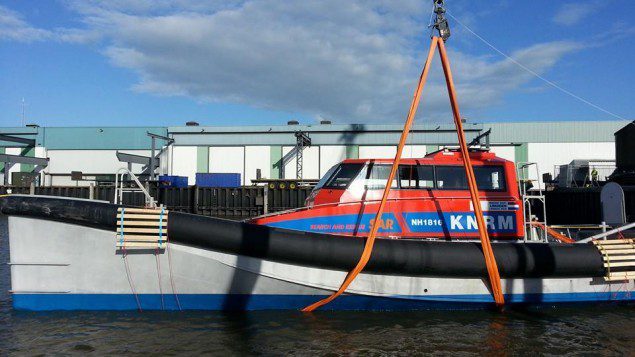
Oh, and look. The Dutch are planning some new boats. An off the shelf hull? With props?

Er… no.

1379715_158010607741715_1433622870_n-635x357.jpg


1385999_158011381074971_107385351_n-635x396.jpg


Can't imagine this spec comes cheap.

Length overall: 19.30 m.
Beam: 6.54 (including heavy duty ‘D’ shaped fenders)
Draft: 1.10 m. (reduced draft for operation in shallow waters)
Weight: 32.5 tonnes
Minimum Crew: 6
Fuel oil: 4.9 m3, 4.16 ton
Carrying max. 120 people (25 inside)
Construction: Marine grade light alloy chined hull and mechanical mounted composite wheelhouse
Classification: Lloyds Register, notation: ✠ 100 A1, SSC Patrol, HSC, G3[✠] LMC
Typical endurance: 12 hours at 25 Knots plus 4 hours at 12 Knots, giving a 348 Nautical miles range.
Max. speed at trial conditions: 31 Kts.
Propulsion: 2 x MTU 8V2000M84L engines with Hamilton 571 water-jets and ZF 2000 gearboxes
Electronics: integrated bridge (SIMS, Ships Information and Management System) with multifunctional, touch screen based system, covering navigation, communication, operational information and signalizing of equipment. Five compatible touch screens mounted for the 3 front row crew positions.
Voyage Data Recorder, several CCTV units, wireless intercom, etc.
Picking up people in horizontal position from the water with hydraulic rescue platform
Two stretchers for patient transport
Towing of small pleasure and fishing craft (bollard pull 7 ton)
Fire fighting on small craft
Technical assistance for small craft.
Significant noise reduction. Set at max. 75 Db
Focus on restricted emission (meet IMO tier 2 – 3 emission standards) and other environmental aspects (outside noise

http://youtu.be/igVY3hkbgVY

(At no point during the whole film do we hear from an accountant)
 
Last edited:
Dear Sybarite,

OK I agree with you that there’s some confusion with terminology regarding the distinction between the “endowment model” vs. “endowment gifts”. Apologies. So here’s a quick practical explanation of what a potential donor might like to know:

1. An endowment to the RNLI is simply a gift to the institution for the purposes of income. It may, or may not have conditions attached to it. Take for example the Carnegie Endowment: Andrew Carnegie restricted this endowment’s ability to spend in all sorts of ways: e.g. new libraries required the state to donate the land and provide the service free to all. The same idea applies to the Wellcome Trust. This practice is both legal and fully recognised by the Charity Commission.

2. An “endowment model” is a slightly different animal: here the charity attempts to raise the bulk of its income from investment sources. This, as I pointed out in my first post, is a major difference between US and UK Universities. Yale University pioneered the idea and it has become known as the “Yale Endowment Model”. Again fully legal and accepted as a valid aspiration for any charity.

3. In 2012 the RNLI’s net investments increased from £251m to £257m. This was comprised of capital gains of £12m and net disposals of £6m, so the capital profit was £12m. In addition the RNLI earned £3.8m in income. The total investment gain therefore totalled £15.8m, which represents a 6% return on its £257m of assets. Adding capital gains to income is perfectly acceptable.
The £38m increase in net assets, has little to do with the price of rice ...in relation to the RNLI’s investments.

4. In 2012 the RNLI spend £116m on lifesaving activities. Its £15.8m investment income (capital + dividends, etc) represented 13.6% of this expenditure. For a charity to be considered as following an “endowment model” it would require the investment contribution to be at least 40% of total charitable income. The RNLI is therefore not following the “endowment model”.

5. How could a donor be sure the RNLI was not overfunding itself? You fairly asked this question, so here’s the answer: If the potential donor believed that 2012’s £116m would roughly be the recurring run rate of lifesaving activities, he would ask a panel of top fund managers what level of return the RNLI could expect, without taking excessive risk.

6. They would tell him 6%, which turns out to be Global Nominal GDP, but that is another story.

7. He would then perform a simple calculation (£116/.06) and come up with £1.9bn, for a fully funded RNLI. Realising that the RNLI is not within a million miles of this number he would move on to the next question...which you were perfectly entitled to ask.

8. Are some fat cats creaming the dosh off? He/she could triangulate opinion from the RNLI’s internal Audit and Risk Committee, its external auditors (Crowe Clark Whitehill), the Charity Commission, the ICSA and of course the men and women at the sharp end. He might perform some of his own work, but would discuss it with the RNLI before taking it public.

With no sniff of a scandal he/she would open his cheque book and donate. If the RNLI chooses to invest the money for the future, he/she can rest assured that IT HAS NOT BEEN WASTED. The donor is simply in a position similar to Andrew Carnegie!
QED
 
Dear Sybarite,

OK I agree with you that there’s some confusion with terminology regarding the distinction between the “endowment model” vs. “endowment gifts”. Apologies. So here’s a quick practical explanation of what a potential donor might like to know:

1. An endowment to the RNLI is simply a gift to the institution for the purposes of income. It may, or may not have conditions attached to it. Take for example the Carnegie Endowment: Andrew Carnegie restricted this endowment’s ability to spend in all sorts of ways: e.g. new libraries required the state to donate the land and provide the service free to all. The same idea applies to the Wellcome Trust. This practice is both legal and fully recognised by the Charity Commission.

2. An “endowment model” is a slightly different animal: here the charity attempts to raise the bulk of its income from investment sources. This, as I pointed out in my first post, is a major difference between US and UK Universities. Yale University pioneered the idea and it has become known as the “Yale Endowment Model”. Again fully legal and accepted as a valid aspiration for any charity.

3. In 2012 the RNLI’s net investments increased from £251m to £257m. This was comprised of capital gains of £12m and net disposals of £6m, so the capital profit was £12m. In addition the RNLI earned £3.8m in income. The total investment gain therefore totalled £15.8m, which represents a 6% return on its £257m of assets. Adding capital gains to income is perfectly acceptable.
The £38m increase in net assets, has little to do with the price of rice ...in relation to the RNLI’s investments.

4. In 2012 the RNLI spend £116m on lifesaving activities. Its £15.8m investment income (capital + dividends, etc) represented 13.6% of this expenditure. For a charity to be considered as following an “endowment model” it would require the investment contribution to be at least 40% of total charitable income. The RNLI is therefore not following the “endowment model”.

5. How could a donor be sure the RNLI was not overfunding itself? You fairly asked this question, so here’s the answer: If the potential donor believed that 2012’s £116m would roughly be the recurring run rate of lifesaving activities, he would ask a panel of top fund managers what level of return the RNLI could expect, without taking excessive risk.

6. They would tell him 6%, which turns out to be Global Nominal GDP, but that is another story.

7. He would then perform a simple calculation (£116/.06) and come up with £1.9bn, for a fully funded RNLI. Realising that the RNLI is not within a million miles of this number he would move on to the next question...which you were perfectly entitled to ask.

8. Are some fat cats creaming the dosh off? He/she could triangulate opinion from the RNLI’s internal Audit and Risk Committee, its external auditors (Crowe Clark Whitehill), the Charity Commission, the ICSA and of course the men and women at the sharp end. He might perform some of his own work, but would discuss it with the RNLI before taking it public.

With no sniff of a scandal he/she would open his cheque book and donate. If the RNLI chooses to invest the money for the future, he/she can rest assured that IT HAS NOT BEEN WASTED. The donor is simply in a position similar to Andrew Carnegie!
QED

Your response is mainly around the notion of endowments. Of course lots of charities would like to have an enormous endowment but there again that all depends. The charity where I was treasurer always felt that we needed to provide an incentive to their members to be involved with the running of activity and it was felt that too large an endowment would reduce the implication. This said we did a major funds campaign and doubled the endowment - using an outside professional fundraiser.

However, there as things stand at present, the RNLI does not need an endowment - of course that might change in the future. If you gross up incomes from all sources and likewise with expenditures you get Income £187m less expenses £153m giving a "profit" or excess of £34m (Sorry I have been using off my head the figure of £38m; it should have been £34m). In other words current income covers all expenses with a £34m margin.

OK Fat Cats is an emotive expression and and the employment rates are probably not out of sync with those of the City of London. However the French have shown that there is another model which works, where not only the crews volunteer but also the administrators.

I think now that I have said as much as I can or need to say on the subject - much to the relief of many I'm sure. I'll leave you to judge - unless somebody starts spouting something again....!!
 
Last edited:
Top