Lee bowing

OK. I'll go and ponder whether to accept your verdict or that of a double world champion (Darts and Cadets) and national Olympic coach, plus my own rationale. I don't think it will take long.

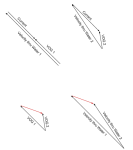
I don't doubt that this individual is a much better sailor than me, nor do I ask you to accept my version at face value. That does not make me unqualified to comment on lee bowing. Here is a series of vector diagrams that illustrate (I hope) why pinching when current is dead on the nose does not gain you anything.
Lee Bowing Velocity Vectors.png
In the first diagram (top left) you are sailing close hauled directly into the current. Subtract current from Velocity through Water to get Velocity over Ground (VOG).
In the second diagram (top right) you have luffed slightly.
In the third diagram (bottom left) I have shown the improvement in VOG as a result of luffing.
In the fourth digram (bottom right) I have shown the improvement in VOG that you would get if you luffed by the same angle in a situation with no current (Velocity thru Water = VOG in this scenario).

Note that the red "improvement" vector is identical for the situation with current and the one without, thus demonstrating that it is the act of luffing, not the presence of current, that results in getting round a windward mark.

Edit: sorry the diagram has come out so small.
 
Last edited:
I don't doubt that this individual is a much better sailor than me, nor do I ask you to accept my version at face value. That does not make me unqualified to comment on lee bowing. Here is a series of vector diagrams that illustrate (I hope) why pinching when current is dead on the nose does not gain you anything.
View attachment 76550
In the first diagram (top left) you are sailing close hauled directly into the current. Subtract current from Velocity through Water to get Velocity over Ground (VOG).
In the second diagram (top right) you have luffed slightly.
In the third diagram (bottom left) I have shown the improvement in VOG as a result of luffing.
In the fourth digram (bottom right) I have shown the improvement in VOG that you would get if you luffed by the same angle in a situation with no current (Velocity thru Water = VOG in this scenario).

Note that the red "improvement" vector is identical for the situation with current and the one without, thus demonstrating that it is the act of luffing, not the presence of current, that results in getting round a windward mark.

Edit: sorry the diagram has come out so small.
Nobody doubts that in open water pinching will always be disadvantageous. The point that I and others have made is that in certain confined situations pinching to obtain a lee-bow effect may allow you to clear a river bend or racing mark without having to tack and waste more time than will be lost by pinching. Clearly, there is a limit to the distance over which this tactic would be an advantage, but I had in mind something of the order of a few cables only.
 
I don't doubt that this individual is a much better sailor than me, nor do I ask you to accept my version at face value. That does not make me unqualified to comment on lee bowing. Here is a series of vector diagrams that illustrate (I hope) why pinching when current is dead on the nose does not gain you anything.
View attachment 76550
In the first diagram (top left) you are sailing close hauled directly into the current. Subtract current from Velocity through Water to get Velocity over Ground (VOG).
In the second diagram (top right) you have luffed slightly.
In the third diagram (bottom left) I have shown the improvement in VOG as a result of luffing.
In the fourth digram (bottom right) I have shown the improvement in VOG that you would get if you luffed by the same angle in a situation with no current (Velocity thru Water = VOG in this scenario).

Note that the red "improvement" vector is identical for the situation with current and the one without, thus demonstrating that it is the act of luffing, not the presence of current, that results in getting round a windward mark.

Edit: sorry the diagram has come out so small.

That is not entirely true.
Your basic error is that you've taken the current vector to be constant. It's a constant speed, but not a constant distance, because the pinching boat goes slower.
The effect of the current is to exaggerate the effects of small variations in the boat's vector, as the ground track becomes the difference between two fairly similar vectors.
The reduced speed means it only pays to pinch when there is a tactical advantage or a serious reduction in the number of tacks required.
Or, where I used to sail, the wind was rarely steady, so pinching and lee-bowing often put you in the best place to use the next puff to get around the mark.

Where I sail now, we sometimes get breeze coming down the valley and waves coming in from offshore, which can give the joyful experience of waves on the lee bow, which I find hard to make the best of.
 
My point was that you don't "obtain a lee-bow effect" you just gain height as a direct result of luffing. It appears greater because with current forward of the beam you travel a greater distance through the water than past the land; such that any sideways component is magnified.
 
My point was that you don't "obtain a lee-bow effect" you just gain height as a direct result of luffing. It appears greater because with current forward of the beam you travel a greater distance through the water than past the land; such that any sideways component is magnified.

Just do the vectors untainted by the underlined subjective terms and all will become clear!
 
That is not entirely true.
Your basic error is that you've taken the current vector to be constant. It's a constant speed, but not a constant distance, because the pinching boat goes slower.

All the vectors in my diagrams are velocities rather than distances. I have redone them to show the effect of reduced speed due to pinching. Note that the difference in VOG as a result of pinching (the red vector) remains the same for the two scenarios (with and without current).
Lee Bowing Velocity Vectors(2).png
The effect of the current is to exaggerate the effects of small variations in the boat's vector, as the ground track becomes the difference between two fairly similar vectors.
I agree with this, note how when you pinch the VOG vector changes angle more than the VTW vector. The error I see people making is that they think there is a step change in the effect when their heading crosses from current just on the windward bow to just on the lee bow. This is not supported by the maths.
 
All the vectors in my diagrams are velocities rather than distances. I have redone them to show the effect of reduced speed due to pinching. Note that the difference in VOG as a result of pinching (the red vector) remains the same for the two scenarios (with and without current).
View attachment 76572

I agree with this, note how when you pinch the VOG vector changes angle more than the VTW vector. The error I see people making is that they think there is a step change in the effect when their heading crosses from current just on the windward bow to just on the lee bow. This is not supported by the maths.

It's supported by Boolean maths, when a 2 degree shift in heading makes "laying the mark"=1
 
Yes! Quite right, it really is as simple as that.

I don't know why some people make such a fuss about it.

Nope - still completely missing the point - lee bowing is most effective when the current is exactly at right angles to where you want to go - so neither side is pushing you towards where you want to go. It’s the change in the apparent wind on either tack that either allows you a smaller angle to the true wind (if you put your lee bow into the tide), or a larger angle if you go on the other tack.
 
Nope - still completely missing the point - lee bowing is most effective when the current is exactly at right angles to where you want to go - so neither side is pushing you towards where you want to go. It’s the change in the apparent wind on either tack that either allows you a smaller angle to the true wind (if you put your lee bow into the tide), or a larger angle if you go on the other tack.

To your heading, indeed.
 
Nope - still completely missing the point - lee bowing is most effective when the current is exactly at right angles to where you want to go - so neither side is pushing you towards where you want to go. It’s the change in the apparent wind on either tack that either allows you a smaller angle to the true wind (if you put your lee bow into the tide), or a larger angle if you go on the other tack.

But that's really mostly only useful in the rather unlikely circumstances that the ground-referred wind is going to stay precisely the same and the current is going to change during the leg.
If the wind drop after the tide changes, it's a recipe for ending up down tide of where you wanted to be.
In reality, the 'ground wind' is bent by the current to some extent anyway, and will usually have shifts or bends to consider.

To what extent would you rate having the tide under the lee bow more important than being on the 'making tack'? And when?

If the destination is dead upwind wrt the 'ground' wind, the lee bow effect simply makes the lee bow tack the making tack any way. But what if the wind initially favours the other tack a little? Where do you draw the line?
 
Nope - still completely missing the point - lee bowing is most effective when the current is exactly at right angles to where you want to go - so neither side is pushing you towards where you want to go. It’s the change in the apparent wind on either tack that either allows you a smaller angle to the true wind (if you put your lee bow into the tide), or a larger angle if you go on the other tack.

No. The current is almost always relevant, not only when perpendicular to the desired course. It will also have negligible effect on the apparent wind most of the time, since wind speed is usually (much) greater than the speed of the current, besides how often have you sailed in a completely constant wind, in terms speed and direction? I can't be bothered to do the draw the vector diagrams to explain as someone else already has, particularly the PBO article referenced earlier in this thread.

Johnalison's scenario is also spot on.
 
No. The current is almost always relevant, not only when perpendicular to the desired course. It will also have negligible effect on the apparent wind most of the time, since wind speed is usually (much) greater than the speed of the current, besides how often have you sailed in a completely constant wind, in terms speed and direction? I can't be bothered to do the draw the vector diagrams to explain......

Steady, still 2 weeks to April 1st :rolleyes:

Tides affect the TRUE WIND and the boat's motion through the water affects the APPARENT WIND!
 
The true wind also affects the apparent wind surely?

Indeed! Ground wind opens play, modified by tides/currents to produce the true wind, modified by the boat's motion to produce the apparent wind.

The trouble is, one has to pick a constant frame of reference for course calcs, and true wind is the most intuitive. But if tides are a significant dynamic factor, it can be easiest to use ground wind.

Hence the tactition looking at different things to those trying to max-out the boat. Else the boat would stop while this kind of discussion took place ;)
 
I would have described True Wind as the resulting wind AFTER all the other factors have affected its direction, whether that be current, land features etc. Apparent wind being the wind you feel once you start moving through the true wind

Posted same time !!!!
 
Tides affect the TRUE WIND and the boat's motion through the water affects the APPARENT WIND!

Yes, of course. But generally speaking lee bowing will have little noticeable effect on apparent wind unless the speed of wind and current are fairly close (or current > wind of course). I probably could have put that better!:)
 
Top