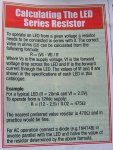
Leds

I assume you are referring to using LEDs on 12 volts ?

The resistor drops the voltage to the correct level for the LED, or multiple LEDs in series. You may not always want three or four or more in series

LED series resistor.jpg
 
Because you need to control the current.
The V/I characteristic of a LED isn't conducive to 4 LEDs in series working well even over a narrow voltage range. It also changes with temperature.
There are LEDs around where you might get away with it, if your 12V was well regulated. But 'boat' 12V being 11.9 to 14+, no chance.
 
I assume you are referring to using LEDs on 12 volts ?

The resistor drops the voltage to the correct level for the LED, or multiple LEDs in series. You may not always want three or four or more in series

View attachment 98565
I don't like the advice to halve the resistance when paralleling with a 1N4148. When the LED conducts it will be the only conducting path through the circuit and thus will have to withstand the full current capability of the circuit. Reduce the resistance and the LED will have to drop greater than its Vf rating, thus burning it out. If you want extra brightness, you could just use a matching LED in reverse, so that it conducts on the other 50% of the duty cycle.
 
The resistor in series is the quick and dirty method of limiting current through the LED. The only way to ensure robustness against voltage spikes is to use a constant current power supply.
 
I don't like the advice to halve the resistance when paralleling with a 1N4148. When the LED conducts it will be the only conducting path through the circuit and thus will have to withstand the full current capability of the circuit. Reduce the resistance and the LED will have to drop greater than its Vf rating, thus burning it out. If you want extra brightness, you could just use a matching LED in reverse, so that it conducts on the other 50% of the duty cycle.
That's nearly completely wrong.
The LED will cope with a peak current and average current higher than the continuous current. You need to read the spec carefully.
LEDs are not great rectifiers, their reverse voltage rating is low, sometimes lower that their Vf, so an inverse parallel pair may have a short life. Again, read the spec carefully.
An LED running as a half wave rectifier will strobe at 50Hz which can be unpleasant or even dangerous.

A constant current supply is a good idea, but in practice an LED with a resistor can survive a lot of abuse, particularly if it's not running at maximum brightness.
 
I have always use resistors in series but this application was for a home brewed navigation light. Bearing mind that Nasa, for example drive their masthead nav lights hard with pulsed current, I think they are pretty robust.

My diy light uses 48 leds wired in a matrix. Four in series across the supply 24 times. They are also linked across so that all leds in a chain are cross coupled to their neighbour. If one led in a chain fails, the others will support the remainder.

(I don't think I would understand this explanation but some might!)
 
Much better to go constant current, which isn't that difficult.
JLCPCB will make the boards with the CC driver like this, just add a decent size transistor/fet.
> EasyEDA - A Simple and Powerful Electronic Circuit Design Tool
I use cree 503 ledS, Prob about as bright as anything else available. strings of 3 driven at 66% max current.

CC driver discussion, not PWM so no probs with RF interference, probably not as efficient as pwm but for a few mA who cares >

 
That's nearly completely wrong.
The LED will cope with a peak current and average current higher than the continuous current. You need to read the spec carefully.
LEDs are not great rectifiers, their reverse voltage rating is low, sometimes lower that their Vf, so an inverse parallel pair may have a short life. Again, read the spec carefully.
An LED running as a half wave rectifier will strobe at 50Hz which can be unpleasant or even dangerous.

A constant current supply is a good idea, but in practice an LED with a resistor can survive a lot of abuse, particularly if it's not running at maximum brightness.
It has been a while since I've done anything above 5v logic levels. I stand corrected. Forgot about the relative value of reverse breakdown voltage. The plane diode is to reduce the reverse voltage across the LED to 0.7v. However, this arrangement will strobe at 50Hz.
 
It has been a while since I've done anything above 5v logic levels. I stand corrected. Forgot about the relative value of reverse breakdown voltage. The plane diode is to reduce the reverse voltage across the LED to 0.7v. However, this arrangement will strobe at 50Hz.
I've got 12V LED lights in my kitchen, some of them have a bridge rectifier built into each bulb.
Some of the mains LED bulbs are quite complicated, particularly the dimmable ones, which work out what a thyristor dimmer is trying to do to an incandescant bulb, then program a constant current. Some of them work quite well, others less so.

Constant current is important if you want e.g. even brightness across an LED-illuminated monitor screen.
 
Why the resistor?

Conventionally one uses three in series and a resistor sized for the correct current.

Why not just 4 in series?

An LED diode has a peculiar current to voltage characteristic not at all linear like a resistor or incandescent bulb. It takes no current until the voltage reaches about 3 volts or a bit less. Once the voltage rises above 3volts the current can increase at a rapid rate. (to destruction) unless that current is limited. (by a resistor or other device)
Now using a 12v supply you can run 4 diodes in series with a small current limiting resistor. (typically dropping .5volt) (yes you still need a series current limiting resistor) No problems if your supply remains at 12v. If it drops to 11v you will get no light. If it rises to 13v you will get too much current and destroy the LEDs.
If you run 3 LED in series from 12v supply the current limiting resistor will be much bigger giving less dramatic current rise with more volts but also giving decent light but less at a supply voltage down below 11v.
So the simple answer is that a set up with 3 LED is more stable with variable voltage supply than 4 LED ol'will
 
An LED diode has a peculiar current to voltage characteristic not at all linear like a resistor or incandescent bulb. It takes no current until the voltage reaches about 3 volts or a bit less. Once the voltage rises above 3volts the current can increase at a rapid rate. (to destruction) unless that current is limited. (by a resistor or other device)
Now using a 12v supply you can run 4 diodes in series with a small current limiting resistor. (typically dropping .5volt) (yes you still need a series current limiting resistor) No problems if your supply remains at 12v. If it drops to 11v you will get no light. If it rises to 13v you will get too much current and destroy the LEDs.
If you run 3 LED in series from 12v supply the current limiting resistor will be much bigger giving less dramatic current rise with more volts but also giving decent light but less at a supply voltage down below 11v.
So the simple answer is that a set up with 3 LED is more stable with variable voltage supply than 4 LED ol'will
However, the volts are up and down a lot (different sources of charging) and not a single led has failed and neither have they declined to light up.
 
However, the volts are up and down a lot (different sources of charging) and not a single led has failed and neither have they declined to light up.
A few thoughts ... if you want something long lived & reliable then spend just a little money and some time. Just cos you've done ok so far doesn't change that, better circuit design, better LEDs run below datasheet recommended max current it *will* last longer. Like decades as an nav or anchor light.

JLCPCB will make the boards with regulators for you, 10 of these boards cost £20 and fiver delivery or more if you are impatient, though I ballsed up a bit with the transistor choice, runs a bit hot but might be ok with a heat sink. Ordering another I'd prob go with a separate transistor.
EasyEDA - A Simple and Powerful Electronic Circuit Design Tool
jBH0O4s.png


Worth spending more on quality LEDs as well, like cree503. I went for C503D-WAN, typ luminosity 48000mcd. Just under 20p each. VERY bright. aNd the red/green ones are inside the colour requirements in the IPRCS annex.
5-mm Round White High-Brightness LEDs | Cree Components
Plus they will be much better matched than the cheapos, so each LED will have very similar voltage drops and use similar power, cheapos can have on LED in a string running brighter and hotter than the rest and as it warms it will draw even more power. From testing the Cree 503s were very well matched so no need to be careful to get each string the same.
 
A few thoughts ... if you want something long lived & reliable then spend just a little money and some time. Just cos you've done ok so far doesn't change that, better circuit design, better LEDs run below datasheet recommended max current it *will* last longer. Like decades as an nav or anchor light.

JLCPCB will make the boards with regulators for you, 10 of these boards cost £20 and fiver delivery or more if you are impatient, though I ballsed up a bit with the transistor choice, runs a bit hot but might be ok with a heat sink. Ordering another I'd prob go with a separate transistor.
EasyEDA - A Simple and Powerful Electronic Circuit Design Tool
jBH0O4s.png


Worth spending more on quality LEDs as well, like cree503. I went for C503D-WAN, typ luminosity 48000mcd. Just under 20p each. VERY bright. aNd the red/green ones are inside the colour requirements in the IPRCS annex.
5-mm Round White High-Brightness LEDs | Cree Components
Plus they will be much better matched than the cheapos, so each LED will have very similar voltage drops and use similar power, cheapos can have on LED in a string running brighter and hotter than the rest and as it warms it will draw even more power. From testing the Cree 503s were very well matched so no need to be careful to get each string the same.
That array wouldn't be much use as a nav light though. The sector discrimination would be way out. My leds are very much cheek by jowl and the cut-off is brilliant (which is more than can be said for some commercially available ones).
 
That array wouldn't be much use as a nav light though. The sector discrimination would be way out. My leds are very much cheek by jowl and the cut-off is brilliant (which is more than can be said for some commercially available ones).
It's easy to bend round the LED legs to get the full 112.5/135deg output, I've yet to build a finished nav light but playing around a little baffle will create a precise cut off.
Which LEDs are you using? Really is worth spending a tiny bit more for quality ones like Cree and constant current drivers can be made by jlcpcb or even off ebay so cheap it seems a bit silly not to go that route.
Any pics of yours?
 
It's easy to bend round the LED legs to get the full 112.5/135deg output, I've yet to build a finished nav light but playing around a little baffle will create a precise cut off.
Which LEDs are you using? Really is worth spending a tiny bit more for quality ones like Cree and constant current drivers can be made by jlcpcb or even off ebay so cheap it seems a bit silly not to go that route.
Any pics of yours?
2.5 V Red LED 3mm Through Hole, Kingbright L-7104SRD-F
Stock no.:862-2976
Qty:100
I'm not sure a pic of an led will be very informative! I wished to use original enclosures. They are by Lucas but I think the design was taken over by Perko.
The leds are pitched very closely with a chain of four fed with 12 volts but the adjacent rows are connected across the matrix resulting in a series parallel arrangement. This, I hope, would cope with a single led failure ensuring that the neighbours would support the others in the chain.

It is not easy to introduce a baffle using the Lucas enclosure but, in any case, that would squander the light which is cut off. My design is tuned so that that emission angles produce the cut-off. The first design used perforated ptfe sheet which is white causing a little blurring. I am now awaiting the arrival of black sheet (not sheep as the spell checker suggested!) which should cure that.
 
2.5 V Red LED 3mm Through Hole, Kingbright L-7104SRD-F
Stock no.:862-2976
Qty:100
I'm not sure a pic of an led will be very informative! I wished to use original enclosures. They are by Lucas but I think the design was taken over by Perko.
The leds are pitched very closely with a chain of four fed with 12 volts but the adjacent rows are connected across the matrix resulting in a series parallel arrangement. This, I hope, would cope with a single led failure ensuring that the neighbours would support the others in the chain.

It is not easy to introduce a baffle using the Lucas enclosure but, in any case, that would squander the light which is cut off. My design is tuned so that that emission angles produce the cut-off. The first design used perforated ptfe sheet which is white causing a little blurring. I am now awaiting the arrival of black sheet (not sheep as the spell checker suggested!) which should cure that.
Ta, was thinking of a pic of the finished product :)

Just had a quick look at the datasheet, yours look like they have 40deg viewing angle, must be hard to get a clean cutoff without baffles unless the fixture has something already, something odd comparing the light output, though I'm not sure what a candela actually is.. the Crees are said to have typ of 15000mcd , kingbright - 460mcd , if i'm looking at the right datasheet and the 2 figures are comparable, big difference even with the difference in viewing angle-

PsOU7P2.png


1uPUSrE.png


Not think it's better to design something to last forever rather than allow for failures? The constant current circuit above costs very little and seems so far to be very reliable (must be many hundreds of nights on the hook with an anchor light using same circuit) and rock solid output independent of input voltage, exactly what the LEDs want for a long and happy life :)
 
If you glue a piece of white plastic of aluminium between the two PCB's up to the front of the lense it will make the light cut off better.
 
Top