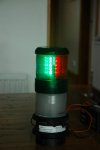
LED Replacement Bulbs for old Lanterns? Are you insured?

Interesting thread - I've just bought a MAST tricolour led lamp from ebay and intend to fit it this winter when ashore. I've checked out other suppliers and HOLT and others now market a tricolour led with partitions between each sector which look good, but not waterproof like the MAST lamp. I've also ordered a cool white and a warm white led to try out in the bicolour, stern and masthead.
 
Well, FYI I've had a response from my insurers (Y Yacht) after they checked with their Underwriters.

They (the Underwriters) "have no objection with you using LED navigational lights on your vessel".

I had specifically explained that I wished to replace the bulbs in the existing units with LED equivalents.
 
Even that reply from the underwriters is not worded unambiguously. I suspect they do not fully understand the question and the wording implies that they are aware that there are tested and approved LED navigation lights - but that isn't the same as replacement bulbs.

It isn't beyond the wit of man to produce a fully compliant LED bulb. Although different from a linear source, filament bulb, a cylindrical LED cluster has the individual diodes arranged such that their cones of light overlap to achieve the required intensity throughout. Because each individual element produces a conical beam correct matching of the cylinder diameter and the angle of the cones could be equivalent to the linear source but a shutter will be needed to separate the sectors. If I remember correctly, most replacement 3 colour LEDs come with a replacement bulb holder to allow the bulb to be aligned within the fitting and I doubt that many of us working at the masthead will get the alignment better than 3 degrees as errors in the light unit and bulb compound! Past PBO tests revealed a number of approved lights which did not appear to meet the cut-off requirements, so maybe the time is right for a private venture (sadly I don't have the funds either...).

Rob.
 
As Rob2 says above.. I think the question and therefore the response do appear ambiguous.

The Aqua Signal original bulb has a fine vertical filament as the light source... I cannot see how a common LED replacement is equivalent because I have not see any with a bright, narrow vertical source of light.
 
As Rob2 says above.. I think the question and therefore the response do appear ambiguous.

The Aqua Signal original bulb has a fine vertical filament as the light source... I cannot see how a common LED replacement is equivalent because I have not see any with a bright, narrow vertical source of light.

The following is purely subjective-about as subjective as a boating mag test of led lamps some years ago.

I fitted 3 led bulbs into an Aqasignal bow lamp.

1. Normal led festoon with the blue tinge, viewed from 1.3 km. away on a very dark night-no moon. Very poor, distorted green.

2. Ditto, with warm white bulb. Good, much improved over the first one. Equal to the filament bulb.

3. Two colour led, red/green. The winner-better than the warm white or OE filament bulb. Expensive but worth it.

So-my simple subjective test gave me the result I expected. A purpose made two colour led at about 20 quid IIRC proved the best-3 viewers and a mobile phone were used to note the results from outside the pub further up the harbour.

As reported earlier, two small cable ties were tightly fitted to the metal ends of the bulb were needed to stop it rotating in use. The ends were snipped off and tucked behind the back of the lamp and worked in opposing directions to keep the festoon type bulb from rotating.

The reduction in electrical consumption was worth it. Warm whites worked in the stern lamp and mast lamp at minimal cost with subjective outputs as good as filament bulbs.

Make of it what you will...............................
 
I did some tests at home in 2013, using a boat lamps tri-colour LEDs in a series 40 masthead unit, and posted the results on this forum.
The LED was lined-up with the red and green sectors in the lens, then in a dark room I photographed the illuminated mast head unit at different angles.
This one is observing from 15 deg off the starboard bow. You can still clearly see one row of red LEDs. I later repeated the test in the marina and at about 150m and an estimated 15deg of the boats head I could still see part of the red sector. at 30 degrees you can still see some red.

I think that this means a boat approaching at 15deg, would still be seeing some red sector and that would give a misleading impression of the relative angles between the two vessel. It may not be too much of a problem, considering how much an average yacht yaws around its heading, but based on these tests I ditched the series 40 and bought a purpose made LED nast head unit. I simple didn't think it was worth the risk.

The series 40 were built for a single vertical filament incandescent bulb, which as noted elsewhere in this thread, provides a bright, very narrow line of light. If you replace it with a bulb several cm wide, you won't get the sharp cut off between sectors you'd expect from an masthead tricolour, it's just geometry.
 

Attachments

  • 15 to port.jpg
    15 to port.jpg
    36.8 KB · Views: 0
I did some tests at home in 2013, using a boat lamps tri-colour LEDs in a series 40 masthead unit, and posted the results on this forum.
The LED was lined-up with the red and green sectors in the lens, then in a dark room I photographed the illuminated mast head unit at different angles.
This one is observing from 15 deg off the starboard bow. You can still clearly see one row of red LEDs. I later repeated the test in the marina and at about 150m and an estimated 15deg of the boats head I could still see part of the red sector. at 30 degrees you can still see some red.

I think that this means a boat approaching at 15deg, would still be seeing some red sector and that would give a misleading impression of the relative angles between the two vessel. It may not be too much of a problem, considering how much an average yacht yaws around its heading, but based on these tests I ditched the series 40 and bought a purpose made LED nast head unit. I simple didn't think it was worth the risk.

The series 40 were built for a single vertical filament incandescent bulb, which as noted elsewhere in this thread, provides a bright, very narrow line of light. If you replace it with a bulb several cm wide, you won't get the sharp cut off between sectors you'd expect from an masthead tricolour, it's just geometry.

If someone can distinguish a faint row of red LEDs just next to the much brighter green LEDs at two miles they've got bloody good eyesight.

It's at those sort of ranges where the lights really matter, and having much brighter lights is a significant advantage.
 
If someone can distinguish a faint row of red LEDs just next to the much brighter green LEDs at two miles they've got bloody good eyesight.

It's at those sort of ranges where the lights really matter, and having much brighter lights is a significant advantage.
Best rewrite ColRegs then.
 
If someone can distinguish a faint row of red LEDs just next to the much brighter green LEDs at two miles they've got bloody good eyesight.

It's at those sort of ranges where the lights really matter, and having much brighter lights is a significant advantage.

This is a good point and it is why when I make my nav lights (that have yet to see the light of day - no pun intended) I ensure the red (as you say, normally more difficult to see) is exactly as bright as the green.

Takes a bit of fiddling (over the years), but quite possible.

The results are satisfying and the clear cut 3 degree cut-off sectors is achieved too.

Now all I need is a boat to sail to a remote island (can't be Fiji as they don't make lights anymore) and set up a manufacturing company. Pie in the sky, but you'll see me coming.

I make pretty good emergency nav lights too; of various permutations to fit all types of boats with power (12V) or AA batteries etc. Brighter than some Hela normal nav lights. The emergency nav lights on offer are pretty pants. In an emergency you want something that you can set up within 30 seconds. All imo.
 
Before you make comments like this:

"If someone can distinguish a faint row of red LEDs just next to the much brighter green LEDs at two miles they've got bloody good eyesight.

It's at those sort of ranges where the lights really matter, and having much brighter lights is a significant advantage."

I suggest you do the test and put the results on this forum.
It's not a faint row of LED's, you can see the row of red LED's and they are almost as bright as the green at 15 degrees.

I'd also suggest you get out a pencil and protractor and draw up the angles for a Tricolour LED in a series 40 mast head unit, you'll then see very clearly that the combination doesn't work.

Having spent 13 years manning survey boats in the North Sea and Eastern Atlantic, I know how important good navigation lights are, you can tell if the navigation light are a few degrees off kilter as vessels approach at night. I've often been in the situation where I'm looking for the first sight of a bit of green or red to provide confidence that the vessel is going to cross ahead. Seeing the a bit of the "other colour" with an error of 15 degrees or more, would be very disconcerting to say the least.

Don't forget if the yacht is doing 5 knots and the commercial vessel is coming towards you is making 15knots the closing speed is 20knots, that's a mile every 3mins, so at your 2 mile range it's only 6mins to a collision!

Any ambiguity caused by dodgy lights should really be avoided, it's a totally unnecessary and avoidable risk.

Given what I discovered doing some simple tests, it isn't surprising that Aqua Signal haven't produced a retrofit for the series 40, they just wouldn't get approval from the MCA and other similar organisations.
 
It's not a faint row of LED's, you can see the row of red LED's and they are almost as bright as the green at 15 degrees.]

Did you try doing the test with a single filament bulb? My Aquasignal S41 bicolour has a reflective back which bounces light all over the place; cutoff is not nearly as sharp as one might imagine.
 
I did some tests at home in 2013, using a boat lamps tri-colour LEDs in a series 40 masthead unit, and posted the results on this forum.
The LED was lined-up with the red and green sectors in the lens, then in a dark room I photographed the illuminated mast head unit at different angles.
This one is observing from 15 deg off the starboard bow. You can still clearly see one row of red LEDs. I later repeated the test in the marina and at about 150m and an estimated 15deg of the boats head I could still see part of the red sector. at 30 degrees you can still see some red.

I think that this means a boat approaching at 15deg, would still be seeing some red sector and that would give a misleading impression of the relative angles between the two vessel. It may not be too much of a problem, considering how much an average yacht yaws around its heading, but based on these tests I ditched the series 40 and bought a purpose made LED nast head unit. I simple didn't think it was worth the risk.

The series 40 were built for a single vertical filament incandescent bulb, which as noted elsewhere in this thread, provides a bright, very narrow line of light. If you replace it with a bulb several cm wide, you won't get the sharp cut off between sectors you'd expect from an masthead tricolour, it's just geometry.

The same subjective test should be made using a standard vertical filament bulb and IMHO you will still see some red by refraction in the lens. It will not be as bright but neither will the green.
 
Top