Leaking volvo stern gland: How worried should I be?

laika

Well-Known Member
Joined
6 Apr 2011
Messages
8,307
Location
London / Gosport
Visit site
I came back to the boat after lockdown to find a mixture of diesel and water in the bilges. The source of the diesel is still under investigation but the water is from the 10-year-old volvo dripless stern gland, now dripping about 10ml per day. I was planning on moving the boat to the solent at the end of June to haul out but...is a leaking stern gland something that can result in sudden catastrophic failure (ie I should stump up the massive cost and inconvenience of hauling out where I am asap) or do these things tend to slowly progress?

Reading this forum makes me think this should be a straightforward DIY job. I'm unconfident with mechanics, generally restricting myself to basic engine servicing and am a little concerned about messing with the shaft coupling. Are those fears misplaced and as long as I don't touch the engine mounts I'm not going to end up with a misaligned shaft?
 
You've done well at 10 years, If it was me I'd lift out were you are for peace of mind.

Obviously I'll have to if necessary, but it'll be heinously expensive, they won't let me stay on the boat and it's at least 5 hours per day commute. Closer to the hamble I have somewhere to stay while I work
 
Interestingly I've just been reading that these seals are supposed to be greased once a year. Despite the company that originally fitted it doing a fair bit of work ashore 2 years ago (incl. replacing cutlass bearing) they didn't mention the stern gland. I'm presuming this is something I should have been doing every time I've hauled out...

I'll put my tin hat on! It can be done in the water, have a look on You Tube.

I will look but a whole load of cash may be preferable to that kind of stress...
 
Interestingly I've just been reading that these seals are supposed to be greased once a year. Despite the company that originally fitted it doing a fair bit of work ashore 2 years ago (incl. replacing cutlass bearing) they didn't mention the stern gland. I'm presuming this is something I should have been doing every time I've hauled out..
A little tube of Volvo stern gland grease costs around a fiver, although a little goes a long way. It is supposed to be done annually, along with ‘burping’ the stern gland if it’s been out of the water.
 
The Volvo rubber stern seal is an incredibly meaty lump of tough rubber - there's a cutaway photo on Vyv Cox's excellent website. If it's only dribbling 10ml a day, it's unlikely to get significantly worse very quickly. It would be helpful if you could grease it before running the engine much more.

The other thing to note with this type of seal is to "burp" it to let air out whenever the boat has been out of the water. This ensures that water reaches the inner cutless bearing of the seal.
 
It won't just let go on you, it'll just keep dripping more and more as time goes on.

If you get some thick silicone grease and push it into the seal (with a McDonalds straw works well), then that will give it a bit more life.

They are easy to change, but replace it with the Radice version, as it has a grease point and also a breather, so you don't have to burp the air out of it when it goes in the water (they're a bit cheaper too).
 
I agree with other posters. The shaft-seal clearance is quite small and the lips can be mostly sealed by inserting some grease. It will be a long time before the flow increases to dangerous levels, something an automatic bilge pump can cope with very easily.
 
I changed mine several years ago and the old one didn't look as if sudden catastrophic failure was very likely. If the boat isn't getting much use then you could wrap self-amalgamating tape over the end and shaft before leaving. I imagine that would reduce your worry level if you are leaving the boat for a long period. Your boat isn't at all likely to sink but at least you know the leak has stopped.

Try greasing and burping anyway as it is good practice. The old trick with a straw makes it a very quick job, especially if you have a small tube of suitable grease handy (silicone is fine). Just squeeze 1-2 mls into the straw, flatten the end, push it into the seal and squeeze the grease into the seal. Any piece of plastic, screwdriver etc. can be drawn over the straw to inject the grease.

N.B. Do not push the straw too far into the Volvo seal or you will go past the lip seals. I can't remember the exact distance but it is probably around 20mm.

Easy enough job to replace it over the winter as long as the shaft isn't scored. Use fine wet and dry and clean the shaft before fitting the new seal. Use the tool supplied to protect new seal when slipping over the end of the shaft. Disconnecting the shaft coupling might be the hardest part, depending on the type. Some are easy and some require a simple tool with heat. You will get detailed instructions if you can post a picture of the coupling.

EDIT: Beaten to the punch. Glad to see you are getting a lot of agreement.
 
Last edited:
Thanks all for the suggestions. The "burping" I'm familiar with but I'm slightly unsure as to how to insert the grease: there's no clearance at the top of the shaft and only perhaps a millimetre at the bottom: Doesn't look to be enough to insert a straw....
 
Thanks all for the suggestions. The "burping" I'm familiar with but I'm slightly unsure as to how to insert the grease: there's no clearance at the top of the shaft and only perhaps a millimetre at the bottom: Doesn't look to be enough to insert a straw....
The Volvo grease comes in a tube with a longish narrow neck. If you burp the gland there is enough room to get the grease in as far as it needs to go.
 
Thanks all for the suggestions. The "burping" I'm familiar with but I'm slightly unsure as to how to insert the grease: there's no clearance at the top of the shaft and only perhaps a millimetre at the bottom: Doesn't look to be enough to insert a straw....
You need virtually zero clearance. Flatten the end of the straw after putting grease into it. Plastic straws stay pretty flat after pinching with pliers and still have plenty of strength. I just use my finger to keep the straw flat as I insert it. You are pushing 2 x wall thickness of a straw into a flexible seal. It doesn't need a gap and doesn't take much effort. I usually squeeze the seal and lift slightly whilst inserting the straw. Pretty much the same action I use when burping as it lifts the seal very slightly away from the shaft.

You now have a grease filled straw sticking out of the seal. Running anything solid over the straw will flatten it and push grease into the seal.

I hope that this makes sense.

The long necked tube from Volvo works but I find the straw easier, especially when afloat. Water tends to squirt out when using the tube as the nozzle leaves gaps. I found that some grease also escaped with the water. :D
 
Last edited:
Lift the seal up and that will create enough clearance to get the straw or nozzle of the Volvo tube in. does not take much grease. I am with the others, it won't hail on you and expect once you have greased it and run it a bit will stop dripping.
 
It won't just let go on you, it'll just keep dripping more and more as time goes on.

If you get some thick silicone grease and push it into the seal (with a McDonalds straw works well), then that will give it a bit more life.

They are easy to change, but replace it with the Radice version, as it has a grease point and also a breather, so you don't have to burp the air out of it when it goes in the water (they're a bit cheaper too).
McD's now use stout paper straws not the big plastic ones that you could flatten. You can thank my 8 yr old granddaughter for that info.
 
Thanks all: this is PBO at its best :-). Really appreciate the advice.

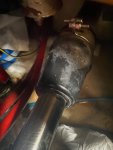
Pic of seal below.

I will endeavour to find a planet-destroying plastic straw (I've got some somewhere ) to mitigate the immediate problem .

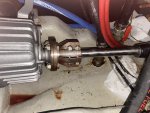
Longer term, any advice on disconnecting then reconnecting the shaft coupling? Sorry for my ignorance: it's not something I've done before and not the type of thing I'l like to get wrong.


IMG_0248.jpeg
 
When I bought my boat in 2005 it had a Volvo seal that had seen years of hard charter use i.e. lots of motoring. I bought a paint roller tray and placed it below the seal to catch drips. In fact it stayed dry. I eventually replaced the seal with one of these https://www.sillette.co.uk/catalogue.pdf#page=17 both cheaper and easier to greas than the Volvo seal. Just fit a tube from the seal to a point well above the waterline and it never needs burping. For a power boat with a high revving shaft you could feed water from a pump, but on a yacht there is no need.
 
Longer term, any advice on disconnecting then reconnecting the shaft coupling? Sorry for my ignorance: it's not something I've done before and not the type of thing I'l like to get wrong.

Do you have a photo of the coupling? It would help you to get the correct advice.
 
Top