Lavac Toilet Issues

lumphammer

Well-Known Member
Joined
21 Aug 2003
Messages
471
Location
Chichester
Visit site
We have a Lavac toilet with an electric pump. When I put the smallest bleed valve Lavac do into the inlet pipe I don't get enough suction to flush the toilet, but when I block off the bleed valve, although I now get a decent flush I am also getting siphoning that gradually fills up the bowl till the water reaches the sea level outside, fortunately that is just below the toilet rim!!!

I am at a loss to know what to do. I'm assuming that if I had a manual pump I would be pumping faster than the electric one and thus providing enough suction to overcome the bleed valve. Is the position of the bleed valve important? I have just inserted it at the highest point in the inlet pipework.

Any other suggestions gratefully received.
 
I can only suggest you try to make your own bleed nipple (end plug of an old style biro) with a slightly smaller hole. We have a manual and have never had a problem. Highest point on the inlet is where we have ours.
 
We have a Lavac toilet with an electric pump.


Any other suggestions gratefully received.


What pump do you have.
The old type was more or less a motorised version of the manual pump, with capacity of 6galls/min. I reckon that's more than a gentle manual pumping rate.

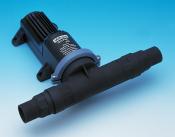
I belive thay now fit this type of electric pump

whale_gulper_toilet_pump__18558_std.jpg


It is rated at 18 litres/min ( 4 galls/minute) which I'd say should be adequate even though less than the old type.

Or perhaps this Jabsco pump http://www.jabscoshop.com/marine/pu...f-priming-diaphragm-waste-pump-12-volt-dc.htm

Perhaps your pump is not pumping correctly or is the wrong type.


The "get you home" solution is to put your finger over the air bleed until the toilet has flushed then take it off to break the syphon. Switch the pump off when the bowl is nearly empty
 
Last edited:
just a thought - have you tried pushing the seat and lid down before flushing? If the vacuum isn't being created properly then blocking off the valve will give the pump that extra bit of help to pull the seals shut. On my Lavac pushing the seat and lid down gives a feeling of an extra bit of sealing although it doesn't need it to flush. Worth a try. And are the seals properly seated? sounds more like a vacuum seal problem than a poor pump.
 
just a thought - have you tried pushing the seat and lid down before flushing? If the vacuum isn't being created properly then blocking off the valve will give the pump that extra bit of help to pull the seals shut. On my Lavac pushing the seat and lid down gives a feeling of an extra bit of sealing although it doesn't need it to flush. Worth a try. And are the seals properly seated? sounds more like a vacuum seal problem than a poor pump.
Agreed
 
The pump is a standard Henderson MkV with an electric drive that runs at about 40 strokes a minute., which doesn't seem particularly fast to me. I forgot to mention that the lid and seat seals are new.

I have been considering a solenoid operated air valve on the siphon that closes when the pump is activated and opens when the pump stops to release the vacuum, but most of the valves I've found are the wrong way round i.e. closed when not activated and open when active.
 
The pump is a standard Henderson MkV with an electric drive that runs at about 40 strokes a minute., which doesn't seem particularly fast to me. I forgot to mention that the lid and seat seals are new.

I have been considering a solenoid operated air valve on the siphon that closes when the pump is activated and opens when the pump stops to release the vacuum, but most of the valves I've found are the wrong way round i.e. closed when not activated and open when active.

The capacity of the manual pump is quoted at 45 strokes per minute so 40 per minute should be adequate.

Have you tried overhauling the pump ( new valves ) ??

Have you checked the inlet for restrictions ??
hoses clear ?
Inlet seacock clear and fully open ?
is the strainer on the inlet clear ... or nearly blocked up with antifouling paint?

Is the outlet hose clear ?

It should not be necessary to go to such extremes as fitting a solenoid valve on the air vent. That's ridiculous.
Correctly installed Lavacs work, and work with minimal maintenance ! Seals from time to time, pump overhaul, keeping hoses clear and unblocking the air vent occasionally all that should be necessary.


The air vent ........ it should only be a pin hole...not got something miles larger I suppose ?
 
the instructions i have say its quite difficult to install the seals correctly. they may be new but they still could be the problem. as long as the seals work even a feeble puimp should create a partial vacuum
 
My valve is a needle whole at the top of the pipe and does it ever seal well you would need a chainsaw to break the seal before equalisation !

John
 
When I replaced the tubing of my Lavac I made the 'bleed valve' with a 1.5mm drill and drilled a hole through the pipe at the top of the gooseneck. It has (fingers crossed) been fine since then. The supplied bleed valves were IMHO far too large and would have needed much too much pumping to get enough water through the system. If you find the vacuum takes too long to break then try a 2mm drill and so on until you get to a happy medium. Syphoning would suggest to me that either your gooseneck is not high enough above the external water level or that the bleed valve is somehow not doing it's job of breaking the vacuum. As someone else has said Lavacs are normally the most trouble free of marine toilets.

Good luck

Chas
 
Last edited:
You MUST have a small hole in the water intake pipe, otherwise you will get siphoning and could easily fill the boat with water, depending on what tack you're on.
The water intake pipe MUST have a loop in it, with the top of the loop above the water level whatever angle of heel the boat sails at.
The bleed hole MUST be in the top of that loop.
Having checked those essentials, it sounds like you might have an air leak into the water inlet pipe somewhere: check all connections, especially into the toilet bowl.
Check the suction: block the hole & pump. It should be quite difficult to lift the lid during pumping and for some time afterwards (at least 5 min): if not, you're not getting a proper seal between the lid and the bowl. Check the seal for nicks etc. Check that the lid centres on top of the bowl: on mine, it is easy to lower the lid so it it is a few cm to one side, so you don't get a good seal. This is due to slop in the lid mounts & may need addressing.
Then play with the size of the bleed hole: the smaller it is, the more flush water you'll get but therefore the more flush water will be left in the bowl after pumping (& in rough seas, too much water will leap out all over the floor. One fix is to sit on the loo to stop the water sloshing out, & you also get a bidet...
Don't use the provided bleed hole inserts: if you've already got a hole at the top of the loop, block it eg with Sikkaflex & start again. Drill the smallest hole you can in the pipe: eg 1mm. If you haven't got a small drill bit, use a heated needle.
Try pumping: if too much water is left in the bowl, make the hole bigger, remembering that it is easy to make it bigger but more challenging to make it smaller!
Once you've got it right, it will be worth the hassle.
A hint: you need a longer flush for a No 2 than a No 1 (if you don't know what a No 2 is, ask your mummy): so set the timer for the length needed for a No 1 and tell people to flush twice for a No 2. That ensures fully flushed pipes without filling the holding tank too quickly.
 
You MUST have a small hole in the water intake pipe, otherwise you will get siphoning and could easily fill the boat with water, depending on what tack you're on.
The water intake pipe MUST have a loop in it, with the top of the loop above the water level whatever angle of heel the boat sails at.
The bleed hole MUST be in the top of that loop.
Having checked those essentials, it sounds like you might have an air leak into the water inlet pipe somewhere: check all connections, especially into the toilet bowl.
Check the suction: block the hole & pump. It should be quite difficult to lift the lid during pumping and for some time afterwards (at least 5 min): if not, you're not getting a proper seal between the lid and the bowl. Check the seal for nicks etc. Check that the lid centres on top of the bowl: on mine, it is easy to lower the lid so it it is a few cm to one side, so you don't get a good seal. This is due to slop in the lid mounts & may need addressing.
Then play with the size of the bleed hole: the smaller it is, the more flush water you'll get but therefore the more flush water will be left in the bowl after pumping (& in rough seas, too much water will leap out all over the floor. One fix is to sit on the loo to stop the water sloshing out, & you also get a bidet...
Don't use the provided bleed hole inserts: if you've already got a hole at the top of the loop, block it eg with Sikkaflex & start again. Drill the smallest hole you can in the pipe: eg 1mm. If you haven't got a small drill bit, use a heated needle.
Try pumping: if too much water is left in the bowl, make the hole bigger, remembering that it is easy to make it bigger but more challenging to make it smaller!
Once you've got it right, it will be worth the hassle.
A hint: you need a longer flush for a No 2 than a No 1 (if you don't know what a No 2 is, ask your mummy): so set the timer for the length needed for a No 1 and tell people to flush twice for a No 2. That ensures fully flushed pipes without filling the holding tank too quickly.
No 1s also need pumping completely out of the system other wise calcium build-up will happen quicker
 
No 1s also need pumping completely out of the system other wise calcium build-up will happen quicker

I flush mine electric lavac once a week with hand hot water, leaving it to work before pumping it out . This dissolves any salt encrustation which some mistake for lime scale (and which is not affected by chemicals, vinegar etc)
 
I now use fresh water to flush my Lavacs. I leave the lid open while I pump-out and when the bowl is almost empty I use the hand-held shower head to add fresh water to the bowl and flush as necessary.

This virtually eliminated smells and encrustations due to using salt water.
 
Top