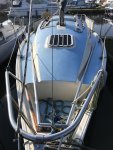
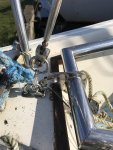
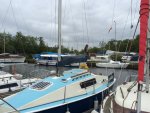
Largest mast taken down with an A frame.

They were lucky to get three goes. It was only a tiddler after all. not sure who let go.

Steveeasy


At one point the heel casting gave way and was blamed. However something has to give, there's no way you can hoist a mast like that and expect it to stay up unsupported whilst you attach the shrouds. If the shrouds and backstay are loosely attached then as soon as it is 90deg, you are safe - as long as you keep pressure on the forestay. Things to watch are snagging on the way up and not attaching them too short.

The other method is too rig temporary masthead lines, secured at the same point of rotation as the heel. This is fiddly but has the advantage of supporting the mast laterally all the way up; you can see it on the drawing posted by coveman at the top right.

On the other point, I would not consider dropping the mast of a 29/30 footer like this, at that size and they become tricky for even two strong people to move. Not the sort of load you want to be humping about on the deck of a small boat.


.
 
I made up some side angled poles from ally tube for a 20ft boat . Worked with three of us, but a bit wobbly. I like the idea of a slide in the mast track, then one is not so concerned about the side poles being hinged in line with the step pin.
I will be raising the 8mtr mast on the Kelt while afloat, so need something that takes care of the boat rocking. Looks like the slide is it, along with a prop at the transom to give it a start.
 
Lots of staggeringly large boats drop their mast in this way on a regular basis to get under the bridges from the Swan River to the sea at Fremantle. A frame is created using spinnaker poles.
I raced an 11m boat and we berthed on the river but raced offshore. Exhausted before we even started racing!
There are certainly one of two 12m boats doing this.
 
At one point the heel casting gave way and was blamed. However something has to give, there's no way you can hoist a mast like that and expect it to stay up unsupported whilst you attach the shrouds. If the shrouds and backstay are loosely attached then as soon as it is 90deg, you are safe - as long as you keep pressure on the forestay. Things to watch are snagging on the way up and not attaching them too short.

The other method is too rig temporary masthead lines, secured at the same point of rotation as the heel. This is fiddly but has the advantage of supporting the mast laterally all the way up; you can see it on the drawing posted by coveman at the top right.

On the other point, I would not consider dropping the mast of a 29/30 footer like this, at that size and they become tricky for even two strong people to move. Not the sort of load you want to be humping about on the deck of a small boat.


.
Its just how I used to do mine on a Dehler. The line that pulled it up went round the bow roller and back to the cockpit on a winch. I used to attach loose lower shrouds and an extra line on the roller furler to pull it out the way as it went up. Used to do it on me own and it worked fine but get a snagged backstay and it could cause problems. The guy never even flinched who was holding the mast fork on the ground. funny Guys.
Steveeasy
 
Slight thread drift! Many years ago a friend of mine with a Rival 32 told me this tale. He had traversed the French Canals with his mast down aboard. Arriving at the Med (Sete?) he was looking for a yard to restep the mast when he espied a likely looking lamp post! With the aid of his crew, who scaled the post, a block and tackle and much skill and care the mast was successfully stepped in the dead of night. Observed by a French yacht, the crew of which decided to try the same the following night. They bent the post and hastily moved on!
 
Can you provide details, please?
Again what is meant by A frame? I would suggest your Jag 23 is typical fractional rig mast with hinge type mast base. Do you want to be able to lower the mast while under way or just in the marina or on the hard? The system of poles hinged to the gunwhale 3/4 way to transom sliding up the mast, has the advantage of very good sideways support (necessary for aft swept spreader rig) to cope with wash from passing boats. It negates the need for mast crutch at the back. But has a limited degree of actual mast lowering say 30 degrees from horizontal which is ok for our relatively high bridges.
If you only want to lower mast for winter then I suggest using 2x spin poles for A frame gin pole or just one gin pole guyed sideways to keep it on c/l. If you have enough helpers you could like I do just guide the mast down keeping it central to a tall stern support post. Use a 4 purchase tackle on the bottom of the forestay or onto a halyard well secured. Halyard is an option where you have furling drum at the bottom of the forestay.
If you are not comfortable with armstrong method of controlling mast on centre line you can rig a system of tensioning and pulling forward the cap shroud from a point about 80cms above deck pulling forward with a rope each side to a winch. Or as described fit additional intermediate stays with chain plate on top of cabin in line with mast hinge axis.
If you are stowing the mast for towing or winter then the usual tackle on forestay gin pole method does allow mast to be lowered to a degree into a stern support where you can man handle it off the base attachment and mast base forward to the pulpit. I will lower mast to a high level stern support (about 2 metres). Then with a man removing hinge pin I lift and slide the mast in the crutch, other man guiding /carrying the base until base goes under the pulpit where it is supported by a rope loop. Beware at this point mast may be top heavy beyond the stern supoport,so base will want to rise when you disconnect. I then move mast down to a lower support for towing on the road and over wintering.
If you prefer a 2x pole A frame type stern crutch then have 2 crutches one high level one low. Once mast base is at the pulpit top of mast is quite light.
If it is the sliding poles arrangement you are interested in let me know PM. ol'will
 
Charter companies often lift out masts by mooring the boat between two others and using the other masts as a crane.

Takes a bit of organisation and coordination, but doable with the right help
 
Yes, helped a fried with a Varne 27 to both take down and step his mast. The bow was in between my boats stern and another's we used the main halyards of the two front boats to lower and re step. As has been mentioned it is the sideways drift that is hard to control, and we had a few scary moments. Would not do it again too wisky.
 
Can you provide details, please?
Found some pictures ( looks very grubby in winter :-( )

The 'tabernacle' is a boon as it largely stops the mast going to one side during lowering / raising
 

Attachments

  • IMG_0944.jpg
    IMG_0944.jpg
    543.7 KB · Views: 18
  • IMG_0950.jpg
    IMG_0950.jpg
    473.5 KB · Views: 18
  • IMG_0941.jpg
    IMG_0941.jpg
    422.4 KB · Views: 16
  • IMG_0812.jpg
    IMG_0812.jpg
    336.4 KB · Views: 16
Last edited:
Found some pictures ( looks very grubby in winter :-( )

The 'tabernacle' is a boon as it largely stops the mast going to one side during lowering / raising

That's very helpful: thank you. (And I'd be delighted if my boat were that clean!)

I hope you'll forgive some follow-up questions ...
... the frame looks like a single piece construction; how do you transport/store it when not in use?
... does having the hinges for the frame not in line with the hinge bolt in the mast give rise to any problems in use?
... and, please pardon the daft laddie question, can you give a brief description of how you use the frame to raise/lower the mast?

Again, many thanks.
 
That's very helpful: thank you. (And I'd be delighted if my boat were that clean!)

I hope you'll forgive some follow-up questions ...
... the frame looks like a single piece construction; how do you transport/store it when not in use?
... does having the hinges for the frame not in line with the hinge bolt in the mast give rise to any problems in use?
... and, please pardon the daft laddie question, can you give a brief description of how you use the frame to raise/lower the mast?

Again, many thanks.
The A frame is permanent fit - I’m on the Broads so mast lowering is pretty common if you want to get anywhere. It’s hinged at the ends of the arms and bolted through the deck with pads below. Construction wise it’s made up of three main tubular pieces with end fittings and block attachment points welded on. In use I attach A second clip to secure the forestay to the A-frame, Slacken the forestay turnbuckle, cleat off the lowering line for safety, disconnect the forestay from the boat, push forward slightly on the mast and remove the bolt behind it in the tabernacle allowing the mast to be fully supported by the A-frame line. With double and triple blocks on the A-frame line it’s really is very easy to then lower the mast down controlling it with one hand and the line with the other. Raising it is equally easy with very little resistance and reverse procedure to re-rig the boat.
 
The A frame is permanent fit - I’m on the Broads so mast lowering is pretty common if you want to get anywhere. It’s hinged at the ends of the arms and bolted through the deck with pads below. Construction wise it’s made up of three main tubular pieces with end fittings and block attachment points welded on. In use I attach A second clip to secure the forestay to the A-frame, Slacken the forestay turnbuckle, cleat off the lowering line for safety, disconnect the forestay from the boat, push forward slightly on the mast and remove the bolt behind it in the tabernacle allowing the mast to be fully supported by the A-frame line. With double and triple blocks on the A-frame line it’s really is very easy to then lower the mast down controlling it with one hand and the line with the other. Raising it is equally easy with very little resistance and reverse procedure to re-rig the boat.
That's very helpful. Many thanks.
 
You may find this system useful which was devised by Colin Haines for the Etap 22i. It uses dummy shrouds to stop any sideways sway when it is in use, and I find it very easy and safe to use - maybe it could be adapted for your larger vessel.

Iirc the etap22 is pretty well set up from the factory for lowering the mast and he came up with that system for someone else in the Trail Sail Association who had a Beneteau 24 or similar.

No matter, it works, and I used the basic principle on our Jeanneau 23 without issue for many lifts and drops. Because the base of the mast was less than 50mm above the toe rail I was able to get away with two rope loops inserted through the tow rails to bring the fixing points for temporary stays to the correct location.
 
Found some pictures ( looks very grubby in winter :-( )

The 'tabernacle' is a boon as it largely stops the mast going to one side during lowering / raising
I would not be so sure the tabernacle will stop mast swinging sideways. Assuming here you mean the mast hinge assembly. The leverage of the mast weight to the dimensions of the tabernacle is huge and I think a swing to one side would open up the tabernacle. If you mean by tabernacle the frame that attaches to the forestay to improve pull angle for tackle then no that will not stop mast swing to the sides. Nice structure though. I know of one boat here where the frame for mast lowering to improve pull angle is in fact the pulpit of the boat. Just swings up to do the job. sorry haven't looked at it closely. That on a 36fter. He does it single handed on water though I think he ties up at a jetty before traversing bridges.
Mast swing sideways must be controlled carefully. ol'will
 
I would not be so sure the tabernacle will stop mast swinging sideways.

Wise words.. I have a slightly smaller mast than the OP but when I drop mine I have a guy on the cabin roof facing backwards who straddles it as it drops so as to stop it swinging... (and if straddle and swinging in one sentance doesn't get the forum some new visitors I don't know what will)
 
On some boats where passing under bridges is frequent the chain plates for the main shrouds are raised so that they align with the fulcrum in the tabernacle.

Thus the mast cannot go side to side with the shrouds staying tight all the way down.

Whilst a gin pole is used on the front of the mast with a line taken from the bow back to the cockpit winch
 
Top