Larger Alternator for Yanmar 4JH5E

Just beaten to it. Good point about output curve, that's why I stuck with a 110A replacement. It had much better output at lower rpm and actually gave a much larger boost than you'd think when going from 80A to 110A (at normal cruising speed). Still theoretical of course as I haven't fitted it yet. One other problem with changing the alternator is that you will probably affect the tachometer. I think that you'll find that the alternator sends a pulse to the tachometer each revolution. Unfortunately, the engine turns at a different speed and the rev. counter is setup to allow for this. Not a big problem for me as I downloaded setup instructions and did some calcs. to get the corect adjustment factor.

You need engine pulley size, alternator pulley size and some technical info about the alternator. Of course you could be lucky and find that nothing has changed.

If no change to alternator or drive pulleys, the change in alternator should not affect the tachometer.

The point about output curves is very valid - you need to choose an alternator which is also fitted to a slow-revving diesel and not a fast revving car.

I have no doubt that fitting a smart controller works alternators much harder - usually only the diode bridge burns and fitting a new one is cheap and easy, apart from the hassle of taking the unit out. Because it happens at the most inconvenient times I carry a replacement now. However the 80 amp Hitachi on the 3YM20 literally melted - the disadvantage of an alternator with no forced cooling.

As I suspect it is exactly the same unit on your engine I'd definitely look at changing it - to one used in a slow-revving diesel (such as the Transit or cast iron Iveco) and with an integral cooling fan.
"Marine" alternators are not worth the extra you are charged for them - the 90 amp replacement for the Hitachi cost me only €79, brand new, and the Magnetti Marelli was £124.
 
just to update the forum. Thanks for the advice and for pointing me to the direction of Electromaax. The Serpentine Pulley Kit seems to be the perfect option allowing a bigger alternator on the Yanmar and putting less strain on the pulleys. Also I took note of the slow running issue and the alternator is designed to have better charging current at lower revs than many alternators. I have started an article here so future visitors to this thread can see how it turns out. The tech support at Electromaax has been very helpful and the package of alternator, pulley kit and smart regulator attracts a good discount. It was helpful that Mistroma pointed out the possible warranty issue and I have checked this out. As the system is designed in conjunction with Yanmar they have reassured me it will not be an issue. Lets see how it pans out when it arrives in two weeks.
Clive
 
In the spirt of concluding posts with the outcome I have now fitted the Large alternator on my new Yanmar 4JH5E. There is an article here and photos here.
All went very smoothly. Will report when the boat is in the water on how well it works. Thanks to all in the forum as usual for great advice.
ForumElectromaax.jpg
 
Hi
I am just buying a new Yanmar Marine engine the 4JH5E
The alternator OEM is 80amps but I need at least 120A or more
I have so far emailed electromaax and energy-solutions but neither have replied. Yanmar also seem to be quiet on the subject
Does anyone know of a direct replacement for the original and if so which one and where from.
Thanks
Clive
www.sephina.org

I have a BALMAR 180 AMP alternator fitted to mine. I had to add pulleys to get a second fan belt and upgrade the wiring from the alternator to the batteries to carry the extra AMPS.
 
Hi
I am just buying a new Yanmar Marine engine the 4JH5E
The alternator OEM is 80amps but I need at least 120A or more
I have so far emailed electromaax and energy-solutions but neither have replied. Yanmar also seem to be quiet on the subject
Does anyone know of a direct replacement for the original and if so which one and where from.
Thanks
Clive
www.sephina.org

My 2016 4JH5E has a serpentine drive belt and not a V belt. I am currently replacing the Yanmar alternator and try to choose between a http://www.rjsmarine.co.uk/charging-kit-60-yp-mc-150 150 amp at about £940 plus VAT and the Yanmar alternator. Marine Power Bursledon tell me there is an 80 amp standard Yanmar unit £512 and a 130 amp at £1041.
 
My 2016 4JH5E has a serpentine drive belt and not a V belt. I am currently replacing the Yanmar alternator and try to choose between a http://www.rjsmarine.co.uk/charging-kit-60-yp-mc-150 150 amp at about £940 plus VAT and the Yanmar alternator. Marine Power Bursledon tell me there is an 80 amp standard Yanmar unit £512 and a 130 amp at £1041.

Those are silly prices. Look for a Prestolite (or Leece Neville) alternator. You should be able to get a 130/140A unit for around £150-200. They are excellent alternators, with good output at lower revs. The renowned Balmar alternators are Prestolite units with pretty paintwork added. Some of the Prestolite alternators have adjustable regulators; the Prestolite website has full specs.
 
In the spirt of concluding posts with the outcome I have now fitted the Large alternator on my new Yanmar 4JH5E. There is an article here and photos here.
All went very smoothly. Will report when the boat is in the water on how well it works. Thanks to all in the forum as usual for great advice.
View attachment 30448

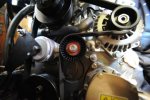
The pulley with the red washer (center of photo) is unsupported at the end. I assume you didn't refit the large pulley cover because it no longer fits. However, the pulley cover does support the end of that central pulley. Without it the shaft of the pulley fails in fatigue where it enters the engine block. The leverage is too high. I learned this lesson the hard (and expensive) way. For the replacement I made a triangular shaped plate to support the end of that pulley.
 
Just read through the whole of this thread. I find it amazing how people rush to install large alternators for very little benefit. A lot of cost and the introduction of unreliable after market components IMHO. The OP has a relatively small battery bank that simply does not require an increase in alternator output. I suspect the increase in charging will be negligible. I would simply have added as much battery capacity as possible such that the existing alternator had some work to do. Using a smart regulator to raise the battery charging voltage to suit the AGM batteries may be worthwhile but increasing the rated output of the alternator will do little with such a small battery bank. If the OP had simply increased the battery capacity he would also have effectively reduced the battery cycles for the same amps used in each cycle. This would extend the battery life. As liveaboards we meet lots of other liveaboards. Failure of high output alternators is a common theme especially in the tropics where engine compartment temperatures are higher than UK and alternators are worked harder and hotter
 
The main thing is to get good current at low engine RPM without belt problems.
An OEM alternator that lacks current at 1500rpm despite having a good rating at full speed might be worth upgrading.
To make use of 150A or whatever, you need very low resistance cabling in the charge circuit.
IT's best to consider any high current loads like bow inverters, thrusters or windlasses, the new alternator might be sending more current their way too.
 
The pulley with the red washer (center of photo) is unsupported at the end. I assume you didn't refit the large pulley cover because it no longer fits. However, the pulley cover does support the end of that central pulley. Without it the shaft of the pulley fails in fatigue where it enters the engine block. The leverage is too high. I learned this lesson the hard (and expensive) way. For the replacement I made a triangular shaped plate to support the end of that pulley.

Is that just an idler? Should all the bending force be taken by the inner race of its bearings and the bolt be in pure tension?
 
Is that just an idler? Should all the bending force be taken by the inner race of its bearings and the bolt be in pure tension?

Indeed .... it's the standard design for an idler/tensioner pulley.

I would be extremely surprised if the end of the securing bolt in any way locates with a cover as a means of providing physical support for the idler pivot. :confused:

Richard
 
The bolt in the end is not standard. The standard set up passes through the engine cover and has a nut on the outside. Without it there is a lot of flex on the shaft. The belt has a large sideways pull as you tension up the alternator. You can as an extra buy an idler pulley.
 
The bolt in the end is not standard. The standard set up passes through the engine cover and has a nut on the outside. Without it there is a lot of flex on the shaft. The belt has a large sideways pull as you tension up the alternator. You can as an extra buy an idler pulley.

I see. If that's the case I'm surprised that anyone would convert it to being located at one end only as it's asking for trouble. :(

Richard
 
The pulley with the red washer (center of photo) is unsupported at the end. I assume you didn't refit the large pulley cover because it no longer fits. However, the pulley cover does support the end of that central pulley. Without it the shaft of the pulley fails in fatigue where it enters the engine block. The leverage is too high. I learned this lesson the hard (and expensive) way. For the replacement I made a triangular shaped plate to support the end of that pulley.

As that was done more than 4 years ago, I'd guess the OP has it sorted by now.
 
Top