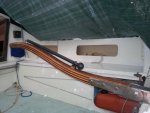
Laminating a tiller advice

Rick_A

Well-Known Member
Joined
14 Mar 2010
Messages
230
Location
Me Perthshire / Boat Loch Riddon
Visit site
Hello people,
With the season fast approaching it is time that i attempt to make a new tiller as the old on is a bit short.
I need some advice on how to do this though. Due to the shape of the tiller it will need a double curve.
I already have the shape and the jig made up to form the tiller.

What i want to know is, as i am going to have to steam the strips to make them easier to bend, do I steam the strips, then set in the jig and glue, or do i set them in the jig for a few days unglued to let them dry and stay closer to the shape and then glue together?
Thanks
Rick
 
I used 10mm strips and Cascamite glue and just clamped them into position One at a time. (Two the first time obviously)
Done with contrasting coloured woods it look FAB.
Capt. RoN
 
get a sheet of ply or mdf, mark out the shape upon the sheet.
get blocks of softwood say 50m/m x 50 x 50 & afix them to the board along the line you have marked with a single screw ( so it can pivot).
cut strips of timber say 3m/m thick for the tiller, clamp these to the s/w blocks. when your happy glue them up
use a bong break to the sheet & blocks
 
I have used 6mm strips and Cascamite, but the first attempt didn't work. I can easily bend the wood into the jig with G clamps, I only put 4 strips onto the jig the fist time so as not to put too much strain on things, but after i left in the jig for 3 days for the glue to harden, when i went to add the remaining 5 strips, I left the tiller sitting on the floor for half an hour, when i came back the double curve had delaminated. Actually it wasn't a gradual delamination, it went suddenly so there was obvious tension on the curve. The wood is now separated again and has gone back to straight.
 
I have used 6mm strips and Cascamite, but the first attempt didn't work. I can easily bend the wood into the jig with G clamps, I only put 4 strips onto the jig the fist time so as not to put too much strain on things, but after i left in the jig for 3 days for the glue to harden, when i went to add the remaining 5 strips, I left the tiller sitting on the floor for half an hour, when i came back the double curve had delaminated. Actually it wasn't a gradual delamination, it went suddenly so there was obvious tension on the curve. The wood is now separated again and has gone back to straight.
wrong adhesive or if its teak possibly not de-greased
 
wrong adhesive or if its teak possibly not de-greased

Strips are Iroko, Cascamite is what i have used for glue. Old one is 37 years old and still together and made with cascamite,
although probably not the same glue these days.
Its the tightness of the S shaped curve that is putting too much tension on in my opinion and I feel it will need to be steamed to get the shape to stay. I don't know whether I should glue it when it comes out the steamer or leave it in the jig for a few days after it has been steamed to see if the wood settles in its new shape, then take out, glue and put back in the jig?
 
I am also about to do this with ash & another wood (which I have forgotten since I bought it)
There is a pbo article in April edition on just this - in club so yet to read all.
To bend I was going to steam then clamp.
 
Strips are Iroko, Cascamite is what i have used for glue. Old one is 37 years old and still together and made with cascamite,
although probably not the same glue these days.
Its the tightness of the S shaped curve that is putting too much tension on in my opinion and I feel it will need to be steamed to get the shape to stay. I don't know whether I should glue it when it comes out the steamer or leave it in the jig for a few days after it has been steamed to see if the wood settles in its new shape, then take out, glue and put back in the jig?

no reason why it should need steaming.
i have used teak with aerodux 500 no probs
 
You need to use a phenol glue, and iroko can be quite wet[ high moisture content] whilst appearing quite dry.
Don t steam it, that just reduces the chance of you getting a good bond.
Aerodux is good
Cascophen used to be the glue we used when building iroko framed Motor Yachts and Fishery patrol vessels to veritas and Lloyds A1 years ago.
Reduce the thickness of the laminate, increase the number.
This will have 2 effects in reducing moisture content, and less thickness will also ease of bending..
 
Is the Cascamite not up to the job then?

Epoxy would be better after degreasing the Iroko with acetone. If the bends are so severe then steaming is an option, but you need to leave it in the jig to dry and then leave the laminates (hopefully now with the curve in them) to get really dry - airing cupboard job - before finally gluing up.
 
Don t bother with acetone.. Its a waste of time and money.
Use meth-elated spirit on teak only. Anything else just compromises the integrity of the glue, unless a primer supplied by the glue manufcturer..
As with Aerolite..Thanks Vic
 
Last edited:
Here is one i prepared earlier....

20140314_154719.jpg

2 seasons old now.
Made of tropical hardwood(3 wood scientists in my company can't agree exactly on the species, but similar to teak) and ash.
9 laminates about 5.5 mm thick.
Bent cold and dry
Glued with epoxy thickened with west systems glue powder.

I used a batten to mark a fair curve on a piece of board then cut out a cardboard profile to test fit.
Step and repeat until i was happy.
I then marked the curve down the middle of a piece of 200 x 50 pine board and cut that with my Jigsaw.
Food wrap to stop the tiller strips gluing to the formers and 2 sash cramps.

Final shaping with spokeshave and finished with epoxy and varnish.

If i was doing it again i would taper the strips from rudder end to hand end say 5.5mm down to 4 mm.

This was one of the most satisfying projects i have done. Good luck.
 
Last edited:
There has been an article in PBO on this in the past two months. Does nobody on the forum buy the magazine? :eek:

Already referred to in post#7. Good article, but it shows a simple curved tiller, so won't add much to OPs problem which seems to be a combination of poor adhesive and a double curve.
 
Top