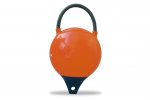
Knots for attaching pick up buoy

eddystone

Well-Known Member
Joined
18 Aug 2013
Messages
1,936
Location
North West Devon
Visit site
When I arrived on my new mooring, the way I had attached a pick up buoy to the two mooring pendants was less than ideal. I intend to re-attach the pick up line to one pendant with the line free to run through the other, held in by the buoy, so that it does not prevent taking the pennants either side of the forestay. I previously used a bowline but I'm not sure this is ideal. I could use an anchor hitch to attach the line to the buoy, but the end that goes on the pendant?
 
Our pickup buoy has a permanent line attached to it and I just pass the other end through both loops on the strops and use a bowline. When I pick up, I drop both strops onto one cleat, untie the bowline and then lead the second strop around the forestay onto its own cleat.
 
There are plenty of knots that are generally thought to be secure. A bowline is often the best general-purpose knot and if I am concerned I will put an extra half-hitch in. A "halyard knot" is compact and will usually tighten itself until it is impossible to undo.
 
Supplementary query - for those that leave a dinghy on the mooring, how do you attach it? I was thinking of attaching to the pick up buoy and then dropping that in the dinghy.
 
Supplementary query - for those that leave a dinghy on the mooring, how do you attach it? I was thinking of attaching to the pick up buoy and then dropping that in the dinghy.

I have a large carabiner on the end of the dinghy painter. That hooks onto the handle of the pickup buoy and is dropped. When picking the mooring up, I simply aim to bring the boat to a stop somewhere between the main buoy and the dinghy and pick up the painter/pickup rope with the boat hook. Carabiner is fastened to the painter by an eye splice. I use a chain for attaching the mooring to the boat as it avoids any issues with chafe.
 
I have a fore and aft mooring so have a pickup line. I used to tie the line to the pennant loops but now I have put an eye splice on the ends of the line and spliced in a snap shackle about a foot down the line so now I pass the line through the pennant loops and attach it back to the snap shackle.
You could do it the other way round and put the snap shackle on the end of the line and splice in an eye down the line.
 
Supplementary query - for those that leave a dinghy on the mooring, how do you attach it? I was thinking of attaching to the pick up buoy and then dropping that in the dinghy.
I attach the painter to the loop that goes through the bottom of my pickup buoy - that way no stress is placed on the handle.

imagenes1316a.jpg
 
There are plenty of knots that are generally thought to be secure. A bowline is often the best general-purpose knot and if I am concerned I will put an extra half-hitch in. A "halyard knot" is compact and will usually tighten itself until it is impossible to undo.

The bowline is my favourite knot especially as it can always be undone.

However, talking to a potential customer on our exhibition stand, we discussed using it for tying to a bosun's chair. (I don't, I use a fisherman's bend).
Chatting away, I noticed he had taken the bowline I had tied in a free line and was idly shaking it. It came undone! No trick involved. The knot was tight when I handed it to him and I found I could repeat his demo, given time. Scary. Try it.
 
The bowline is my favourite knot especially as it can always be undone.

However, talking to a potential customer on our exhibition stand, we discussed using it for tying to a bosun's chair. (I don't, I use a fisherman's bend).
Chatting away, I noticed he had taken the bowline I had tied in a free line and was idly shaking it. It came undone! No trick involved. The knot was tight when I handed it to him and I found I could repeat his demo, given time. Scary. Try it.
There have been threads about this, and apparently the bowline is forbidden to rock climbers. They use an extension of the figure of eight, but I can't recall the exact method.
 
There have been threads about this, and apparently the bowline is forbidden to rock climbers. They use an extension of the figure of eight, but I can't recall the exact method.

That isn't entirely true. Most climbers use a figure of eight, but the bowline still has its adherents (mainly because it is an easy knot to untie after it has been loaded. You have to be aware that it can work loose if it hasn't been loaded (or properly dressed), and this is particularly so if you are using very new ropes. There are a number of bowline variants (e.g. the 'yosemite bowline') that were designed to address this deficiency whilst still preserving the advantages of the knot.

I don't have a single method of tying in when climbing. Mainly I use a fig 8, but I will occasionally use a bowline if I think that I'm going to be falling off a lot.
 
All knots - or 'bends' - reduce the Ultimate Breaking Load of a rope to some degree, due to the distortions of the load-path within the tight curves inside the rope. A Bowline retains about 50-65% of the Ultimate i.e. losing one-third or more of the rope's notional strength, while a Double Figure of Eight loses only about one-fifth.

A bowline is optimal tied in a rough, hairy traditional hemp rope. It can slip much more readily tied in a modern, slippery core-and-sheath rope. For more detailed info, ask a rope specialist at SIBS.
 
Pickup line is eye spliced to the pickup buoy and to the loop in one of the strops at the other end. A separate small loop is spliced through each eye of the strops and an Inglefield clip is included in each loop. No knots to come undone, no need to untie/re-tie anything. Inglefield clips are very easy to hook/unhook.
As my mooring is fore and aft I use Inglefield clips to join the two pickup buoys also.
 
Yes I also have suspicions about a bowline in quite slippy braided line, especially when the dinghy/pick-up buoy might be slewing around, changing the direction of load. However, given my splicing skills I think i'd prefer to use an anchor or halyard hitch. I probably have a line with a carabiner spliced on somewhere on the boat, which i will use for the dinghy.
 
Utter tosh... it is one of the knots we use.

Thank you for the update. I was maybe overstating it in saying forbidden, but I was quoting a previous thread which indicated that bowlines were proscribed nowadays as a means for attaching a critical line. If I were using a bowline for support, as in a bosun's chair, I would add a half-hitch to the tail.
 
Thank you for the update. I was maybe overstating it in saying forbidden, but I was quoting a previous thread which indicated that bowlines were proscribed nowadays as a means for attaching a critical line. If I were using a bowline for support, as in a bosun's chair, I would add a half-hitch to the tail.

The issue with a bowline is reducing the strength of the line by 50%
 
Thank you for the update. I was maybe overstating it in saying forbidden, but I was quoting a previous thread which indicated that bowlines were proscribed nowadays as a means for attaching a critical line. If I were using a bowline for support, as in a bosun's chair, I would add a half-hitch to the tail.
I was always taught to add a half hitch to the tail.
 
The issue with a bowline is reducing the strength of the line by 50%

Not for climbing (either of the rock or mast variety). The difference in strength reduction between a bowline and fig 8 is pretty small. Even with this reduction (which is not as much as 50%), the residual strength will be nowhere near the peak force that it is possible to generate in a fall, and above the level at which serious injury or death would occur to the climber (if they experienced such an arresting force).

If you are planning to climb the mast on 3mm cord, then knot strength might become an issue, but in normal situations, other considerations are more important. I would have no concerns about attaching to a halyard with a bowline finished of with 1/2 a double fishermans (or even a 1/2 hitch as others have suggested), but I would take much more care with the knot than a fig8.
 
Top