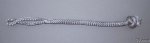
Knot instead of chain hook

If you are using a rolling hitch then probably you are only using a single-line snubber, lead either over the main bow roller, or asymmetrically through fairlead to cleat. Both are sub-optimal, as they will not prevent the boat snaking around at anchor.

The advantage of a good V-snubber with a hook is that it can be lead symmetrically through both fairleads to both cleats - and this significantly damps down snaking at anchor.

Admittedly, you could rig a V-bridle with a rolling hitch - but I doubt many of you do!
 
The advantage of a good V-snubber with a hook is that it can be lead symmetrically through both fairleads to both cleats - and this significantly damps down snaking at anchor.....Admittedly, you could rig a V-bridle with a rolling hitch - but I doubt many of you do!

There may be some mileage in this 'bend'....

VT.jpg
 
I anchor about 300 nights a year, rolling hitch all the time. Never jammed yet. I have a chain hook on board---recovered hooked onto my anchor complete with length of polypropylene snubber. Obviously didn't work for somebody!
 
After struggling with a chain hook for number of years, someone pointed out how a rolling hitch wouldn't fall off until asked to and I've never used the hook since.

My problem with the hook was getting it to stay on the chain, under the pulpit and outboard of the bow roller, while persuading a bight of more chain to leave its locker. Invariably this took several attempts and involved some swearing. I haven't seen the article; perhaps there's a tip to avoid my problem.

Incidentally, since then I have also been persuaded of the merit of using a seriously long (10m) piece o rope for an effective snubber.

Derek

I'm sorry to read of your woes but also confused. We anchor lots and always use a hook. I don't remember it EVER falling off. I know people say a rolling hitch works for them, but the hook is so simple and effective I'm not persuaded to give it up just yet.
 
Mmmm. . . I would suggest a dyneema soft shackle is better than either a hook or a rolling hitch.

It's faster than the rolling hitch but unlike the hook can be attached on deck and then run out over the roller.

I switched to the soft shackle two years ago and have not looked back.
 
If you are using a rolling hitch then probably you are only using a single-line snubber, lead either over the main bow roller, or asymmetrically through fairlead to cleat. Both are sub-optimal, as they will not prevent the boat snaking around at anchor.

The advantage of a good V-snubber with a hook is that it can be lead symmetrically through both fairleads to both cleats - and this significantly damps down snaking at anchor.

Admittedly, you could rig a V-bridle with a rolling hitch - but I doubt many of you do!

We sometimes rig a bridal in extreme conditions to take the load off our bowsprit and lower the effective depth so we have a higher scope ratio. When we do so we use a sheep shank onto he bridal from the existing snubber, hitched on as normal.

Have found zero difference in snaking with or without snubber, with or without bridal. On fact we only snake in wind against tide situations at which times the only thing that stops the snaking is good choice of helm position.

Guess it depends on the boat but won't a v off the bow pull the boat more left and right than not? It adds a small amount of rotational force to the boat in the very direction of the current snake surely?
 
I once read a scholarly article about the mechanics of snaking at anchor - yes the extent of snaking does depend on a lot of factors such as windage and c of g of the boat. But the conclusion of the article was that the further stern wards and the wider the v-bridle, the less the snaking. This is one reason you rarely if ever see a catamaran snaking, because the always have a wide v-bridle lead back to cleats virtually amidships.
 
Mmmm. . . I would suggest a dyneema soft shackle is better than either a hook or a rolling hitch.

It's faster than the rolling hitch but unlike the hook can be attached on deck and then run out over the roller.

I switched to the soft shackle two years ago and have not looked back.

I included a Dyneema soft shackle in the article based on your previous recommendation. I hope to accumulate experience with one in the next few weeks.
 
> Generally that is easier than leaning out past the bow to do it with a chain hook.

We used a chain hook, attach to the chain just below the bow roller and use the winch to put a loop in. No need to lean over and simpler and quicker than tying and untying a knot.
 
> Generally that is easier than leaning out past the bow to do it with a chain hook.

We used a chain hook, attach to the chain just below the bow roller and use the winch to put a loop in. No need to lean over and simpler and quicker than tying and untying a knot.

Like many things, "It all depends". My (twin) bow rollers are mounted out on a S/S fabrication which keeps the rollers, and therefore the anchor and chain, well clear of the bow. It also makes it more difficult to reach the chain to attach a hook, outboard of the roller.
 
I included a Dyneema soft shackle in the article based on your previous recommendation. I hope to accumulate experience with one in the next few weeks.


Oh, ok . . . I have been up in Greenland and not reading magazines. Just got back - difficult ice year up there.

Did you use a "classic" design (with a diamond knot) or one of the he "stronger" designs? My sense is for snubber applications the "stronger" designs are desirable - because the dyneema diameter is limited by chain link size, you want the dyneema small enough to thread thru easily. I have also found that tighter weave dyneema is a bit easier to use.

There has been zero noticeable wear or chafe on mine.
 
Oh, ok . . . I have been up in Greenland and not reading magazines. Just got back - difficult ice year up there.

Did you use a "classic" design (with a diamond knot) or one of the he "stronger" designs? My sense is for snubber applications the "stronger" designs are desirable - because the dyneema diameter is limited by chain link size, you want the dyneema small enough to thread thru easily. I have also found that tighter weave dyneema is a bit easier to use.

There has been zero noticeable wear or chafe on mine.

YM tends to use proprietary kit rather than home made, which is more the territory of PBO. So the one photographed in the article was bought at a chandlery. The ones I have came from www.tradline.co.uk who seem to be considerably cheaper than many yacht outlets and will make custom shackles to order.
 

That's a nice but 'conventional' one, using a diamond knot. Take a look on the same site at the stronger 'button knot with buried tail'. The 'conventional' design is about 150% of the dyneema cord strength while the 'stronger' design is about 250% because it eliminates the weak point where the cord enters the diamond (which is where the conventional design always breaks).

YM tends to use proprietary kit rather than home made, which is more the territory of PBO. So the one photographed in the article was bought at a chandlery. The ones I have came from www.tradline.co.uk who seem to be considerably cheaper than many yacht outlets and will make custom shackles to order.

Ah ok, unfortunately, as far as I know no-one has started making the 'stronger' design commercially yet (unless your custom place would give it a go), and most of the commercial ones I have seen have been in softer rather than harder lay dyneema (like NER STS). So this is in fact one area where the average layman can make a significantly better product than is generally available commercially because we improved the state of the art last winter and the commercial guys have not yet caught up. Interestingly the most eager early adapters of the improved design have been the slackline community.
 
That's a nice but 'conventional' one, using a diamond knot. Take a look on the same site at the stronger 'button knot with buried tail'. The 'conventional' design is about 150% of the dyneema cord strength while the 'stronger' design is about 250% because it eliminates the weak point where the cord enters the diamond (which is where the conventional design always breaks).


I will thank´s.
 
To those of us who do not have twin bow rollers on the stemhead and use a hook (or rolling hitch for that matter) do you just cleat the hook line and run through a fairlead (assuming you don't use a bridle)?
 
Top