Kiwi grip deck paint - anyone used it?

........Sorry LJS, couldn't resist! :giggle:

Very happy about it, after two years.
The only minor drawback vs. the typical gelcoat with embedded microdiamonds is that it's slightly harder to clean.
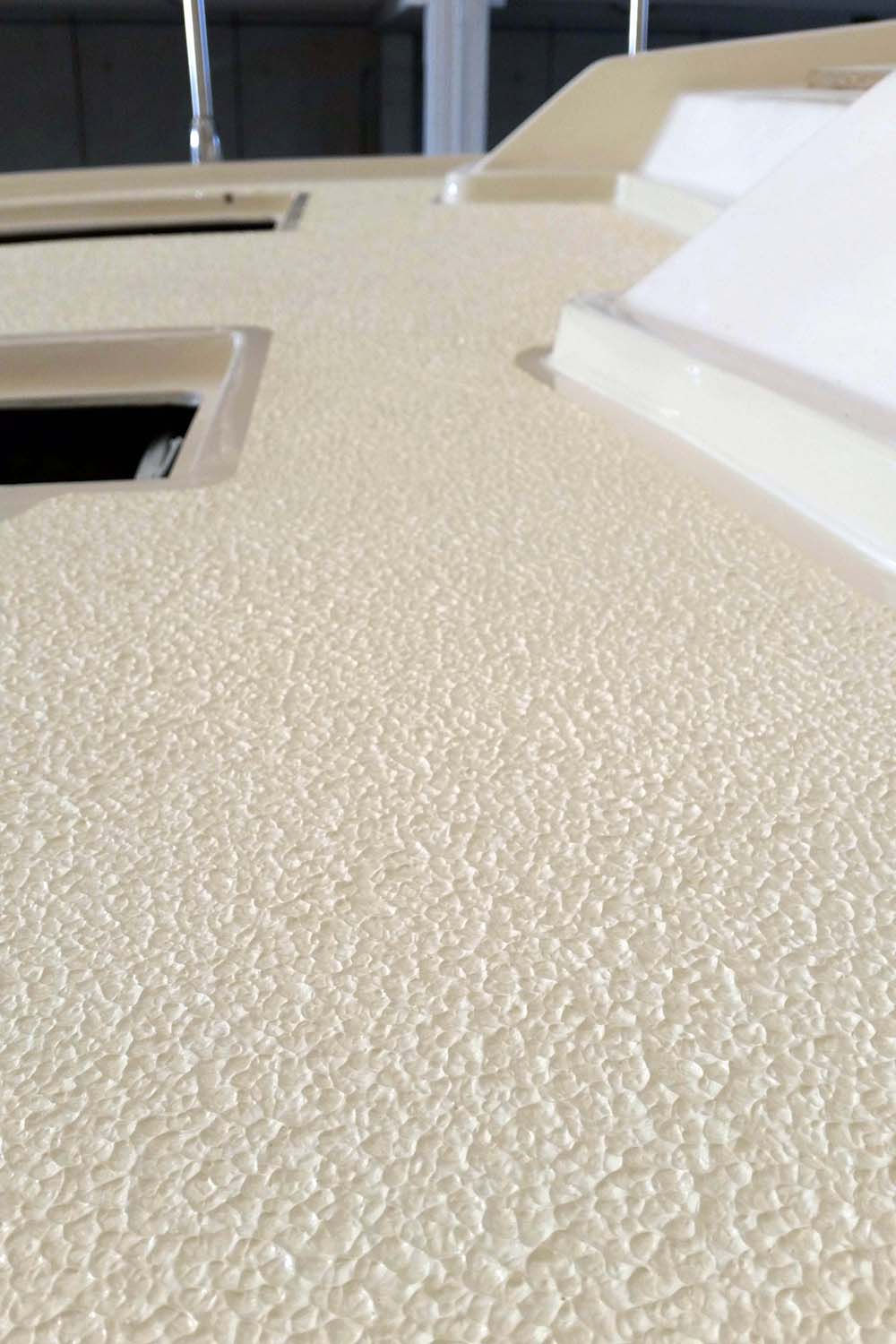
But not as much as you might think looking at the surface, which is indeed more rough at the touch.
To the point that you would expect it to be uncomfortable when walking on it barefoot, but surprisingly that isn't true.
We are barefoot onboard 100% of the time, and neither myself+swmbo nor any guests ever perceived any difference vs. other boats.

If you're interested in some pics, or anything else more specific, just ask!
 
Thanks. I’m looking at using it on my flybridge where we regularly bbq and often spill fat, so we need something that is both com and cleanable. It’s good to hear that after 2 years you’ve got no regrets. I think we’ll give it a go (y)

Which finish did you go for?
 
If by finish you mean which technique was used, I went for what in my understanding was the "standard" one, i.e. putting one putty knife at a time full of the stuff on the deck, spreading it very roughly, finishing with their specific roller. And repeat till completion.
Very easy, it's just a matter of keeping a constant "hand" while rolling.
For the colour, even if it's possible to add some to achieve any colour you want, I sticked to one of their standard ones, the light beige.
Which in fact matches pretty well the boat gelcoat.

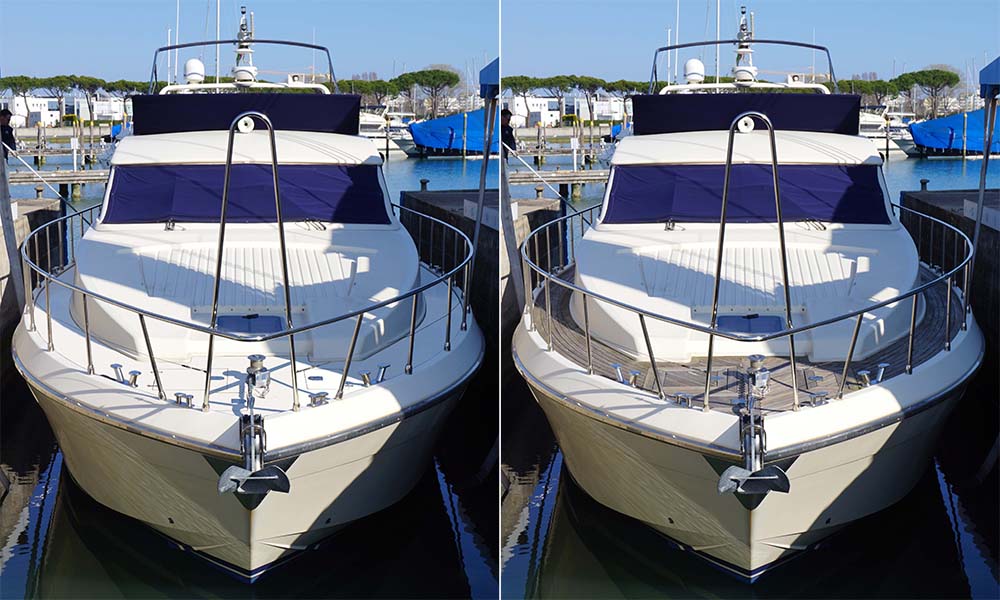
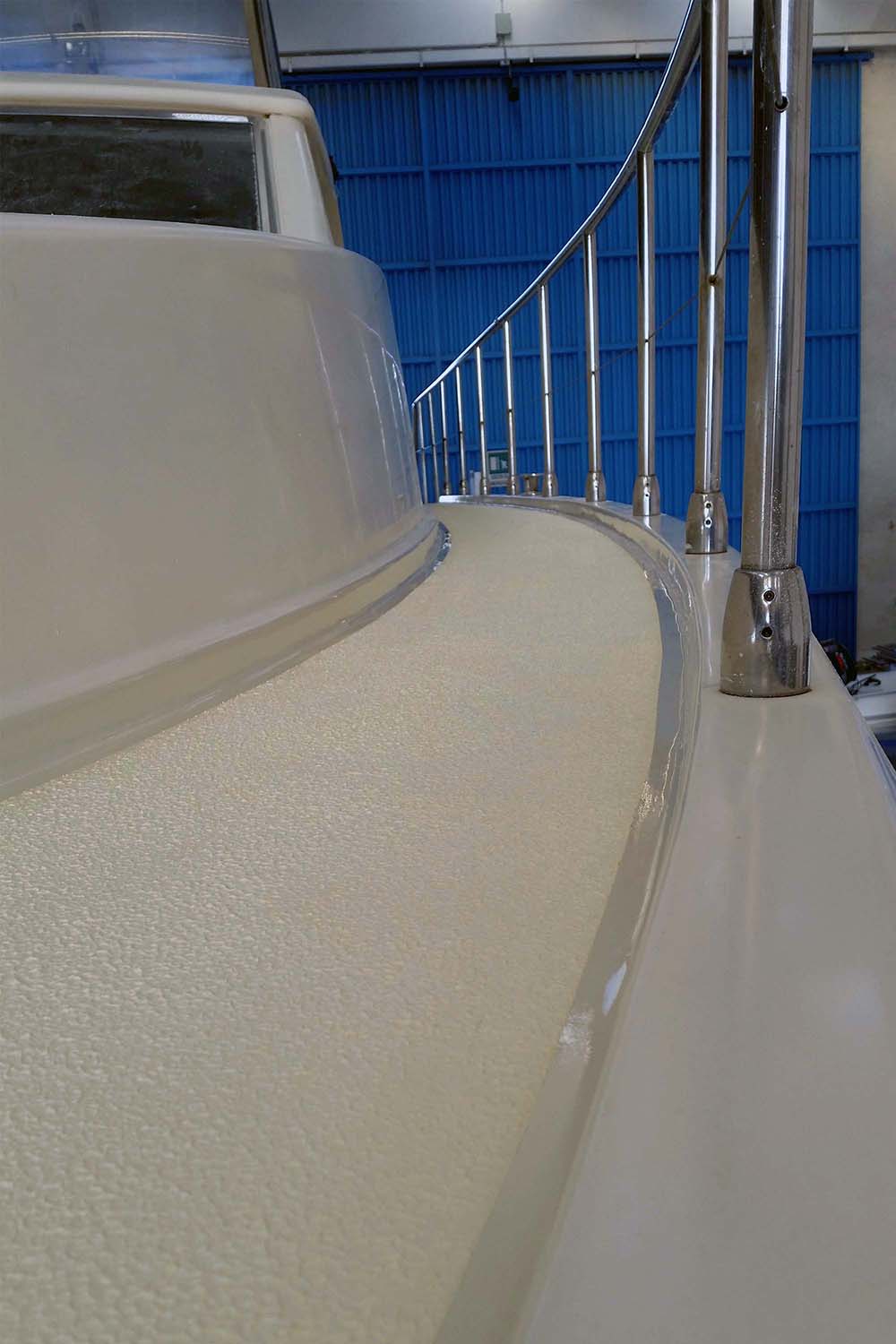
Below a few pics of the final result.
The left size of the first pic was actually photoshopped before doing the job, just to get an idea of how the deck was going to look like.
All the others are the real deal.

iIHGLxAU_o.jpg

xB2siny7_o.jpg

NWNAG7ww_o.jpg

0n4uZAjP_o.jpg

ipeih1Dl_o.jpg
 
I didn't do it myself. Not that it isn't DYI-able, but most of the work went into the teak removal and in the deck preparation, which is the part I didn't fancy.
Rolling on it the Kiwigrip is the final and faster part of the job, which a couple of workers completed in less than half a day, IIRC.
But if your f/b floor never had teak on it (AKA devil's work, on GRP decks!) and is already nice and smooth, it should be sufficient to lightly sand it, clean it, mask with some tape any part that shouldn't be kiwigrip-ed (like for instance the hatch and walkaround borders in the above pics), and you're good to go.
 
I can testify that the result looks very nice, and comforteable to walk on,
almost looks as if it was original

don't know for the cleaning, try to avoid doing too much cleaning, let alone on someone elses boat ;-)
 
Looks a nice job, mine needs doing soon. Can anyone tell me if Kiwi Grip will seal small or hairline cracks from water ingress if applied over them?
 
Can anyone tell me if Kiwi Grip will seal small or hairline cracks from water ingress if applied over them?
It surely can, but I'm a bit puzzled by the concept of hairline cracks due to water ingress.
On a GRP deck, all I can think of are the so called spider cracks, which are just an aesthetic and very superficial problem, affecting only the gelcoat.
What sort of "cracks from water ingress" do you have in mind, exactly?
 
It surely can, but I'm a bit puzzled by the concept of hairline cracks due to water ingress.
On a GRP deck, all I can think of are the so called spider cracks, which are just an aesthetic and very superficial problem, affecting only the gelcoat.
What sort of "cracks from water ingress" do you have in mind, exactly?
I didn't do it myself. Not that it isn't DYI-able, but most of the work went into the teak removal and in the deck preparation, which is the part I didn't fancy.
Rolling on it the Kiwigrip is the final and faster part of the job, which a couple of workers completed in less than half a day, IIRC.
But if your f/b floor never had teak on it (AKA devil's work, on GRP decks!) and is already nice and smooth, it should be sufficient to lightly sand it, clean it, mask with some tape any part that shouldn't be kiwigrip-ed (like for instance the hatch and walkaround borders in the above pics), and you're good to go.
I remember seeing the side by side pix of the teak and the photoshopped image before, but not the actual finished item and I must say it looks fabulous.
 
It surely can, but I'm a bit puzzled by the concept of hairline cracks due to water ingress.
On a GRP deck, all I can think of are the so called spider cracks, which are just an aesthetic and very superficial problem, affecting only the gelcoat.
What sort of "cracks from water ingress" do you have in mind, exactly?
He's asking if the coating will protect the GRP from water ingress in the future.
 
He's asking if the coating will protect the GRP from water ingress in the future.
Well, if that was the question, Kiwigrip alone is the wrong answer, imho.
After removing the teak, my deck was obviously a mess, and I wouldn't have even considered putting the KG on it directly and call it a day.
So, all the surface was treated with a thin layer of epoxy filler and then sanded silk smooth, before finishing with the KG.
Therefore, the deck was already as waterproof as when it came out of the mould (if not even more!), already at preparation stage.
Coming to think of it, maybe the KG alone could have been enough, considering that the deck obviously isn't meant to be permanently submerged as the hull is.
Me, I'd rather be safe than sorry, but each to their own.
 
I remember seeing the side by side pix of the teak and the photoshopped image before, but not the actual finished item and I must say it looks fabulous.
Thanks for your appreciation.
Also myself and the first officer (aka SWMBO) actually prefer the un-teaked look, on top of being immensely more practical - which was the main goal, anyway.
 
It looks like it would cut your bare feet to shreds. Is it completely safe?
I perfectly understand your concern, based only on the pics.
But in spite of the appearance, as also BartW confirmed based on his first hand experience, it feels absolutely fine when walking on it bare feet.
Not to mention that it never goes anywhere near the uncomfortably hot temperatures that teak can reach in the Med sunshine.
And the funny thing is that if you touch the surface with your hand, it does feel a bit rough and unpleasant - sort of.
But not at all with bare feet, for reasons that I actually can't understand.
 
It surely can, but I'm a bit puzzled by the concept of hairline cracks due to water ingress.
On a GRP deck, all I can think of are the so called spider cracks, which are just an aesthetic and very superficial problem, affecting only the gelcoat.
What sort of "cracks from water ingress" do you have in mind, exactly?
Ah, sorry I meant, Will it seal existing spider cracks to prevent water ingress" :)
 
Ah, sorry I meant, Will it seal existing spider cracks to prevent water ingress"
If it's only gelcoat spider cracks that you are concerned about, I never heard of them being bad enough to create water ingress.
I mean, they are typically very thin and superficial, with zero effects on the fiberglass underneath.
So, I would be very surprised if they should be the culprit for any water ingress from the deck that you might be experiencing.
Just as an example, worn out sealants in the stanchions bases are a much more likely point of water ingress inside the boat from the deck.

That said, KG is an acrylic polymer, that I don't think could let one single molecule of water to go through it, once hardened.
Besides, while the gelcoat is extremely non-elastic (which is the reason why it may crack, to begin with) the KG always remains relatively flexible.
So, regardless of any water ingress problems, I'd expect KG to work very well for covering any gelcoat cracks, with no risk to see them reappearing on the KG-treated surface, over time.
 
Top