
Keeping head's discharge hoses clear

TiggerToo

Well-Known Member
Joined
23 Aug 2005
Messages
8,409
Location
UK
Visit site
This is not to brag. Just to record a small success story. Following several bits of advice over the years, here and elsewhere, I established a simple routine for use and maintenance of the heads on Tigger:

1) Make sure the toilet is flushed extensively ("20 pumps" rule - sufficient to clear everything from the hose) EVERY TIME (including just urine)
2) Every year, add "brick cleaner" (dilute HCl) and let it sit in the pipe for 30 min or so

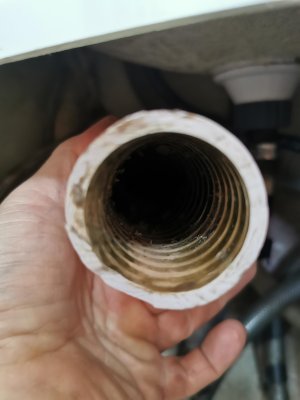
Attached you see what the hose looks like. This is a 28 year old pipe. No smells, very little scale. I recommend this to anyone who may be concerned about blocked toilet hoses.

IMG_20250507_125120.jpg
 
This is not to brag. Just to record a small success story. Following several bits of advice over the years, here and elsewhere, I established a simple routine for use and maintenance of the heads on Tigger:

1) Make sure the toilet is flushed extensively ("20 pumps" rule - sufficient to clear everything from the hose) EVERY TIME (including just urine)
2) Every year, add "brick cleaner" (dilute HCl) and let it sit in the pipe for 30 min or so

Attached you see what the hose looks like. This is a 28 year old pipe. No smells, very little scale. I recommend this to anyone who may be concerned about blocked toilet hoses.


View attachment 193165
Well done. I agree too as that is also my long term experience. No need for expensive special hose, just basic pvc ones, although I do not use brick cleaner, just occasional use of Harpic X10 toilet cleaner which contains Hydrochloric acid.
 
The issue is that stale urine is alkali and precipitates calcium carbonate out of the sea water. Flushing good, descaling essential ever now and again. Had no issues now I got that routine on our Jabsco

However I am pleased to be informed that Harpic has HCl as straight Muratic acid not readily available in the UK
 
Jabsco recommend a minimum of seven strokes per metre of hose. You'd be surprised at how long your hose is. For us, it means 40 strokes 🙄
 
I renewed the outlet hose on our Lavac last year as it was completely blocked. I also rerouted & shortened the hose, removing the bit which collected water. Also doubled the number of pumps to evacuate. Now working well.
Had to cut up the old hose to get it out - it was almost totally blocked!
 
Same as any other toilet, I think. Shut the seacock while you're pumping the acid solution through?

With the Lavac, you just keep the lid open, fill the pan with freshwater and HCL, then pump contents into discharge pipe, repeat to fill pipe, then close outlet seacock and soak HCL. No need to shut seacock on inlet side.

Lavac actually state that smell is from inlet, stale water. So far in over 15 years of use, no scale build up in Lavac outlet pipe without any HCL flushing. I assume the high volume of seawater on a Lavac flush cleans pipe out.
 
With the Lavac, you just keep the lid open, fill the pan with freshwater and HCL, then pump contents into discharge pipe, repeat to fill pipe, then close outlet seacock and soak HCL. No need to shut seacock on inlet side.

Yes, I agree, and should have made it explicit (i assumed it would be obvious that you didn't want to be pumping water in).


Lavac actually state that smell is from inlet, stale water. So far in over 15 years of use, no scale build up in Lavac outlet pipe without any HCL flushing. I assume the high volume of seawater on a Lavac flush cleans pipe out.

Agree, and I never had a scale problem when I had a Lavac (but small boat so not long run of outlet pipe).
 
Last edited:
The antisyphone valve is on the seawater inlet side, sucking up seawater, so you can’t pump HCL through that. If it was on the discharge side, it would spray poop and pee through it into the boat.

https://www.sparesmarine.co.uk/_webedit/uploaded-files/All Files/Lavac Marine Toilets.pdf

Yes, you don't need an anti-syphon valve in the outlet pipe of a Lavac (because it sucks in enough air with the waste to break the syphon if there's a loop), but you do want an anti-syphon loop (as shown in the Lavac instructions you linked to), which is what alahol2 asked about.
 
Last edited:
Be careful of poring HCI into a LAVAC bowl with the outlet seacock closed as I did that some years ago and it blew my Hendersen Mk V pump apart as the sea clock closed the gassing can and did in my case closed the outlet NRV and built up too much Pressure that blew the pump apart
 
But how do you fill the outlet pipe if the outlet seacock is open?
You just pump a volume through that displaces any seawater, waste, then close seacock.

It is likely most outlet seacocks are in the same space as the head, so not a hard task to coordinate.

Anyway, my experience I that you do t need to do this.
 
But how do you fill the outlet pipe if the outlet seacock is open?
As urine will mostly gather be the toilet bowl, the scale will be mostly there also. Thus I just fill the bowl with descaler to deal with bowl pump and first section of tube
.
5 years in I have had no occasion to fill entire heads outlet siphon pipe and I probably never will before I swallow the anchor maybe 10 years time
 
OK.
I fitted the Lavac and pipework about 20 years ago. Every winter I remove the pump and clean it, there is always a thin layer of 'calcium carbonate'(?) on the innards and valves which I clean off manually. I peer into the pipes but have never seen any major build up. My only worry was, in view of the layer every year in the pump, that there may be a substantial (and growing) layer hidden somewhere in the pipes. It was this that prompted my original question.

I'll just carry on as I've been doing...
 
Top