Keel/Rudder design

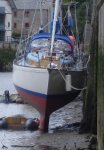
In the UK, it's common practice to put a boat in a steel cradle for antifouling, etc. The boat rests on its keel and adjustable props support the hull to stop the boat falling over. It works fine and no damage is caused. Some people use scrubbing posts, and again no damage is caused.

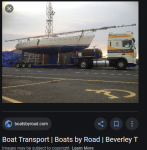
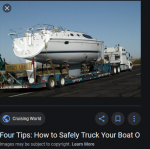
Remember that most new boats are transported by road on low-loaders, again resting on their keel. The road journey naturally causes much more vibration than merely sitting in a cradle in the marina, but no damage is caused. My own boat was brought 750 miles by road from the factory.

Does your boat have a bolt on keel and what is her draft.

The easiest way to transport a boat with a bolt on keel is to fit the keel after transport. No only doe this reduce the height ot eh boat during road transport, it makes routing easy as you are less restricted by low bridges.

My boat was transported by low loader from Cape Town to Johannesburg 1400 Km then to Durban 600 Km and had to go by a special route due to low bridges.

Much easier to transport with bolt on keel detached and it it just before launch.

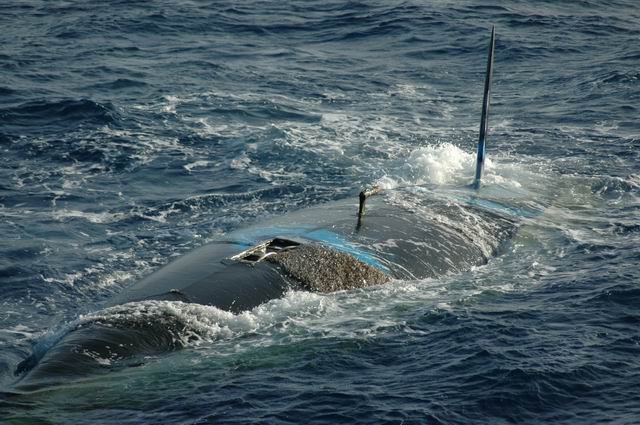
I personally saw the damage to the hull of Moquni that lost its keel in 2005 and was shocked at the resulting damage

The Moquini Mystery
 
In the UK, it's common practice to put a boat in a steel cradle for antifouling, etc. The boat rests on its keel and adjustable props support the hull to stop the boat falling over. It works fine and no damage is caused. Some people use scrubbing posts, and again no damage is caused.

Remember that most new boats are transported by road on low-loaders, again resting on their keel. The road journey naturally causes much more vibration than merely sitting in a cradle in the marina, but no damage is caused. My own boat was brought 750 miles by road from the factory.

I think it would depend on the design/construction. Having 8(?) tonne supported on a fin keel would be asking too much.

Screenshot_2020-11-18 transporting keel yachts by road - Google Search(1).pngScreenshot_2020-11-18 transporting keel yachts by road - Google Search.png
 
Statements like these fall down on the numbers/%s. As these boats were produced in the 10s of thousands, and the documented failures are perhaps in the 10s, it becomes problematic to suggest 'a lot' vs 'a lot'.
Indeed. If you just take Bavaria as an example, between 2000 and 2008, they were building about 5000 boats/year. Since then about 3000 boats/year. So in the last 20 years, they have probably built about 80,000 boats. I only know of 1 that's lost it's keel (the Match 42).
 
Indeed. If you just take Bavaria as an example, between 2000 and 2008, they were building about 5000 boats/year. Since then about 3000 boats/year. So in the last 20 years, they have probably built about 80,000 boats. I only know of 1 that's lost it's keel (the Match 42).
I think there's been two Bavarias losing their keel (a small % overall).

The facts: surely everybody remembers the keel that some years ago fell off a Bavaria Match 42 and recently all know that an almost new 90ft Oyster lost the keel. Some know about two First 40.7 but less know about a Bavaria 390, a Jeanneau 37, a Vand den Stadt 45, a Sweden yacht 42, a Fast 42 a Maxi 110, a Max Fun 35 or more recently a Comet 45 and some days ago a Davidson 50.

It would be very easy to blame Laurie Davidson for the loss of keels on Finistere (2018) and Castaway (1987). Was it a design problem or maintenance problem?
 
I think there's been two Bavarias losing their keel (a small % overall).

The facts: surely everybody remembers the keel that some years ago fell off a Bavaria Match 42 and recently all know that an almost new 90ft Oyster lost the keel. Some know about two First 40.7 but less know about a Bavaria 390, a Jeanneau 37, a Vand den Stadt 45, a Sweden yacht 42, a Fast 42 a Maxi 110, a Max Fun 35 or more recently a Comet 45 and some days ago a Davidson 50.

It would be very easy to blame Laurie Davidson for the loss of keels on Finistere (2018) and Castaway (1987). Was it a design problem or maintenance problem?
So, do you agree that 2 in over 100,000 boats from Bavaria losing their keels makes your initial post look a bit silly?
 
  • Like
Reactions: pvb
The Garcia Exploration yachts don't even have a bolt on keel but a lifting one but I don't suppose any of them have been outside the hospitality area of a marina. Jimmy Cornell is of course a fantasist who has never actually sailed. Some/most Scandinavian built boats have bolt on keels with a steel shock dissipation structure; according to a friend who sails in the Northern Baltic it's normal to hit a submerged rock at speed at least once a year because there are so many of them.
 
I didn't mention Bavaria in my initial post? :rolleyes:
Not directly, but you did say the following, which amounts to the same thing. Will you now admit that your initial post was bolox?

"I believe the modern day production yachts are good for Coastal Cruising, sitting in a marina and club racing but definitely not for Blue Water Cruising."
 
  • Like
Reactions: pvb
Not directly, but you did say the following, which amounts to the same thing. Will you now admit that your initial post was bolox?

"I believe the modern day production yachts are good for Coastal Cruising, sitting in a marina and club racing but definitely not for Blue Water Cruising."

There's a problem with fin keeled yachts. Do you deny it?

The fact is that fin keel yachts cannot take a hard grounding

Why do keel failures happen and what can we do to prevent it?

Keel failure: the shocking facts - Yachting World
 
I'm not entirely sure why blue-water sailing is the criteria.

I am unlikely to stray more than 40 miles from the coast but I want my keel to be as unlikely to fall off as if I were crossing an ocean.

I have no more wish to drown in in national waters than in international waters.

Or is the idea that within helicopter range you might stand a chance of being rescued before you drowned?

If so, that seems a pretty poor argument for tolerating weakness in a hull structure.
 
Not directly, but you did say the following, which amounts to the same thing. Will you now admit that your initial post was bolox?

"I believe the modern day production yachts are good for Coastal Cruising, sitting in a marina and club racing but definitely not for Blue Water Cruising."

Why should Coopec agree you you its his own opinion and you are free to disagree but do not have the right to require any one to change their opinion.

There are some that say modern catamarans are not suitable for Ocean crossing yet plenty do. It all about personal choice.

The issue with keels falling off is that like a airplane crash is a dramatic event that should ho happen so needs attending to like the cause of a airplane crash
 
There's a problem with fin keeled yachts. Do you deny it?

The fact is that fin keel yachts cannot take a hard grounding

Why do keel failures happen and what can we do to prevent it?

Keel failure: the shocking facts - Yachting World

I think we've just shown beyond doubt that there isn't a "generic problem" with fin keeled yachts. A failure rate of 2 in 100,000 (on 0.002%) does not show a problem. Added to that, we know that in one of these cases is was established that there was a design fault which was rectified, and my guess is that in the other case there was some other underlying reason for the keel loss.

I bet if you looked at boats with encapsulated keels, you would find at least a 0.002% failure rate in something or other. It's not just keel failures that make boats unsafe or unsuitable for offshore sailing you know.

I offered you the opportunity to bow out gracefully, but you don't seem to want to take it.
 
If I were buying another boat, I'd be considering...
What seems to have happened is that buyer's concept of boat shape has change at that level of the market, I'm guessing influenced by racing trends? Just in the same way car design changed?

I'm asking that because while the long fin might have performance benefits for racing, I don't see those applying to rich, retiree world cruising, and if you're not going full tilt all the time, what's the point? Why not just go for a safe, long shallow keel? Sorry, I'm a little older and remember when something like a Golden Hind is what people would set off in.

(A 31, not Drake's that is)

Or is it manufacture led, ie price?

Were I spending $1m, it's not what I would buy.

And, is my conclusion the Bendy Toy was poorly made? Yes, that is my sincerely held opinion.
With regard to your motives, I find it quite disconcerting that you are prepared to search my posting record as far back as 6 years. Seems a bit weird. As such, I’ll now steer clear of this troll.
More noise and no signal again.

Your post came up on the first page of Google while searching about keel failures. Seriously, who goes about chiding others for "being libellous" for 6 years? Or has it been a lifetime's commitment of yours. born out of watching Rumpole of the Bailey?

Get a life (or at least learn how much such a case would cost and, hence, the likelihood of anyone pursuing one is zero).
 
Last edited:
Not directly, but you did say the following, which amounts to the same thing. Will you now admit that your initial post was bolox?

"I believe the modern day production yachts are good for Coastal Cruising, sitting in a marina and club racing but definitely not for Blue Water Cruising."

The makings of a bluewater boat
April 27, 2018
Knowing very little about what we were embarking on, we joined the Bluewater Cruising Association and asked as many people as we could about what we should be looking for in an offshore yacht. In the Pacific Northwest, the consensus seemed to be that the “bluewaterness” of an offshore yacht boiled down to six main elements: a long keel, a skeg-hung rudder, heavy displacement, reputable offshore builder, large water and diesel tanks, and a cutter rig or ketch design.

The makings of a bluewater boat - Ocean Navigator
 
A failure rate of 2 in 100,000 (on 0.002%) does not show a problem.
No, that's not a fair equation where it's also been shown that many of those might only be sailed a few fair days a year.

A keel's not going to be a problem merely because of its existence, you'd have to work out a better equation based on the miles and conditions it is sailed in.

From knowing young lads who did this for a living, I'd expect most to make a dash to somewhere nice during a very safe windown (so as to protect the owner's investment), then to spend most of their lives doing 3 week gentle cruises each year.

The Moquini. There is lots to learn from it.
The DIT reported that visual inspection and wall thickness testing showed, in the area of the keel, that the yacht did not conform to design specification and "the workmanship is appallingly substandard"
moquini%205.jpg
 
Last edited:
I am surprised at the vitriolic, bigoted, sarcastic, narrow minded and just plain rude comments of people commenting above. Each to his own I say. I love yachts. I love ALL yachts (especially ones without fin keels and balanced rudders)

You have just described your own posts perfectly (y)
 
Last edited:
Top