KAD running hot

Just a thought, but what about your raw water intake for the cooling, could it be that the inlets are grown over with weed or similar? Worth going down or getting someone to go down for a look. Especially as it's both engines, could be growth on both.
 
Not a good idea . The water sucktion thru the drive cools the drive if you for a prolonged time are on plane .

I,m still searching for an answer if high load temps of 90-95 are just the nature of the beast or an issue .
 
The official Volvo KAD owner manual specifies the thermostat operating temperatures. The thermostats start to open at 81 deg C and should be fully open at 94 deg C. They don't specify a specific running temperature. However if the engine temperature is over 94 degs C then the thermostats can no longer control the temperature. So the actual operating temperature should be less than 94 and over 81.

My KAMDs used to run at about 84 degs C at 3200 rpm in the med with a 30 deg C sea temperature. I checked the temperature with an IR thermometer pointed at the thermostat housing and also with temperature sensors epoxied into the top of the turbo charger exhaust housing plugs. However the actual gauges indicated 90 degs C.
 
My KAMD44 reads about 40-60 at 1400rpm, about 90 at cruising - 3000 - 3200rpm. Told by the service engineer that it's about right.
40-60 is too low; it should be about the same as with higher loads. Either the thermostat is not working, or the gauge is showing the wrong reading. If they run cold, this causes a lot of different problems, as the fuel does not burn cleanly.
 
The official Volvo KAD owner manual specifies the thermostat operating temperatures. The thermostats start to open at 81 deg C and should be fully open at 94 deg C. They don't specify a specific running temperature. However if the engine temperature is over 94 degs C then the thermostats can no longer control the temperature. So the actual operating temperature should be less than 94 and over 81.

My KAMDs used to run at about 84 degs C at 3200 rpm in the med with a 30 deg C sea temperature. I checked the temperature with an IR thermometer pointed at the thermostat housing and also with temperature sensors epoxied into the top of the turbo charger exhaust housing plugs. However the actual gauges indicated 90 degs C.
Thanks K, that's really useful. Were the temperatures taken with the IR thermometer the same as the ones on the exhaust housing?
 
Thanks K, that's really useful. Were the temperatures taken with the IR thermometer the same as the ones on the exhaust housing?
The temps on the turbo exhaust housing were the same as the thermostat housing give or take a degree. I measured the temps after at least 30 minutes of cruising so everything is properly heated through.
 
Last edited:
40-60 is too low; it should be about the same as with higher loads. Either the thermostat is not working, or the gauge is showing the wrong reading. If they run cold, this causes a lot of different problems, as the fuel does not burn cleanly.
Should this weather ever improve i will recheck those figures.
 
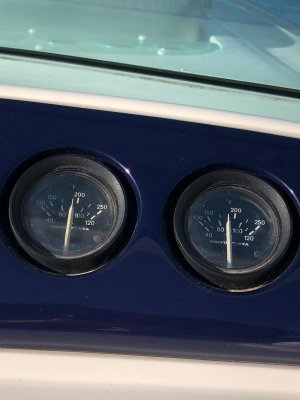
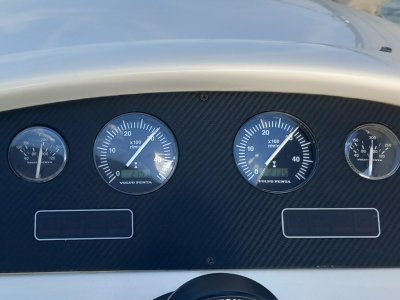
One of my partners sent me the following pic at cruise speed.

In light of the above comments, perhaps I'm worrying about nothing.
Thats much better than mine which I think are too hot, the starboard engine did kick out a some coolant into the bilge.
Gauges2.jpg
 
90 and even a bit north of it seems to be the nature of the beast when loaded up . Decalcing the heat exchangers might help to sleep safe bot maybe its not needed at all
 
On my KAD300's I see 86 celsius at 1300 rpm and 94 celsius at 3200 rpm. Connectors being 20 years plus could cause small change in resistance so actual reading could be slightly off. As long as you have no alarm and the needle stays firm at cruising speed you will have no issue. If you google operating temp for KAD300 is says 82-93 celsius
 
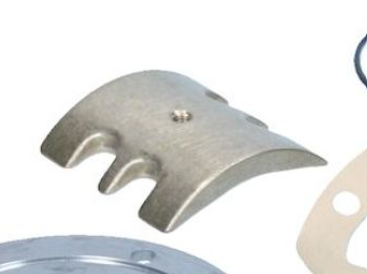
Pete. My money is on the raw water pump housing impeller cam is wearing down. Your boat gets used more than most and these tend to be forgotten about. Just like the side cover they do wear.
 
Thanks, it was changed in the spring. In fact, we fit new impellers every year (we do find ours wear quite quickly, which could be another indicator of an issue).
When I got my first boat it had a Kad300 and we didn't change the impeller for six years until we set off one afternoon and the alarm went off god knows how long the previous owner had it in there for - then obviously change it with a spare.
when inspecting my old one it had worn down but as the jabsco manual states it could have been turned the other way and fitted as a get me home
 
Top