JW's Upgrades for 2016 - Tender

A website with both IT and EN pointed me to "T-track" or "traveler", though the latter mostly refers to the boom rail, as I understand.
Anyhow, I'd rather avoid anything like that, for a heavy-ish rib...
M, I think that some pics could help trying to find some alternative solution, if any.
 
Genoa tracks with modified car arrangements would be man enough for the job IMHO, the only question is whether they would slide smoothly with 400 kgs on top. I think they would if kept lightly greased, though I'd want to do some trials first. I'd avoid the complication of ball bearings if poss.
 
Hmm tricky. The genoa cars are not designed for downward loads so wouldn't work well ihmo. Linear roller bearings are precision items and tend to work as sliders on round sections so need extra work to get them to serve as train track type devices. I'd prefer simple PTFE block bearings but I fear with 250kg on the aft chock the thing will be too hard to push even with grease

I think I'd be looking at a custom made square U rail81x45 internal section and 800 long, with the sliding chock bases made as cars from 80x40x 500 long RHS with wide castors (rollers) at each end hidden from view inside cut outs in the RHS. and then a pair of matched (talking to each other) 24v low geared linear actuators, lead screw type, (one on each chock), 300 stroke, to do the motion. Need a sketch?

Only loosely related here are pics of my Laser chocks. Made for aesthetics as well as function - I didn't like the teak blocks I had on last boat, due to the very prominent positioning of flybridge chocks. You could use something like this concept, welded onto the sliding cars that I'm talking about above

6EBFC4D8-FE5E-4FE9-A096-BEAAF06BF658.jpg

412C92EF-3AD9-476C-BB46-BAD312C1F444.jpg
 
Last edited:
What did Sealine hse for their manual SECS system?
Don't jeanneau have something on their currentvNC11/14 models where the whole rear bench seat/locker slides forwards and backwards.

Pretty sure they are Genoa car tracks and the weight must be a couple of hundred kg
 
Thanks
I didn't expect replies that quickly.
Nick and MAPISM - I had a cup of tea with some yachtie friends and they cam up with the track and car idea - 34mm T section it is called - by Harken - in fact it isn't T section - more like an I section with a fat middle web for the bolts to screw down.

I think the Harken track would handle the weight but we also "kicked round" an idea like JFMs (without the motors) which I think needs some more investigation.
We were thinking of a purpose made roller incorporating nylon rollers (about 30mm ish dia) inside two S/S channels (one that fits inside the other) - the bottom channel might be replaced with a T track.
Maybe JFM can elaborate on his idea.

My feeling is that I would end up with something "purpose made" like this:-
http://www.rollon.com/IN/en/products/linear-line/2-x-rail/

I will post some pics later that show the problem.
I think that our boat yard has some time to lift and scrub the boat this morning - SWMBO is coming out tomorrow for a couple of weeks and it would be nice to have a clean boat bottom - better weather forecast etc...

Thanks for the replies - please keep the ideas coming.
 
I believe that H+B technic had such a gliding system in their product range, but they don't have any of their accesory's on their website
if you want I can asc them, or you could visit them at Mets in November,...

some pics woudl be helpfull,
I also had sort of a "shoulder" but the new tender goes just over it,

isn't modifiing the crane arm an option ? ad some part to make the arm slightly longer...?

we modified our crane; made a attachment for the cable on the front end of the arm,
and now we have doubled the cable so that it goes through a roller, with the hook, and the cable end is fixed on the end of the arm
We achieved that the cable could lift almost double of the weight, the position is slightly more foreward (5cm) then before,
the vertical movement is now at half the speed, but thats no problem.
 
Before going too complicated I'd definitely see what can be done with standard track.

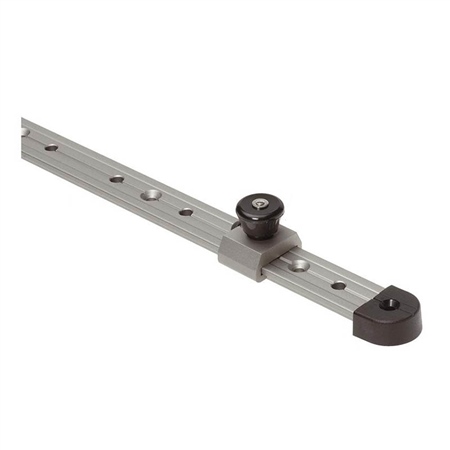
Fix two sections of track like this to the flybridge deck

2974.jpg


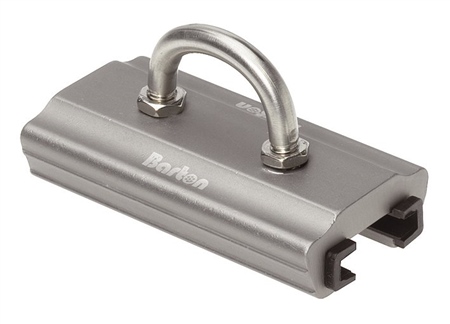
Then on each section of track, have two simple cars like this 12-18" apart, remove the U-bolts, and bridge them with a stainless profile that will accommodate the chocks.

2973.jpg


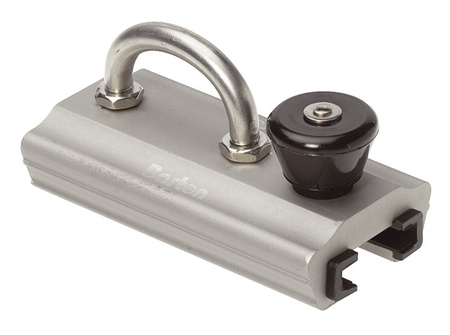
Better still, make one of the cars locking so that the chocks will be securely held in either position

2972.jpg
 
Before going too complicated I'd definitely see what can be done with standard track.

Fix two sections of track like this to the flybridge deck

2974.jpg


Then on each section of track, have two simple cars like this 12-18" apart, remove the U-bolts, and bridge them with a stainless profile that will accommodate the chocks.

2973.jpg


Better still, make one of the cars locking so that the chocks will be securely held in either position

2972.jpg
Nick, I gotta disagree a bit I think. Those genoa cars will struggle with the loads we are talking about, not in the sense of busting but in the sense of not providing a friction-free sliding action when loaded. Their rated capacities are not telling you that there is easy friction free sliding when loaded. Furthermore they are absolutely not designed to provide enough limitation in the car rotating around an axis parallel to the direction of slide. That means the top of a 180mm high chock is going to be wobbly/floppy more than you'd like (yuk!)
 
Thanks everyone

This is the problem

DSC06929_Small_zpswcdhy6hn.jpg


DSC06938_Small_zpsiw7ulsir.jpg


There is enough space once the dinghy is up there and the crane will lift it.
So a sliding chock system does seem to be the answer.

The best idea that I have at the moment is a roller based device - rollers sandwiched between two surfaces seem to be a good idea.
Once the dinghy is in place, it will be strapped down so the forces on the rollers are just the weight of the dinghy.

I like the simplicity of Nicks argument but I fear that JFM would be right.
I probably couldn't reach the chocks/runners once the dinghy is in place.

I feel sure that this is an engineering problem and that something can be fabricated.
The trick would be to make it a really simple construction.
 
Mike, if you want to persue the track idea, the track is available in different widths, I think a no 3 is 35mm, perhaps there is something even wider. lewmar offer an upgrade on the sliders - delron balls - they really make a huge difference to the friction.
 
The trick would be to make it a really simple construction.
Precisely, but I can't think of a way to keep it simple/easy/smooth, with the tracks+sliding cars solution.
Looking at your pics, a thought popped to my mind - though explaining it will be more challenging than build it.... !:nonchalance:
Bear with me for a minute:

First of all, as I recall, the crane is on stbd side, and you have the tender bow on the same side, right? If not, forget all this post.
But if yes, I think it might be possible to just slide the bow (which is much lighter than the stern) above the center of its chock, provided that you modify the stern chock as follows:
Instead of the typical two pins on each side of the chock, think of one fixed round pin in the center, plus one removable pin on one side of the chock (or two, one on each side, if necessary for better stiffness).
This way, the stern chock could be free to rotate, hence allowing you to position the tender diagonally - as much diagonally as necessary to avoid the bow interference with the crane.
Now, if the bow chock is large enough (and if it isn't, maybe it could be made larger on its side towards the boat stern), after lowering the tender and centering perfectly its stern on the partially rotated stern chock, the tender bow should lie on the bow chock, albeit obviously not centered.
But since most of the tender weight is taken by the stern chock, which can rotate freely, you should be able to pull manually the tender bow, sliding it above its bow chock till it's centered.
The last step would be fitting the removable pin(s) on the side(s) of the stern chock to lock its rotation.
Actually, if the center pin is solid enough, the locking pin(s) could be unnecessary, because once the bow is in its position on the fixed bow chock and the tender is properly tied, it couldn't move anyway. But you can check if it's better to fit locking pin(s) or not also afterwards.
When lifting the tender, I would think that the cable pull alone should be sufficient to make the tender bow slide towards the boat stern, with the stern chock rotating to follow the movement, till it'll be eventually lifted from both chocks.

I hope the explanation (and possibly also the idea! :)) makes sense, but if not, let me know and I'll try to make a drawing.
 
Yup, after seeing the pic, and before reading MapisM's post, I thought also that only one end of the RIB needs to move.

Mapis, you have to remember that the crane must be exactly athwartships when the dinghy is stowed, and cannot be slewed at all until AFTER the dinghy is in the "300mm astern" position ready for launching the dinghy (I think!)

For some reason, I'm thinking hurricane has to have the o/b engine on the starboard side, same side as crane, but Hurricane can you confirm that please?

Hurricane can you post pic of the dinghy space taken from the port aft corner of the flybridge so I can make on an idea? I'm thinking:

1. Rotatable (10 degrees) front chock on a pin, exactly as per mm, port side of JW, bow of dinghy
2 Sliding aft chock - design below
3. Operation of slide mechanism as follows
(a) to slide the starboard chock aft in preparation for dinghy launch, you have a dyneema 8mm line that clips onto the aft end of the starboard chock, then runs through a pulley on the GRP aft extreme starboard corner of flybridge deck, then the line goes forward and to port (diagonally) to a pulley near the staircase hatch, then it runs to and clicks onto the crane hook. You lower the crane wire 400mm, click the dyneema line onto the crane hook, haul in the crane wire 300mm, and hey presto the aft end (the end near the crane) of the tender slides aftwards. All this with the crane perfectly athwartships. Then you can rotate/slew the crane and you're good to go.

(b) to stow the dinghy after craning it onto the flybr, you do the same except the dyneema line clicks onto the front end of the chock, then thru a deck pulley quite near the crane base, then it runs to the crane hook. you lower the dinghy into its non final position. Then slew the crane so perfectly athwartships. Then use crane wire to pull in the dyneema line so rotating the dinghy into the stowed position

Now, with the power/pull of the crane instead of human elbow grease or motorised actuators, you don't need low friction linear bearings. The chock can have a flat PTFE base and slide in a simple s/s track.
 
Last edited:
There was a grand design where a glass roof section were mounted on Harken Cars and Genoa Tracks and it appeared to move very smoothly. When they did one of the few years on catch up it was still going great guns.
 
There was a grand design where a glass roof section were mounted on Harken Cars and Genoa Tracks and it appeared to move very smoothly. When they did one of the few years on catch up it was still going great guns.
Where you have a big panel sliding on those tracks, and a track at each end or each side, more than a metre apart, it's fine. But here we are trying to slide a single chock along a single track, without the ugliness of a pair of tracks spaced well apart. The top face of chock - 180mm high - is going to wobble in a direction perpendicular to the track because genoa cars are not designed to eliminate rotation of the car along an axis parallel to the track
 
Mapis, you have to remember that the crane must be exactly athwartships when the dinghy is stowed, and cannot be slewed at all until AFTER the dinghy is in the "300mm astern" position ready for launching the dinghy (I think!)
Good point, if that is the case my thoughts re. lifting the tender is flawed, but maybe it's still not a big deal to just push the tender bow towards the stern a bit, before operating the crane...
Re. the position, I don't have any pics on the PC I'm using atm, but if you check the very first frame of this video you'll see that I was right in remembering the tender position.
At least with the old one - can't be positive about the Novu, though.
 
Nick, I gotta disagree a bit I think. Those genoa cars will struggle with the loads we are talking about, not in the sense of busting but in the sense of not providing a friction-free sliding action when loaded. Their rated capacities are not telling you that there is easy friction free sliding when loaded. Furthermore they are absolutely not designed to provide enough limitation in the car rotating around an axis parallel to the direction of slide. That means the top of a 180mm high chock is going to be wobbly/floppy more than you'd like (yuk!)

Yep, I did say I'd want to do some trials first to make sure the operating effort wasn't too high, although the better option is to use the cars linked to by Aquapower, or mentioned by Asm, that have runners. It also appears from the spec that they will comfortably take the load.

I don't quite follow the wobble point, or at least I don't see why the relevant chock dimension is 180mm. If the keel is the main point of contact with the chock, and the sides of the V only hold the RIB upright, then surely that dimension can be as low as 20mm, and wobble wouldn't be much of an issue.
 
Thanks. OK, you memory is confirmed correct! I just have some vague (very vague) recollection that with the Novu Hurricane has decide the dinghy must be the other way around, but I might be completely mis-remembering that. He can confirm!

Anyway, even if my memory is completely useless it has created a nice opportunity to reminded of that very nice video! :encouragement: (Dramatic choice of music MM!)
 
Top