
Jeanneau cutlass bearing

Exactly same as mine , not threaded in shaft, just small indent , I just worked different chisels in the split and drilled a bit more into shaft because must have been a tiny bit not quite drilled out that done it then , it’s so annoying when you can move it a few mill left to right and the bugger still won’t drop out , my arm broke off in the end trying to bash it round but I had to have a new one anyway, vetus 40 £118 , the new cutlass bearing 35x1.875”x140 fitted a treat
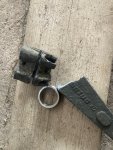
 
Exactly same as mine , not threaded in shaft, just small indent , I just worked different chisels in the split and drilled a bit more into shaft because must have been a tiny bit not quite drilled out that done it then , it’s so annoying when you can move it a few mill left to right and the bugger still won’t drop out , my arm broke off in the end trying to bash it round but I had to have a new one anyway, vetus 40 £118 , the new cutlass bearing 35x1.875”x140 fitted a treat
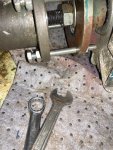
At least i'm not the only one,. So the vetus 40 fits fine on a 35mm shaft? Thanks again or the info.
 
I haven’t measured the rudder shaft but vetus 40 is stamped on the old one I’ve taken off , been trying to put some photos on but for some reason site won’t let me do it,
 
I got that off easily enough as it was off recently enough but i do remember it took nearly 2 days when I did it first. I made a pullers with 1 inch steel and long bolts. Lots and lots of heat and a hammer.
 
Exactly same as mine , not threaded in shaft, just small indent , I just worked different chisels in the split and drilled a bit more into shaft because must have been a tiny bit not quite drilled out that done it then , it’s so annoying when you can move it a few mill left to right and the bugger still won’t drop out , my arm broke off in the end trying to bash it round but I had to have a new one anyway, vetus 40 £118 , the new cutlass bearing 35x1.875”x140 fitted a treat
Last question hopefully. When you installed the new cutlass did you just hammer it in or make up something like a threaded rod to pull it in?
 
The phenolic ones swell in water, so the bearing has a bigger clearance from new to compensate. I fitted one that swelled more than had been allowed for, gripping the shaft very tightly. I had to replace it with a brass one after one season.
Hi Vyv, I have to say that you normally come across as very knowledgable, but phenolic swelling causing a problem from moisture absorption? it was probably a machinest that got it wrong or the bearing was made as a clearance fit and you pressed it in ? causing ID to shrink (that's what I normally see as the problem) in practice the biggest changes that have to be allowed for are from thermal swell which you get with rubber. The trend is now to use fully phenolic composite shaft bearings, which are Lloyds approved (no rubber no carriers) but this is mainly on larger vessels than what we see talked about here. Phenolic can have lubricants added so during start up and run down (when bearing runs dry) they wear less than rubber, and they can also resist marine growth. So phenolic are not generally a bad choice.
 
With the size that I purchased it just pressed in nice by hand
This is always what worries me about a press fit bearing, it can be an easy press or a tight press if you are a bit sloppy with measurements, the result of a tight press fit is the ID closes down leaving less running clearance between bearing and shaft. If you get a clearance fit bearing and bed it on epoxy the ID is exactly the same size as when it was removed from the Lathe where they are made to have a running clearance and thermal swell clearance.
 
Hi Vyv, I have to say that you normally come across as very knowledgable, but phenolic swelling causing a problem from moisture absorption? it was probably a machinest that got it wrong or the bearing was made as a clearance fit and you pressed it in ? causing ID to shrink (that's what I normally see as the problem) in practice the biggest changes that have to be allowed for are from thermal swell which you get with rubber. The trend is now to use fully phenolic composite shaft bearings, which are Lloyds approved (no rubber no carriers) but this is mainly on larger vessels than what we see talked about here. Phenolic can have lubricants added so during start up and run down (when bearing runs dry) they wear less than rubber, and they can also resist marine growth. So phenolic are not generally a bad choice.
It was many years ago but it was exactly as I described. I recall the information with it explaining that the shaft to rubber clearance would be slack on fitting and close up after immersion. I certainly did not press it in.

I fitted it during winter haul out and noticed during the season that the engine/drive seemed sluggish. At haul out next winter I could barely rotate the prop by hand.
 
Interesting and clearly not right, In our machining we take into account the thermal expansion of the shaft and the carrier (assuming marine temperature can be between 0C and 32C) the thermal expansion of the bearing and the moisture swell of the bearing and the wall thickness of the bearing. Thermal change is the biggest factor in our calculations. Our type of phenolic resin composite has a far smaller moisture absorption rate than most other composite bearings.
As an example for a 25.00mm ss shaft and a 40.00mm bronze carrier Min running clearance is 0.03mm, moisture swell is 0.04, unplanned thermal change is 0.06mm, add them up and you get our min radial displacement of 0.13mm
 
Top