JB Weld Extreme Heat paste in thick layer issue

skippeer

Well-Known Member
Joined
29 Mar 2019
Messages
77
Location
Sweden
Visit site
As a temporary solution for the season did I apply "JB Weld Extreme Heat" and used it as any chemical metal paste in a thick layer.
Ones you open and mixed it you need to use it directly, not like 2 components epoxy pastes there you can mix exactly what you need now and save it for next project.

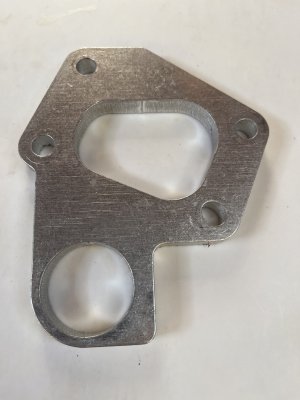
I picked JB Weld Extreme Heat because it is the flange on the exhaust manifold I am trying to refill what has corroded away as a temporary to when the Penta workshop have time to help me with my D2-55 A engine.
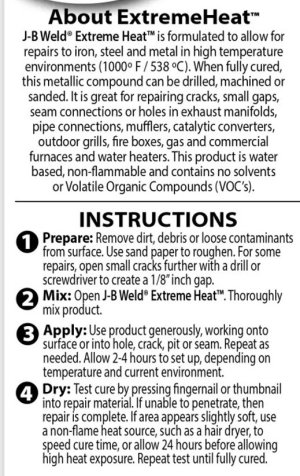
After 22 hours in 25 Celcius degrees still soft.

Will be searching for my electrical air heat gun in the boat and use it to stress the process.

What chemical metal paste can cope with high temperatures?
Considering to remove the soft JB Weld paste.

Any other DIY persons able to share experiences?
 

Attachments
  • JB Weld instruction.jpg
    JB Weld instruction.jpg
    165.2 KB · Views: 29
Last edited:
Sounds like perhaps you did not thoroughly mix the product before applying? It should go off in an hour or so and be fully cured in 24 hours.

Not much help I’m afraid. You might need to scrape it out and do the repair again.
I mixed it several minutes and got the same grey colour (a metal stick or screwdriver is best because at the start the content is partly "hard").
I am starting to suspect that JB Weld have failed to provide bullet proof instructions, all the videos I have seen today has thin layer only examples.
 
I mixed it several minutes and got the same grey colour (a metal stick or screwdriver is best because at the start the content is partly "hard").
I am starting to suspect that JB Weld have failed to provide bullet proof instructions, all the videos I have seen today has thin layer only examples.
Most 2 part resins have an exothermic cure reaction, so the thicker the layer the faster it cures, to the point of smoking and cracking if taken to extremes.
 
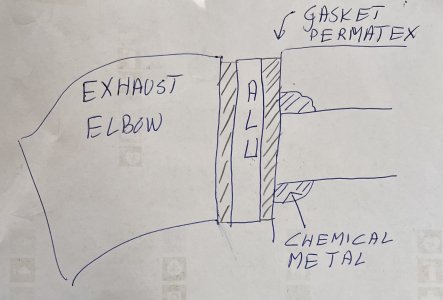
JB Weld Extreme Heat seems to get very mixed reviews from what I've read. I was contemplating using it to repair the corroded flange on my Volvo Penta MD2040 heat exchanger but abandoned the idea after reading the reviews and chatting to Marine Enterprises who said that in their experience epoxy repairs don't last on HE flanges, although I suspect you could get away with it if the damage is just minor pitting. A replacement HE is stupidly expensive but you should be able to track down a specialist aluminium welder who can repair it. The corrosion is milled out, provided there is sufficient good material left, and the flange built up again in layers to avoid putting to much heat into it, before being milled flat. It's a known weakness on several Volvo engines and having repaired mine I've isolated the elbow from the HE using a mica based gasket, high temp fibreglass sleeving on the studs and PEEK washers to prevent a reoccurrence of the galvanic corrosion. Parts4engines.com were looking into their own isolation solution last time I chatted to them but that was about 6 months ago.
 
Last edited:
I used the knife now and removed the crap.
Have a conversation with a local Penta workshop that only can help me with a new HE even though I have an aluminium welder ready (he installed a SS arch recently). No joined forces.

In August can the local Penta company help me with a new expensive HE.
Hard to fix logistic with multiple local companies when I now am abroad without a car and don't speak spanish.

Would love to get a temporary solution in place for the season.
Will walk to local chandler to see if they have any chemical metal paste at all.

amazon.es is an alternative but no hit for chemical metal paste besides different JB Weld products that I am scared of testing again.

Fallback solution might be original JB Weld that can withstand 260 Celcius degrees and Amazon can deliver it tomorrow.

Wiki web page claims
J-B Weld can withstand a constant temperature of 260 °C, and the maximum temperature threshold is approximately 316 °C for 10 minutes.

The green Penta paint can only withstand 200 C so my assumption is that the flange area on HE is below that temperature
 
Last edited:
As a general rule I'd steer clear of marine fabricators / welders for this type of job, although your guy could be an exception. You want someone who specialises in repairs to cast aluminium, and your best bet is most likely to be someone who does a lot of repairs to aluminium cylinder heads or blocks on cars (or outboards), who will also have access to the necessary machining equipment. They should also be a lot cheaper! Are you able to post a photo of the damage?
 
From memory the exhaust gases will be in the region of 400-500c but the heat exchanger and exhaust flange run way cooler than this and as you say the VP paint is only rated to 200c or so. Also, if look at the gaskets sold by the likes of Parts4engines for the heat exchanger where it attaches to the block they supply regular green gaskets which I think are rated to 250c. I went overboard with my isolation solution as the Mica gasket is rated to 1000c, the fibreglass sleeves 600c and the PEEK washers 250c continuous and 300c intermittent, but you can keep your hand on the water injected part of the exhaust elbow when the engine is running and I suspect the flange itself is closer to 200c. The two part regular JB-Weld is a great product and in your situation I'd probably go down this route, provided the corrosion isn't too bad, just be aware that the differential expansion between the aluminium and the epoxy is likely to cause it to fail after a while.
 
Yesterday did I got delivery from Amazon.es to the marina reception of JB Weld original epoxy.

Removed all traces of JB Weld Extreme Heat.
Brushed with brass brush and grid 80 sandpaper.
Cleaned with CRC Brakleen Pro.

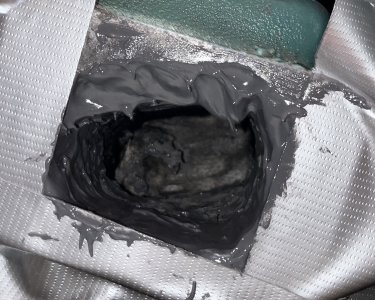
Used a small stiff brush to get good penetration into all the pits, used a small ice cream spade and the back of a wooden fork to get the level in line with the inner part of the exhaust hole.

First layer applied at 18:00.

At midnight (6-7 hours later) did I read that a guy applied a second layer when the epoxy become sticky.
At midnight the surface had cured so much that I could sand it, a bit disappointed.
I sanded, cleaned and applied a second layer to achieve a surface more in line with the original shape.

When searching for others sharing I found this web page about applying second layer
Can You Put JB Weld Over JB Weld? - Weld Minds

Image is taken after the first layer applied.
 

Attachments

  • IMG_5388.jpeg
    IMG_5388.jpeg
    1.2 MB · Views: 26
Last edited:
How old was the original Extreme Heat? i.e. Had it past its sell by date?
I bought it in December 2024.
My big mistake was that I applied it in thick layers.
The thinner parts cured fine.

The JB Weld company has failed to explain that this product is only for tiny small pits.
Not to be used as ”putty” paste.
Sad experience, when I can find other brands I will go with them.

Plan B was to go with a ”epoxy metal”, Spanish for me unknown brands was a project risk so I picked JB Weld original epoxy. After 6 hours curing it was a bit ”sandy” in its structure, not as West System epoxy (stone hard).
 
JB Weld takes up to 24 hours to cure fully at which point it will be rock hard, if its been mixed properly. However that's a pretty major repair you are attempting. I don't think it will last very long. It really needs welding
 
JB Weld takes up to 24 hours to cure fully at which point it will be rock hard, if its been mixed properly. However that's a pretty major repair you are attempting. I don't think it will last very long. It really needs welding
I agree on that this is a temporary solution until the Penta company got time for me to install a new heat exchanger.
 

Attachments

  • IMG_5312.jpeg
    IMG_5312.jpeg
    1.1 MB · Views: 21
  • IMG_5395.jpeg
    IMG_5395.jpeg
    1.6 MB · Views: 17
It's definitely worth looking into a specialist welding repair rather than a replacement HE when you get a chance. Volvo Penta wanted £2k for a new HE casting for my MD2040 and although the damage on mine was on the limit of what could be repaired it cost £400 and is effectively as good as new. This entailed milling out the corroded metal to fresh, building up the repair in stages so as not to introduce too much heat, milling it flush and redrilling/tapping the studs.
 
Before suggesting good ideas based on your local circumstances please reminder I am 3000 km away from my home in a country I only know as a transient sailor.

Local SS arch welder said he could weld alu but many persons has warned me due to it is a very special art to well cast alu.

I know nothing because I am south of Barcelona (that is the truth).

Temporary fix until Penta guys can install a new HE, part cost 4 600 euro.

(Roughly what it cost me to get my MB fixed last year, rust on aft subframe.)

Now after 12 hours curing was the JB Weld hard as a rock, if you want to sand with less hard work 6 hours curing time was perfecto.
 
Last edited:
Sure that is good product, Devcon as well.

I planned just to replace the exhaust elbow as a quick task and suddenly faced corrosion.
No time to order products with long delivery time to the marina I am in.

My focus is to get a temp safe fix in place until the HE can be replaced.

My initial idea was to use PBO article as a blue print but no car, no renting company around, no knowledge of experienced alu welder. The only one I found was 2-3 hours car drive away but no car.
 
Top