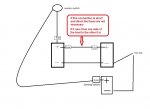
Is this correct diagram for fusing the battery cables?

Akestor

Well-Known Member
Joined
12 May 2018
Messages
428
Location
Athens, Greece
www.youtube.com
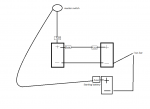
I recently added 2 new service batteries port and starboard, and the only way to parallel them was run cables under the bilge (high enough and bundle them inside 2 thick spiral hoses). Together with the 2 cables of the starting battery, there are 6 cables running. Even they are supported frequently, vibration is evil and can cause chafing, so think fusing them with 80amp fuses (35mm cable) to have a peace of mind... I guess 2 fuses needed for the wire that connects the 2 positives of the service batteries correct?
1601133500599.png
 
Are you expecting a bi-directional current ? Or is it some highly technical competition to see which one blows first ?

The fuses are there to protect the cable. If there's a battery at each end of the cable, each battery needs a fuse. Just the same as cables linking a main battery bank to a windlass/thruster battery in the bows.
 
The fuses are there to protect the cable. If there's a battery at each end of the cable, each battery needs a fuse. Just the same as cables linking a main battery bank to a windlass/thruster battery in the bows.
Rubbish! Never ever seen anything like that on a battery bank, and I have seen some big battery banks.
 
Rubbish! Never ever seen anything like that on a battery bank, and I have seen some big battery banks.

Perhaps, if you read the OP again, you'll take note of the fact that the two service batteries are on opposite sides of the boat, so the cables paralleling them are fairly long. It's nothing like an ordinary battery bank.
 
I recently added 2 new service batteries port and starboard, and the only way to parallel them was run cables under the bilge (high enough and bundle them inside 2 thick spiral hoses). Together with the 2 cables of the starting battery, there are 6 cables running. Even they are supported frequently, vibration is evil and can cause chafing, so think fusing them with 80amp fuses (35mm cable) to have a peace of mind... I guess 2 fuses needed for the wire that connects the 2 positives of the service batteries correct?
batteryconnections.jpg
Why not put the two batteries which make up the domestic bank next to each other and the engine start battery on the other side. That will reduce the number of cables running from one side to the other and eliminate the need for the two fuses in the paralleling cable
 
Fuses protect a cable from shorts to other unfused conductors.
You can sometimes get better protection by making sure there is nothing conductive which can possibly get near the cable.
The length of the cable is irrelevant. If it is protected by proper insulation such that it is totally unlikely to get shorted to anything, there is no problem.
Like keeping all the ground cables at a respectful distance, using extra protection from any metalwork etc.
The impedance of two fuses between the two batteries is not ideal in terms of them working properly as a bank.
For symmetry, you might take the connection to the master switch from the node between the fuses.

Millions of cars (and tenss of thousands of boats) do not have fuses in the main 12 line from the battery with neglibible incidence of trouble. These days people seem to be very willing to put in lots of fuses, but quite slack in protecting things from contact. We often see bare naked terminals on both sides of a fuse, which deserves a slap.
 
Millions of cars (and tenss of thousands of boats) do not have fuses in the main 12 line from the battery with neglibible incidence of trouble. These days people seem to be very willing to put in lots of fuses, but quite slack in protecting things from contact. We often see bare naked terminals on both sides of a fuse, which deserves a slap.

As people often say, you can walk away from a burning car!

Electrical faults are the prime cause of boat fires.
 
As people often say, you can walk away from a burning car!

Also car electrical installations have been carefully designed and tested, and installed under a quality-controlled process. In the unlikely event of a problem, you are far more likely to get a recall notice because a couple of other people's cars caught fire, than for yours to be one of the few out of thousands. Most boat electrics, by comparison, are ad-hoc one-offs that are their own test prototypes.

Still, what Tern says about protection other than fusing is relevant. There's something to be said for running high-current positive and negative cables separately from each other so that even if damaged, they can't short together. At least for most of us the surrounding structure is unlikely to be conductive.

Pete
 
View attachment 99516
Why not put the two batteries which make up the domestic bank next to each other and the engine start battery on the other side. That will reduce the number of cables running from one side to the other and eliminate the need for the two fuses in the paralleling cable
Hi Vic! As the boat already had battery cases port and starboard it was making the installation faster and easier. At 28kgrs each battery i thought it's also good for balance.
 
If that positive cable earths out in the bilge, perhaps close to the engine, one fuse blowing isn't going to protect the cable. The cable will still be connected to the other battery, and could be glowing like an electric bar heater. So, two fuses, one either end, is sensible.
How with a properly installed and secured cable is that likely to happen?
 
Another difference to cars. I've no idea what became of the car I drove in 1987 and it's electrical installation. Whereas some cables from that date are still used in my boat. With a possible hard life of 30, 40 or more years, fusing of cables had better be done properly.
 
How with a properly installed and secured cable is that likely to happen?
Last year in my marina. Yes I am sure the cable was properly secured when it was fitted but after time and maybe disturbed by someone working on the engine it chafed against the engine. There was no fire, apparently the amount of smoke it created may have helped to prevent a fire from developing, and the insurance covered the smoke damage, engine lift out and rewire.
I don't know the op's cable route through the bilge but if it's nowhere near the engine or other cables etc, then yes it would be near impossible for a short when properly installed.
 
I have port and starboard battery banks, but take on a a single fused positive from each to an isolator. Connections to busbars, paralleling etc, are all downstream of that isolator and hence primary battery fuses.
 
I have port and starboard battery banks, but take on a a single fused positive from each to an isolator. Connections to busbars, paralleling etc, are all downstream of that isolator and hence primary battery fuses.
In my set up some devices have to run independently of the master switch such as VHF, bilge pump, fridge ( with its own master 40 amp switch) , solar charger, battery monitor + wire, windlass with dedicated switch/fuse . They are connected directly on a +bus bar that comes before the main Master Switch. All fused of course.
 
Why not make the parallel connection on the master switch ? save having a cross ship connection and save you a fuse too! If your master allows the house to be used for engine start you should take that into account on the fuse and cable rating too. Otherwise what you suggest is good practice.
 
Top